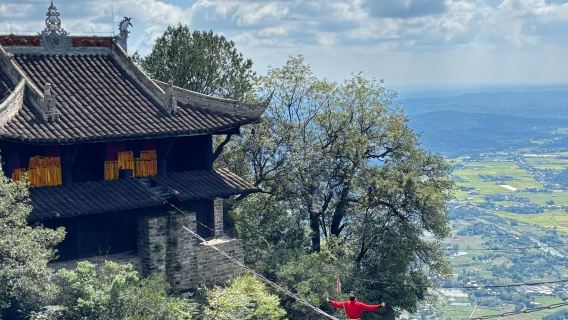
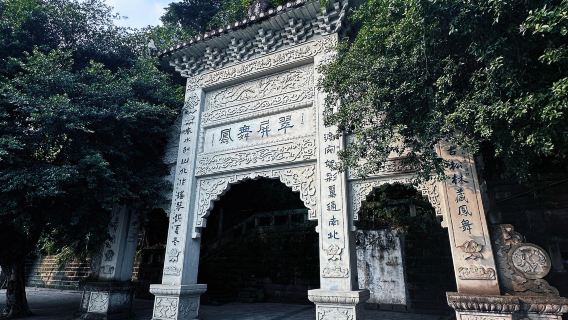
Qiqu Mountain Temple is located in Zitong County, Sichuan Province, 49 km from Mianyang. It is the ancestral temple of Wenchang Dijun, the god of literature in China's indigenous Taoism, originally built during the Jin Dynasty for the people of Shu to worship Zhang Yazhi. In the early Yuan Dynasty, after Zhang Yazhi was enshrined as "Wenchang Dijun," the Taoist temple "Wenchang Palace" was constructed here. Through multiple expansions during the Yuan, Ming, and Qing dynasties, it gradually formed a Taoist cultural architectural complex with three main axes. The temple covers an area of 12,000 square meters, with a building area of 6,000 square meters. Key structures include the Yuan Dynasty Pantuo Stone Hall, Ming Dynasty Guixiang Hall and Tianzun Hall, and the Qing Dynasty Baichi Tower, preserving some architectural techniques from the Song Dynasty. The temple comprehensively showcases architectural styles from the Yuan to Qing periods, serving as an important example for studying ancient architectural history.
In 1996, Qiqu Mountain Temple was listed as part of the fourth batch of National Key Cultural Relics Protection Units.


Liangdancheng is located in Zitong County, Sichuan Province. In August 1965 during the Third Front Construction period, the China Academy of Engineering Physics (Ninth Academy) relocated to Zitong, where they successively completed the design plans for the atomic bomb and "hydrogen bomb." The former site of the Ninth Academy is known as "Liangdancheng."
In January 2017, the National Development and Reform Commission and the National Tourism Administration announced the "National Red Tourism Classic Attractions List," with Liangdancheng being included in China's Red Tourism Classic Attractions List.
In 2014, the Liangdancheng attraction in Zitong, Mianyang was recognized as a national defense science and technology industrial military culture education base. Zitong County announced plans to invest 300-500 million CNY over 3-5 years to develop the Liangdancheng attraction into a national red tourism classic site and a national 4A-level tourist attraction capable of receiving over 300,000 visitors annually.


Mianyang Xianhai Scenic Area is a provincial-level water conservancy scenic area established based on the Chenkang Reservoir. Located 10 km from downtown Mianyang, it is conveniently accessible via National Highway 108, Mianzi Road, and Mianyang's Second Ring Road. The area features complete infrastructure and specializes in water recreation and water sports. It offers various tourism projects including Hongyuan Amusement Park and cycling fitness activities, while also serving multiple functions such as vacationing, leisure, sightseeing, commercial housing, and conferences.
The scenic area is divided into nine functional zones: water source protection area, water sports zone, water entertainment zone, leisure zone, villa conference zone, rural resort zone, static water area, land-based scenic forest belt, and aquaculture zone. Featuring water sports and entertainment, it also serves multiple purposes including vacationing, leisure, sightseeing, commercial housing, and conferences. Currently, it stands as one of China's larger suburban leisure destinations near urban areas, fully showcasing the beauty of lakes and mountains while blending cultural and natural landscapes.
Xianhai Scenic Area is located in the heart of the golden tourism circuit that includes Jiuzhaigou, Huanglong, Emei Mountain, and Jiannan Shu Road. It covers a planned area of 36.8 km², with the first-phase development spanning 13.8 km² and water surfaces occupying nearly 7 km². The area boasts lush forests, picturesque landscapes, and over 40 islands and peninsulas. Modern European-style buildings dot the scenery, exuding continental charm. Additionally, the area features attractions tied to historical tales such as those of Emperor Qin Shi Huang and the Three Kingdoms period, as well as ancient post roads and the legendary Immortal Tree.