Things to do in Jiang County
Explore top experiences
Top 10 attractions in Jiang County

Nanfan Stone Memorial Archway
Jiang County · 13.7 km from downtown

Taiyin Temple
Jiang County · 7.8 km from downtown

Jiangbei Grand Canyon
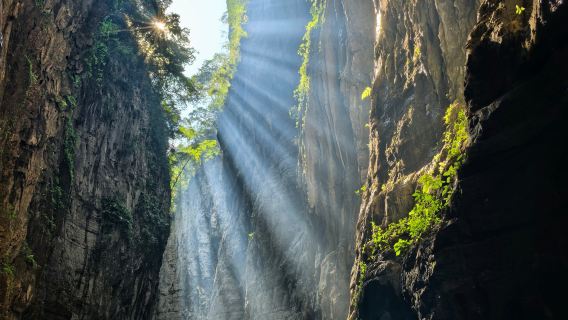
Jiangbei Grand Canyon Tourist Scenic Area is located in Moli Town, Jiang County, Shanxi Province, with a viewing area of 20 square kilometers. Currently, the Attraction has developed multiple tourism projects. It is a tourist destination in southern Shanxi that integrates food, accommodation, travel and entertainment. The four major features of the Jiangbei Grand Canyon Tourist Scenic Area: Canyon rafting: The total length of the rafting river is 5.2 kilometers, with a drop of 204 meters. It is a rafting attraction with a strong drop in height in North China. You can take a boat at leisure time, feel the breeze on the river, appreciate the gentleness and elegance of nature without any danger, and cultivate your soul; the brave can paddle the boat, strike the water in the middle of the stream, and fight the raging waves. Although there are dangers, you can fully appreciate the magnificence of nature and exercise your body; explorers can cross mountains and waves and drift in dangerous situations, appearing on the crest of the waves and sinking into the water, just to conquer nature. Water Challenge: The water challenge is divided into several levels. Crazy treadmill, stepping up to the top, light steps, Omega turntable, traveling through time and space, flying to success. The overall design is novel and unique, with bright colors, suitable for players of all ages. Unique landscape: Jiangbei Grand Canyon Scenic Area combines the majesty of Mount Tai, the steepness of Mount Hua, the tranquility of Mount Lu, the peculiarity of Mount Huang, and the beauty of Mount Emei. The scenery changes endlessly in four seasons. Spring is a sea of flowers, summer is a summer resort, late autumn is full of red leaves, and winter is covered with silver. The Attraction includes many ancient villages such as Shi'e, Dajintang, Xiaobeishan, etc. You will see very local folk snacks, labor scenes, and on-site handicrafts of southern Shanxi; exquisite dough sculptures and embroidery; authentic freshly ground soy milk, freshly braised tofu brain, tofu, handmade steamed buns, and elegant farmhouse dormitories, which reflect the folk delicacies with southern Shanxi characteristics. You can also participate in these scenes for a close experience and enjoy the different mood of self-reliance.Jiang County · 20.2 km from downtown

Qiao Temple Stele Pavilion
Qiao Temple Stele Pavilion faces east and is a standalone building with a rectangular floor plan. The stone base of the pavilion is 17m long, 2.60m wide, and 1.50m high, and the pavilion body is approx. 15m high.Jiang County · 12.1 km from downtown


Emperor Qinshihuang's Mausoleum Site Museum
Emperor Qinshihuang's Mausoleum Site Museum, also known as the Terracotta Army, is located about 1.5 kilometers east of the Mausoleum of the First Qin Emperor and forms part of the extensive necropolis. There were more than a thousand terracotta soldiers unearthed here, each with a different facial expression. Standing before the massive underground army, you will feel the extraordinary might of the Qin Emperor that enabled him to unify six warring states two thousand years ago. The Qin Emperor Ying Zheng began building the mausoleum for himself at the age of 13. Nearly 720000 men and 38 years were required to complete this vast project.China · Xi'an

Jiang County Confucian Temple
The Confucian Temple of Jiangxian County was first built in the third year of Changxing in the Later Tang Dynasty (932 AD). It was rebuilt and expanded in the Yuan, Ming and Qing dynasties. Only the Dacheng Hall and Minglun Hall are preserved. The Dacheng Hall is three bays wide and four rafters deep, with a single-eaved hip roof. It is a hall-type structure and still retains the characteristics of Yuan Dynasty architecture. Minglun Hall is five bays wide and six rafters deep, with an inner corridor in the front eaves and a single-eaved hip roof. It is now a Qing Dynasty relic.Jiang County · 460m from downtown

Shaanxi History Museum
History background: Shaanxi History Museum is located in the northwest of the Dayan Pagoda in Xi'an. It is one of the landmark attractions of Xi'an. The museum was planned in 1983, started in the summer of 1986, and officially opened on June 20, 1991. It was named Shaanxi History Museum. In 2016, Shaanxi History Museum was selected as "China's 20th Century Architectural Heritage" by the Chinese Cultural Relics Society and the Chinese Architectural Society. Museum Features: Shaanxi History Museum is a large modern museum, and its completion marks a new milestone in the development of China's museum industry. This museum is a Tang-style building complex with a "central hall and four corner towers". The main and secondary buildings are well-organized, the heights are staggered, and the momentum is solemn. It integrates national traditions, local characteristics and the spirit of the times. The museum covers an area of 65,000 square meters, and houses more than 380,000 cultural relics ranging from simple stone tools used in the initial stage of ancient humans to various artifacts in social life before 1840, covering a time span of more than one million years. The cultural relics are not only numerous and diverse, but also of high quality and wide value. The collections in the museum are dazzling and exquisite. It is an art hall that showcases the history and culture of Shaanxi and ancient Chinese civilization, and is known as the "Pearl of the Ancient Capital, the Treasure House of China." There are many treasures in the museum, including bronzes from the Shang and Zhou dynasties, pottery figurines from various dynasties, gold and silver utensils from the Han and Tang dynasties, and murals from Tang tombs. Most of them are treasures from the prosperous periods of the Han and Tang dynasties, and some of them are fine items that are prohibited from leaving the country. Collection treasures: There are three exhibition halls in the center of the museum. The first exhibition hall displays cultural relics from the prehistoric civilization of Lantian ape-man 1.15 million years ago to the Qin Dynasty; the second exhibition hall displays cultural relics from the Han Dynasty and the Wei, Jin, Southern and Northern Dynasties; and the third exhibition hall is mainly cultural relics from the prosperous Tang Dynasty. Each exhibition hall has its own treasure. There are special exhibition halls on the east and west sides of the central hall. On the west side, there is a "Special Exhibition of Tang Dynasty Treasures (Treasure Hall, Cultural Relics Unearthed in Hejiacun)", where many fine gold and silver wares from the heyday of the Tang Dynasty were transferred to be exhibited. On the east side, there is a "Treasures of Tang Dynasty Murals Exhibition", which exhibits a number of authentic Tang Dynasty tomb murals. The tripod The tripod is placed in the first exhibition hall at the entrance of the museum, and it can be said to be the treasure of the first exhibition hall. The replica is placed here, and the original is kept in the warehouse. Inscription on the outer wall: The inscription "All under heaven is the king's land; all the people are the king's subjects" reflects the land ownership system in the Western Zhou Dynasty. There are four lines of inscriptions with 28 characters on the inner wall of the Yi Ding. The general meaning is: In early August of a certain year, Wang Jiang took back the land originally given to Shi Lu and gave it to Yi, who then made this tripod to commemorate it. Queen's Seal: One of the treasures worth seeing in the second exhibition hall is the jade seal of the empress of the Han Dynasty, which is displayed separately. The seal is made of Xinjiang Hetian mutton-fat jade and is engraved with a Chihu, symbolizing royal power. Three-color camel figurines carrying music: This world-famous tri-color camel figurine carrying music is located in the third exhibition hall of Shaanxi History Museum. Its overall appearance and color are well preserved. There are seven men sitting on the camel's back, holding different musical instruments in their hands. Among them, the figurine holding the clapboard is listening attentively, as if intoxicated by the wonderful music. The woman in the middle is performing, and the camel opens its mouth wide and looks up to the sky, as if it is also singing with its master. Gold-inlaid animal head agate cup: This cultural relic, located in the special exhibition "Tang Dynasty Relics Special Exhibition", is one of the first 64 national treasures listed by the State Administration of Cultural Heritage that are never allowed to be exhibited abroad. There are also many other treasures such as black-glazed oil-drip bowls, green-glazed porcelain pots with handles, gilded silver bamboo-joint copper incense burners, gold bowls with mandarin duck and lotus petal patterns, and so on.China · Xi'an

Jinguo Museum
Located in Qucun Town, Quwo County, Jin State Museum is the first site museum in the province with Jin culture as its theme, built on the basis of the national key cultural relic protection unit "Qucun-Tianma Site". It was officially opened to the public on National Day in 2014. It is the first large-scale site museum in Shanxi Province that integrates cultural relic collection, protection, research and cultural relic display, and is a platform that fully displays the historical and cultural features of Jin State. The Jin State Museum takes Jin culture as its theme and has created three highlights: the history of Jin State, the history of excavation, and the site exhibition. The History and Culture Exhibition Hall uses the history of Jin State as a clue and, through a large number of precious cultural relics unearthed from the tombs of Jin Hou, shows a series of major events that have influenced the course of ancient Chinese history, including the enfeoffment of Tang by Shu Yu, the change of Tang to Jin by Xie Fu, the loyalty of Wen Hou to the king, the expansion of territory by Xiangong, the hegemony of Wen Gong, the dictatorship of the six nobles, and the division of Jin by the three families. The Site Excavation History Exhibition Hall shows the hardships, extensive reading of geography, and search for evidence by three generations of archaeologists from the School of Archaeology and Museum Studies of Peking University and the Shanxi Provincial Institute of Archaeology, as well as a series of major achievements in archaeological excavation; the Site Exhibition Hall adopts a method of one site and one display method, focusing on the four groups of tombs of Jin Hou and his wives and three chariot pits, presenting the audience with a panoramic picture of the tombs of kings and princes of the state during the Western Zhou period. The "Qucun-Tianma Site" where the Jin State Museum is located is large in scale, starting from Tianma Village in Yicheng County in the east, Qucun Town in Quwo County in the west, starting from the bank of Fu River in the south, and reaching Qiaoshan slope in the north. The site is 3,800 meters long from east to west, 2,800 meters wide from north to south, and covers an area of nearly 11 square kilometers. After more than ten consecutive large-scale explorations and excavations by Peking University and the Shanxi Institute of Archaeology, a total area of 12,000 square meters was revealed, and more than 1,000 tombs were excavated, including more than 800 tombs from the Zhou Dynasty. Especially in the core area of the site, nine groups of 19 tombs of early Jin monarchs and their wives, ten chariot pits, and more than 12,000 precious cultural relics of various types were discovered. The excavation results provided support for the solution of the chronicle of the Western Zhou kings in my country's "Xia, Shang and Zhou Chronology Project". It was listed as one of the top ten archaeological discoveries in China in 1992 and 1993, and was rated as one of the 100 major archaeological discoveries in China in the 20th century in 2001.Quwo · 27.2 km from Jiang County

Quwoxian Chunqiu Jin Guocheng Sceneic Area
The Spring and Autumn Jin State City, located in the scenic tourist area of the Huihe River in Shicun Town, Quwo County, is one of the key cultural industry projects of the provincial government and an important part of the county's "six districts, four parks, one city and one stadium" overall tourism space layout. The Attraction covers an area of about 800 acres. It aims to rescue, protect, collect, study and display Jin culture, and aims to relax, sightsee and perceive the Spring and Autumn Jin culture. It makes full use of the terrain and plans to display the architecture, film and television city, history, residence, food and folk art of the Three Jins near the water. The Attraction is mainly divided into four major sections: the Spring and Autumn Jin State Film and Television Exhibition Hall, the Ming and Qing Dynasty Royal Palace, the Snack Street, and the Special Amusement Park. It is a comprehensive tourist Attraction integrating the display of Jin State culture, the promotion of the Huihe River spirit, the experience of folk customs in southern Shanxi, ecological agricultural sightseeing, leisure culture and entertainment.Quwo · 17.1 km from Jiang County

Longmen Grottoes
One of the four major grottoes of China and a UNESCO World Heritage Site, the Longmen Grottoes are a trove of 1000 years of Buddhist art treasures. Bounded by the Yi River, the caverns are divided into two sections at East Hill and West Hill. The caverns at East Hill contain mostly Tang dynasty (618-907) works, while the caverns at West Hill were cut out during the Northern, Sui, and Tang dynasties and contain the carvings that are most representative of the site. The Buddha and bodhisattva sculptures that inhabit the caverns are carved into an endless variety of poses and expressions of mercy and kindness, while the caves themselves lend a stately and dignified atmosphere. The artistry of these sculptures is truly a priceless inheritance of Buddhist art.China · Luoyang
Experiences you can't miss in Jiang County
Featured Cultural experiences in Jiang County
View all Cultural experiences
Free cancellation
Book now for tomorrow
From€30.13
Free cancellation
Book now for tomorrow
From€30.13

Featured Day tours in Jiang County
View all Day tours
5.0/5
· 1 reviewInstant confirmation
Book now for tomorrow
From€60.03
Free cancellation
Instant confirmation
Book now for tomorrow
From€153.61
Free cancellation
Instant confirmation
Book now for tomorrow
From€76.09


Free things to do in Jiang County
Nanfan Stone Memorial Archway
Jiang County · 13.7 km from downtownJiang County Confucian Temple
Jiang County · 460m from downtownShaanxi History Museum
China · Xi'an
Song Du Huangcheng Cultural Tourism Resort
China · Kaifeng
Grand Tang Mall
China · Xi'an
Luoyang Museum
China · Luoyang
Shanxi Museum
China · Taiyuan
Henan Museum
China · Zhengzhou
What travellers say about Jiang County

行走毛毛July 8, 2026
4.0
Although it's just a gate located on the street and still serves as a passageway, it's a key cultural relic. Many people who love cultural relics will come here specifically to take a set of photos. Locals, seeing this, are very curious about what's so special about it. That's the essence of tourism, I guess.
Nanfan Stone Memorial Archway

sangjingyinAugust 9, 2025
4.0
It's a remote location, free, and no reservations required. Many online claims that a temple facing south is called Taiyin Temple are incorrect. The temple originally got its name from Taiyin Mountain, but was later moved. The reclining Buddha is unique, but the later-replaced head of the statue above is quite poor...
Taiyin Temple

可爱的旅游生活89August 1, 2026
4.0
The dense forest canyon is lush and cool, offering a variety of activities such as rafting and viewing the Buddha's Hand scenic spot. It also has complete farmhouses and attractions. Some attractions charge extra for a second time. It is suitable for families to enjoy water activities and escape the summer heat. A 3-hour visit is recommended.
Jiangbei Grand Canyon

M37***45October 6, 2026
4.0
Qiaosi Stele Tower (Qiaosi Stele Tower | Qing Dynasty, Daoguang 17th year) is the largest existing single-unit brick and stone imitation wood stele tower in my country, integrating architecture, brick carving, stone carving, and calligraphy. It is about 15 meters high. Facing east, it stands by the lotus pond at the entrance of the village. It has a single-eave hip roof with brick and stone imitation wood brackets under the eaves. The front has five stele chambers with seven steles. The upper part of the tower is decorated with brick-carved railings, window lattices, and hanging flowers on all four sides. The tower body is carved with scenes of two dragons playing with a pearl, flowers and birds, farming, merchants traveling, and journeys. The mythical beasts on the roof ridge and the multi-layered pagoda-shaped ridge are very distinctive. It is a masterpiece of southern Shanxi brick carving.
Qiao Temple Stele Pavilion

钧雨October 24, 2026
5.0
I first visited Lishan Garden, then took the free shuttle bus to the Terracotta Warriors. Overall, it was quite nice. However, the first electric shuttle bus I took in Lishan Garden tried to drop off tourists at a non-designated stop, forcing them to return to the starting point and take the bus again. Only after I insisted did they take me to the bronze chariots and horses.
Emperor Qinshihuang's Mausoleum Site Museum
_M1***71October 23, 2026
5.0
My trip to the Shaanxi History Museum was made possible by the wonderful explanations given by our guide, Ms. June. Her profound knowledge and engaging approach, rather than simply reciting from a textbook, transformed each artifact into a captivating and accessible narrative, clearly outlining the historical timeline of the Zhou, Qin, Han, and Tang dynasties. Her lively and engaging explanations, coupled with her patient answers to questions, brought the millennia-old relics to life. What was initially a rushed visit became an immersive historical journey. Highly recommended!
Shaanxi History Museum

许泱流October 18, 2026
5.0
The Jin State Museum, which recently reopened after renovations for the Mid-Autumn Festival, is divided into three main sections: the first section displays the history and ancient artifacts of the Jin State and the pre-Qin period; the second section features a realistic display of Jin State tombs; and the third section showcases porcelain. The overall flow of the exhibits is well-organized, providing a comprehensive experience from understanding and reading about history to witnessing it firsthand.
Jinguo Museum
JieyuFebruary 18, 2026
4.0
The overall area is quite large, and the planning and design are generally well done. It features mountains, water, and cultural elements. The water area is substantial, and the reservoir capacity is also very large. However, it appears to have undergone secondary development, with several submerged buildings in the water.
There are quite a few businesses operating there, offering a variety of dining and entertainment facilities.
The biggest drawback is the extreme inconvenience of parking during holidays. The parking lot is quite far from the scenic area, and it costs 10 yuan per vehicle.
Quwoxian Chunqiu Jin Guocheng Sceneic Area

程咬金金October 24, 2026
5.0
The Longmen Grottoes are renowned for their beautiful scenery and rich historical significance. Construction of the grottoes began in the 17th year of the Taihe reign of the Northern Wei Dynasty (493 AD) and continued until the Northern Song Dynasty. Among them, the Vairocana Buddha statue is considered a pinnacle of Tang Dynasty stone carving art. Legend has it that the Buddha's face was modeled after that of Empress Wu Zetian! She has stood quietly on the banks of the Luo River for over 1400 years.
Longmen Grottoes


