Things to do in Jishishan
Explore top experiences
Top 10 attractions in Jishishan


Bingling Cave-Temple Complex
Located in the upper reaches of Liujiaxia Reservoir, on the north bank of the Yellow River in Sigouxia, southwest of Yongjing County. On the steep and dangerous red sandstone cliffs 2 kilometers long from north to south, the cave shrines are lined up one after another, and the plank roads are suspended in the air. It is magnificent and spectacular. It is one of the three largest caves in Gansu and one of the five largest caves in my country. Bingling Temple was formerly known as "Tangshu Cave", which means "ghost cave" in Qiang language. It was called "Longxing Temple" in Tang Dynasty, "Lingyan Temple" in Northern Song Dynasty, and "Bingling Temple" after the Yongle Period of Ming Dynasty. Bingling is called "Benlang" in Tibetan language, which means "one hundred thousand Buddhas". Bingling Temple Grottoes were first built in the first year of Jianhong in the Western Qin Dynasty (420 AD). Since the Sixteen Kingdoms period, it has gone through the Northern Wei, Northern Zhou, Sui, Tang, Song, Yuan and Ming dynasties, with a history of more than 1,600 years. During the period when the Western Qin Dynasty built its capital in Linxia, the king personally visited the grottoes and wrote inscriptions, the originals of which are still preserved on the rock walls. From the time the grottoes were carved in 420 AD to the Song Dynasty, the grottoes had a great influence on Han Buddhism, Pure Land Buddhism, Huayan Buddhism and Zen Buddhism. At the end of the Yuan Dynasty and the beginning of the Ming Dynasty, the Yellow School (Gelug School) of Tibetan Buddhism was introduced to Bingling Temple. Bingling Temple Grottoes, based on the inheritance of folk art from previous generations, absorbed foreign Buddhist art and created vivid sculpture and painting art with a brand-new attitude and concise approach. Its relief pagodas and Tantric murals are as famous as those of Mogao Grottoes and Maijishan Grottoes. The grottoes are divided into three parts: the upper temple, the cave ditch and the lower temple. The lower temple is more spectacular. They are distributed on a cliff 200 meters long and 60 meters high. There are 196 caves and niches in Bingling Temple Grottoes, 694 stone statues, 82 clay sculptures, and more than 900 square meters of murals. The larger Maitreya Buddha statue from the Tang Dynasty is 27 meters high, and the smaller statue is 10 centimeters high. Among them, there are 2 caves and 1 niche excavated in the Western Qin Dynasty, 8 caves and 25 niches excavated in the Northern Wei Dynasty, 2 caves in the Northern Zhou Dynasty, 2 caves in the Sui Dynasty, and 20 caves and 113 niches in the Tang Dynasty. The artistic achievements of Tang Dynasty works were quite high, and there were more than 3,000 monks at that time. The ink inscription of the famous monk Faxian in the first year of Jianhong in the Western Qin Dynasty (420 AD) in this cave is the earliest chronological inscription preserved in the caves in China. It provides a mark for the dating of other ancient caves in the country and has very important historical value. The main body of the cave statues and murals is composed of the large seated Buddha in the natural cave No. 169 and all the small and medium-sized caves in the cliff face. Cave No. 169 was formerly known as Tangshu Cave, and is now called "Tianqiao Cave". It is 15 meters high, 8 meters deep and 20 meters wide. It is one of the earliest and best preserved caves in my country. There are three types of shapes in the cave: Buddha niches, stone carvings, and stone-based clay sculptures. Niche No. 171, located on the cliff of the cave, has a large seated Maitreya Buddha statue made of stone-based clay from the Tang Dynasty. It is carved against the mountain and is 27 meters high, majestic and solemn. The Western Qin "Manjusri Bodhisattva Asking about Illness" in the cave is one of the earliest Vimalakirti Sutra Transformations seen in my country. The original Cave No. 16 is now located in the Sleeping Buddha Hall opposite the cave group. The 8.6-meter-long clay sculpture of Bingling Temple Reclining Buddha is a reclining Buddha from the Northern Wei Dynasty, which has very important research value. The 25-cm-tall maid statue from the Tang Dynasty is one of the more precious existing cave statues in my country, and fully embodies the style of the prosperous Tang Dynasty. Next to the cliff at the entrance of Bingling Temple stands the steep Sister Peak, surrounded by scenic spots such as the Mandarin Duck Cave and the Medicine Spring, with green mountains and clear waters, dangerous peaks and strange rocks.Yongjing · 18.3 km from Jishishan

Dadunxia Scenic Area
Jishishan · 15.7 km from downtown

Jiuzhaigou National Park
Jiuzhaigou National Park is located in Jiuzhaigou County of Ngawa Prefecture. With its towering snow-capped peaks, dense forests, and vibrantly colored pools and shoals, crystal-clear streams meander through the forests and shallows. Combined with Tibetan wooden houses, prayer flags, and the unique traditional customs of the Tibetan and Qiang ethnic groups, Jiuzhaigou National Park is often referred to as a "beautiful fairyland". Jiuzhaigou National Park features a Y-shaped layout, consisting of three main valleys: Shuzheng Valley, Rize Valley, and Jiuzhaigou-Zechawa Valley, with a total length of over 50 km.The attraction is equipped with eco-friendly sightseeing vehicles that stop at designated stations. Visitors can wait at each station and conveniently tour various attractions within the site by taking the sightseeing vehicles.China · Jiuzhaigou

Ganga Secret Scenic Spot
The "Gangjia Secret Realm" is located in Gangjia Town, Xiahe County, Gannan Tibetan Autonomous Prefecture, with a total area of 131.23 square kilometers. The altitude difference between the north and south of the Attraction is 1,300 meters. The unique geological structure contains a variety of geological resources such as cliffs, grasslands, plateau lakes, stone forests, canyons, prehistoric caves, and rivers. The Bajiao Ancient City, Zuohai Temple, Baishiya Temple, and the Denisovan Site Cave have become the imprints of the Attraction profound historical and cultural heritage. Academic masters and eminent monks such as Guru Padmasambhava, Tsongkhapa, Gongtang Cang, and Gendun Gumpel have successively studied, practiced, and preached in the Gangjia area.Xiahe · 41.6 km from Jishishan

Mengda Heavenly Lake
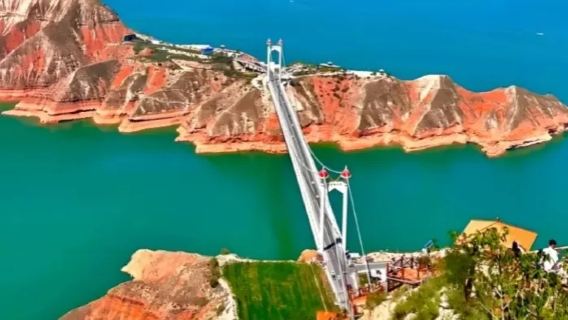
Mengda Heavenly Lake is located in the eastern part of Mengda Township, Xunhua Salar Autonomous County, about 180 km from Xining and about 90 km from Linxia city center. It is a highland lake surrounded by mountains, with dense forests and a tranquil environment. Visitors can hike and stroll here, view and photographHeavenly Lakeand the beautiful scenery around it, and experience a fresh landscape rarely seen in the Northwest, making it a great choice for those touring Qinghai and Gannan. Mengda Heavenly Lake covers a large area, and there are electric shuttles available within the scenic area. The visitor route involves taking a shuttle from the scenic area entrance to the foot of the mountain, then hiking or riding a horse up to theHeavenly Lakearea on the mountainside. After exploring aroundHeavenly Lake, you can head down the mountain and return to the entrance. The entire visit takes about 3-4 hours. Most visitors stop by while passing through, and will head to Tongren, Linxia, or Gannan to stay for the night. When visiting Mengda Heavenly Lake, the first thing to note is the scenery along the way. Whether you are coming from Xining or Linxia, you can see the spectacular crimson Danxia landforms along the road. Furthermore, theYellow Riveralong the way is clear and emerald green, creating a beautiful contrast with the fiery red Danxia, perfect for photography and sightseeing during the journey. Upon arriving at the scenic area, you can purchase a ticket to enter. You can take a sightseeing shuttle inside the scenic area or drive your own vehicle, though you still need to purchase a full-price ticket if driving. The distance from the scenic area entrance to theHeavenly Lakeparking lot at the foot of the mountain is about 3-4 km. The route is filled with dense forest scenery, a rare sight in the Northwest, making you feel as if you have entered a lush forest oxygen bar in the Jiangnan region. After getting off at theHeavenly Lakeparking lot, you can hike up the mountain. There are over 1,200 steps, and it generally takes over 1 hour to reach the edge ofHeavenly Lake. Due to the slightly high altitude (approx. 2,400-2,500 m), hiking can be relatively tiring, so be sure to walk slowly and avoid strenuous exercise. If you lack the energy, you can also choose to ride a horse up the mountain. Locals provide horses at the parking lot, and a one-way ride costs approx. 50 yuan. On the way up, you can see an ancient forest with many sturdy, centuries-old trees, which is quite amazing and worth a stroll. Upon reaching the mountainside, you will see the beautiful lake surrounded by mountains. Mengda Heavenly Lake is about several hundred meters long and wide. The lake water is emerald green, and the surrounding mountains and forests are dense, creating a very quiet and beautiful environment, perfect for photography. There is a wooden boardwalk aroundHeavenly Lake. Visitors can stroll along the boardwalk to view the lake, photograph the lake surface from various angles, and see the trees and cliffs on the hillsides by the lake. The boardwalk takes about 1 hour to complete. After exploring the boardwalk, you can walk or ride a horse down the mountain (you can negotiate the price for riding down, which is approx. 20 yuan), and then take a shuttle back to the scenic area entrance.Xunhua · 19.9 km from Jishishan
Lanzhou Danxia Geological Park
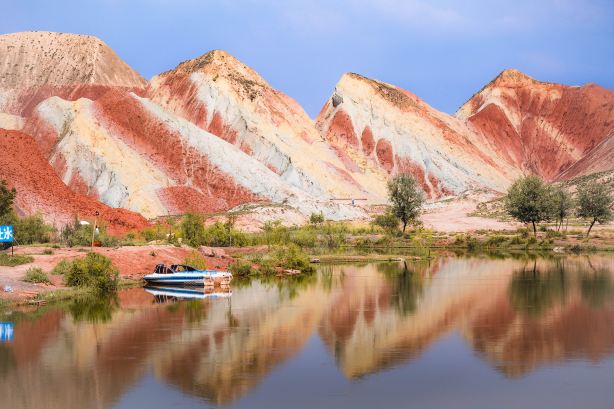
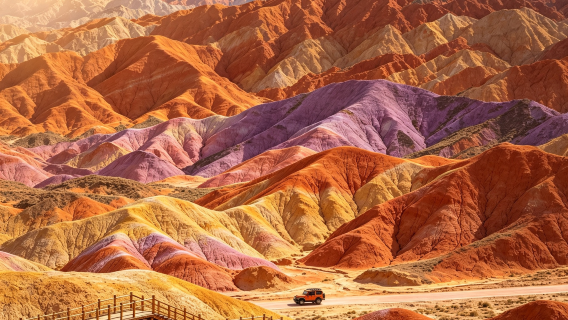
Lanzhou Danxia Geological Park is a key cultural tourism project in Gansu Province and a comprehensive cultural tourism initiative prioritized by the Lanzhou Municipal Committee and Government. Located by the Yellow River, the park is just 13 km from downtown Lanzhou and 30 km from Lanzhou Zhongchuan International Airport, making it one of the closest Danxia landform clusters to a major urban center in China. With a total planned area of 400 sq km and a core visiting area of 25 sq km in its first phase, it ranks among the largest discovered landscapes of its kind in the country. The park primarily features red mountain bay formations, along with spectacular Danxia cliffs, isolated peaks, secluded valleys, narrow gorges, and balancing rocks. Its colorful mountains set against winding waterways create a masterpiece of Danxia landform scenery. The attraction features seven viewing platforms showcasing the Danxia landforms: Silk Road Glow, Silk Road Eagle, Flying Apsaras Exploration, Nine-Colored Danxia, Danxia Reflecting Sky, Emerald Peaks Rippling Sky, and Danxia Summit Scenic View. It also includes the Ancient Silk Road Gateway, Shajing Tribe Cultural Square, Desert Bells Scenic Boulevard, and a 2,550m Danxia boardwalk viewing area. As a key cultural tourism project in the province, Lanzhou Danxia Geological Park adheres to the principles of "ecological protection, green development, preserving original features, and moderate development." Leveraging Lanzhou's unique resource advantages and focusing on the domestic tourism market, it aims to cultivate new growth drivers for Lanzhou's cultural tourism industry and establish a new highland for cultural tourism in the city.Yongdeng · 86.1 km from Jishishan

Shapotou Scenic Area
The scenic spot is located 16 kilometers west of Zhongwei City, Ningxia, on the southeastern edge of the Tengger Desert. The scenic spot has successively won honors such as "the first batch of national 5A-level tourist attractions", "the top 500 global environmental protection units", and "the first batch of national tourism standardization demonstration units". The three major cultural elements of the scenic area include the "Yellow River Culture" based on the intangible cultural heritage sheepskin rafts, the "Desert Culture" based on straw grids and Desert Legend Park, and the "Starry Sky Culture" based on the Desert Star Hotel. The tourism resources of these three elements have created a unique and magnificent landscape of "sunset over the long river and starry sky in the desert". The "six major ways to play" are highly praised and loved by tourists. Among them, the Yellow River projects include sheepskin rafting, Huangtengda, Yellow River speedboat, drift boat, passionate sandboarding and high-altitude bungee jumping, etc. The desert projects include Desert Camel, Desert Flying (Stepping into the Blue Clouds), and Sand Sea. Surfing, etc., starry sky projects include stargazing lectures, meteor feasts, sand therapy experiences, star cakes and other special products. In addition, there are also privately customized products for hiking, desert expansion, and educational and entertaining study experiences. The scenic area not only has diverse cultural elements and fun project experiences, but also multi-level accommodation experiences waiting for you: the butler-style Diamond Hotel, the quiet Desert Star Hotel for stargazing, the quiet Yellow River Courtyard in the bustling city, and finally the economical and affordable business-style Tourist Service Center Hotel and other differentiated tourist accommodations for you to choose from.China · Zhongwei

Bafang Shisanxiang
Bafang Shisanxiang is a historic Hui ethnic district preserved in the old town of Linxia. In ancient times, people established religious quarters around eight mosques, gradually forming a settlement pattern of "living around the mosque and trading around the quarter." "Bafang" (Eight Quarters) thus became the synonym for the Hui residential area in Hezhou. With its blue-brick alleys, brick-carved gate towers, and bustling daily life intertwined, walking inside feels like unfolding a long scroll of life in an old Northwest city. On the wall of Dagaxa Lane, there is a large brick carving titled "Panoramic View of Bafang Shisanxiang" that captures the entire district. The Dagongguan old residence restores the old scenes of Bafang families drinking Gaiwan tea, receiving guests, and the historical scenes of the Tea Horse Road trade and merchant caravans. In the Handicraft Museum, you can see intangible cultural heritage crafts such as carved gourds, copper fire pots, Hezhou clay sculptures, and egg carvings. The "Dragon and Phoenix" brick-carved screen wall in front of the Beixiang Mosque, dating back to the Qianlong reign of the Qing Dynasty, is also worth stopping to admire. Themed alleys like Hezhou Suyuan Lane, Silk Road Hui Merchant Lane, and Tongqu Lane, as well as the Gaiwan Tea Square and the Hongshui River area, are all perfect for strolling and exploring at a leisurely pace. If you get tired of walking, why not sit down for some "Gua Wanzis" (tea scraping)? Learn from the locals how to use the lid to scrape the tea leaves, then blow and sip a cup of Gaiwan tea, paired with Youguoguo (fried dough) and Sanzi (fried dough twists). In Bafang Weidao Lane, you can also find local snacks such as beef offal soup, sugar oil cakes, Liangpi (cold skin noodles), and sweet wheat.Linxia · 33.3 km from Jishishan

Kumbum Monastery
Kumbum Monastery is one of the important monasteries of the Gelug (Yellow Hat) sect of Tibetan Buddhism and the birthplace of Tsongkhapa, the founder of the Yellow Hat sect. The monastery features magnificent architecture, abundant treasures, and a strong religious atmosphere, making it one of the more popular travel destinations in Xining. Overview of the visit It has distinct differences in architectural layout compared to Han Chinese Buddhist temples in inland China: the complex here is not symmetrically arranged along a central axis. The monastery is an ancient architectural complex composed of numerous halls, scripture halls, stupas, and colleges, with each sutra hall, main hall, and stupa irregularly distributed on a small hill. Travelers can explore the site in a relatively free manner rather than following a straight path along a central axis. The Great Golden Roof Hall of Kumbum Monastery is the center of the entire architectural complex. It is said that Master Tsongkhapa was born here, and when he was born, his umbilical cord blood dripped on this spot, from which a bodhi tree grew. Later, a stupa was built around the tree, and a monastery was constructed, hence the name. Believers hold that this tree and stupa are the embodiment of the master. The three unique features of the attraction: butter sculptures, murals, and appliqué embroidery. Butter sculptures are made by mixing butter with various pigments to mold and carve into figures of Buddhas, people, flowers, birds, animals, and pavilions. Travelers can admire exquisite butter sculptures at the butter sculpture hall inside the temple (located far from the main gate). Vibrant centuries-old murals can be appreciated in the main halls, corridors, and front galleries of the temple. Appliqué embroidery involves cutting colored satin into desired shapes, such as Buddha figures or animals, stuffing them with wool or cotton, and embroidering them onto cloth hangings. In the temple's great sutra hall, two rare large appliqué embroidery pieces—"Sixteen Arhats Displaying Divine Powers" and "Eight Immortals Crossing the Sea"—hang on either side. The four major religious festivals (based on the lunar calendar): 1. Cham dance (14th day of the first month) and butter sculpture exhibition (15th day of the first month); 2. Cham dance (14th day of the fourth month), Buddha unveiling, and Cham dance (15th day of the fourth month); 3. Buddha unveiling, Cham dance (6th day of the sixth month), and golden Buddha procession (8th day of the sixth month); 4. Full-day Buddha unveiling (22nd day of the ninth month) and Cham dance (23rd day of the ninth month). During these festivals, activities like Buddha unveiling and ritual dances take place, attracting large crowds of devotees and travelers, creating a lively atmosphere.China · Xining

Bingling Temple World Cultural Heritage Tourist Area
Bingling Temple World Cultural Heritage Tourist Area is located in Yongjing County, Linxia Hui Autonomous Prefecture, Gansu Province. This cultural attraction combines Buddhist cave art with natural scenery, covering a total area of 180 square kilometers. It consists of three main sections: Bingling Lake, Gansu Bingling Danxia National Geopark (Bingling Stone Forest), and Bingling Temple Caves. In December 2020, it was designated as a National 5A-level Tourist Attraction by China's Ministry of Culture and Tourism. Bingling Lake is the reservoir of Liujiaxia Hydropower Station, named after the Bingling Temple at its far end. With crystal-clear, unpolluted water meeting national Grade II drinking standards, this vast misty lake stretches like an endless green silk ribbon through mountain ranges, blending southern China's elegance with the plateau's grandeur—a dream destination for travelers. Liujiaxia Hydropower Station, China's first independently designed million-kilowatt hydro project in Asia, is recognized as a National Industrial Heritage Education Base. The Binglingshi Stone Forest is a Danxia landform composed of Cretaceous purplish-red fine sandstone from the early Cenozoic era. In 2011, it was officially designated as the Gansu Bingling Danxia National Geopark by the Ministry of Land and Resources. Within the geopark, thousands of towering peaks and countless crisscrossing ravines form a labyrinth of winding tributary valleys, creating a surreal stone forest landscape alongside uniquely shaped rock formations. This natural sculpture gallery holds immense value for geological research, tourism development, natural aesthetics, and ecological conservation. The Bingling Temple Grottoes, dating back over 1,600 years to the Western Qin period of the Sixteen Kingdoms era, is a nationally protected cultural heritage site and was inscribed on the UNESCO World Heritage List in 2014. The grotto complex consists of three main sections: the Lower Temple area, Upper Temple area, and Donggou area. It preserves 216 cave shrines, over 800 Buddhist statues, more than 1,000 square meters of murals blending Tibetan and Han Chinese artistic styles, 56 stupas, and 438 cultural relics. The site contains ink inscriptions from the first year of Jianhong era (420 AD) of Western Qin - the earliest dated Buddhist cave inscription found in China, which serves as a crucial benchmark for dating early grotto art. The Bingling Temple World Cultural Heritage Tourist Area boasts abundant resources, where natural views and cultural landscapes complement each other to create a magnificent and mysterious panorama. Every visitor can embark on a perfect journey here to explore cultural heritage and experience the beauty of nature.Yongjing · 29.6 km from Jishishan
Experiences you can't miss in Jishishan
Featured Cultural experiences in Jishishan
View all Cultural experiences
Free cancellation
Instant confirmation
Book now for tomorrow
9% off
Limited-time sale
From€33.18€36.86


5.0/5
· 3 reviewsFree cancellation
Instant confirmation
From€133.53
From€224.32

From€227.60
From€220.01
Free cancellation
Book now for tomorrow
From€214.31
From€220.01
Featured Day tours in Jishishan
View all Day tours
4.8/5
· 223 reviews· 1.1k bookedFree cancellation
Instant confirmation
27 consecutive positive reviews
From€117.50

4.3/5
· 7 reviews· 76 bookedFree cancellation
Instant confirmation
Book now for tomorrow
From€64.19

4.9/5
· 62 reviews· 349 bookedFree cancellation
Book now for today
96.8% of travelers recommend
From€15.36

5.0/5
· 4 reviews· 22 bookedFree cancellation
Instant confirmation
Book now for tomorrow
From€67.52

5.0/5
· 10 reviews· 56 bookedFree cancellation
Book now for tomorrow
From€45.14
5.0/5
· 16 reviews· 95 bookedFree cancellation
Instant confirmation
Book now for tomorrow
77 travellers saved
From€55.82

4.9/5
· 78 reviews· 490 bookedFree cancellation
Instant confirmation
Book now for today
97.4% of travelers recommend
From€49.14
5.0/5
· 2 reviewsFree cancellation
Instant confirmation
From€78.90
Free things to do in Jishishan
Bingling Cave-Temple Complex
Yongjing · 18.3 km from JishishanImmediate access, Book now for today, Cancel anytimeDadunxia Scenic Area
Jishishan · 15.7 km from downtownJiuzhaigou National Park
China · JiuzhaigouImmediate access, Book now for todayGanga Secret Scenic Spot
Xiahe · 41.6 km from JishishanMengda Heavenly Lake
Xunhua · 19.9 km from JishishanLanzhou Danxia Geological Park
Yongdeng · 86.1 km from JishishanImmediate access, Book now for today, Cancel anytimeShapotou Scenic Area
China · ZhongweiImmediate access, Book now for today, Cancel anytimeBafang Shisanxiang
Linxia · 33.3 km from JishishanKumbum Monastery
China · XiningImmediate access, Book now for today, Cancel anytimeBingling Temple World Cultural Heritage Tourist Area
Yongjing · 29.6 km from Jishishan
What travellers say about Jishishan

游来游去的鱼鱼🐡September 30, 2026
5.0
The Bingling Temple Grottoes are hailed by scholars as an "encyclopedia of Chinese grottoes," holding an irreplaceable and important position in my country's grotto art. It is not only one of the three major grottoes in Gansu, but also the first Yellow River grotto on the Silk Road.
Bingling Cave-Temple Complex

138***66October 4, 2025
5.0
The Dadun Gorge Scenic Area is located in Xining City. It's not far, but the hike up takes a while. The road is in good condition, though. Once you reach the top, the scenery is breathtaking.
Dadunxia Scenic Area

菡啵格尔October 20, 2026
5.0
Before coming to Jiuzhaigou, I hesitated for a long time about whether to buy the VIP sightseeing bus ticket, but finally decided to try it. The smaller bus is more flexible than the regular one, making the ride less tiring and the pace of sightseeing more comfortable. There are many attractions in Jiuzhaigou, and walking around all day can be quite tiring. Having a shuttle bus definitely makes things easier, and the scenery along the way is beautiful; I didn't want to close my eyes while on the bus. Overall, the service and experience were decent, but it depends on your itinerary for the day, and the price is indeed significantly higher than the regular sightseeing bus.
Jiuzhaigou National Park

M41***91October 3, 2026
4.0
As the first stop in Gannan from Linxia, it's a pretty good tourist attraction, with all three viewing platforms worth taking photos at. However, even during the off-season holidays, the shuttle buses are hard to find, so I can only imagine how ridiculous the queues will be during the summer peak season.
Ganga Secret Scenic Spot

Invisible WindMay 27, 2025
5.0
孟达天池被誉为“高原西双版纳,天域香格里拉”,面积约300亩,池水清澈碧澄与蓝天一色,群峰倒影,随波微动。湖中水鸟飞翔,鱼儿舒然游动。区内森林覆盖面积14万余亩,有亚热带、暖温带植物,林中栖息苏门羚、林麝、狍鹿、岩羊、狐狸、雪鸡、马鸡等珍禽异兽。去循化赏秋,首先要去的一定是孟达天池,秋季的天池是一年中最美的,那层林尽染的孟达山林与微波荡漾的一汪池水,足以满足你对秋景所有的向往。尤其是天池的彩虹瀑布,在秋叶灿灿中释放出所有的激情。
Mengda Heavenly Lake

kiu先生October 13, 2026
5.0
The scenic area is large and clean, with a refreshing atmosphere. There are so many animals, the shows are fantastic, the kids had a blast, and the visit was very comfortable. The staff were very welcoming, and the routes were well-designed – it was so convenient! I'll definitely come back next time.
Lanzhou Danxia Geological Park
M43***25October 19, 2026
5.0
As a 5A scenic spot, it offers a lot of fun. The sheepskin raft on the 22nd even sang a song for us. The song "Flying to Success" was quite exciting. Sandboarding was fun. The "Flying to the Desert" attraction offered panoramic views of the desert area. Sitting on a camel's back felt like being on the Silk Road. The package ticket was quite cost-effective. It's currently the off-season, so there weren't too many people, and the weather was good and not too sunny.
Shapotou Scenic Area

M37***45September 5, 2026
4.0
Hidden within the Eight Squares and Thirteen Lanes is China's first museum dedicated to covered bowl tea—the Hezhou Mingyuan Covered Bowl Tea Culture Museum! The entire museum is housed in an ancient Qing Dynasty residence in Northwest China, preserving the "style of the Tang and Song Dynasties and the layout of the Ming and Qing Dynasties." Even the walls are decorated with blue and white porcelain covered bowls—it's incredibly unique! A leisurely stroll through it is so relaxing!
Bafang Shisanxiang

奥莉的粉丝October 19, 2026
5.0
Excellent, even more satisfying than expected. However, there were just too many people, which somewhat affected the experience. Kumbum Monastery has a long history, and its architectural complex is more complete than that of typical Tibetan Buddhist temples, including a printing house. Overall, it's worth a visit.
Kumbum Monastery

M28***94August 5, 2025
5.0
I drove there on a self-driving tour from Liujiaxia Town. It was a long way to go. Some of the statues on the grotto walls were blocked by gauze and could not be seen clearly. Some were still empty. Only the Buddha statues were magnificent. I took a long detour back to the entrance. It is suitable for scholars and scholars. I think it is okay. If you want to see the special grottoes, you need to make a separate reservation and buy a ticket, which seems to be 300 yuan.
Bingling Temple World Cultural Heritage Tourist Area


