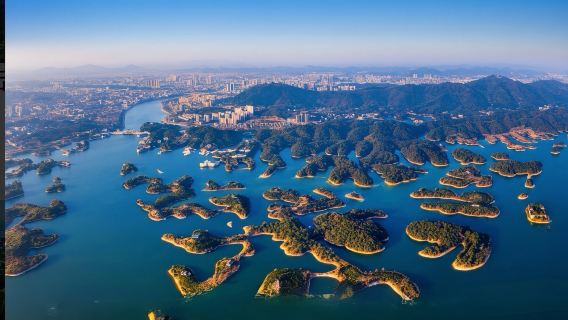
Tongcheng

Things to do in Tongcheng

Search attractions or local attractions & tours
Search

Explore top experiences

Top 10 attractions in Tongcheng

View all Attractions
Orange Isle Scenic Area
No. 3 of Best Things to Do in Hunan Jiangxi Fujian Region

Orange Isle Scenic Area

9
4.6/5
13.7k reviews
Orange Isle Scenic Area is a narrow sandbar lying across the heart of the Xiang River in Changsha, stretching approx. five km. It faces Yuelu Mountain to the west and borders Changsha's old city to the east, surrounded by water on all sides. Named after the abundant orange trees planted on the isle, it was historically called Shuiluzhou. Formed by river alluvium, this sandbar has existed for over a millennium, where the "River and sky in evening snow" scenery was once among the Eight Views of Xiaoxiang. In 1925, the poem "Spring in a pleasure garden - Changsha" was composed here, with its iconic line "Alone I stand in the biting fall, watching the Xiang River flow north past Orange Isle's head," which made this riverine landmark widely renowned. The highlights of the visit are concentrated at the islet's head: A granite art sculpture over 30 m tall, modeled after the 1925 youth image, stands facing the river as Changsha's highly recognizable landmark. Nearby, the Questioning Heaven Platform extends toward the river center, where leaning on the railing reveals the mighty Xiang River flowing northward, with Yuelu Mountain and the city skylines on both banks facing each other across the water. The Songju Pavilion, white marble poetry stele, and the 200-year-old ancient phoenix tree at the islet head are all in this area. Heading north from the islet head, a hundred-acre orange orchard bears golden fruits in fall, while bamboo groves, peach orchards, plum gardens, and osmanthus groves take turns showcasing seasonal flora. The historic Zhuzhang Ferry (where Zhu Xi and Zhang Shi once crossed the Xiang River for lectures) and the Huxiang Culture Exhibition Hall are scattered along the way. At the islet's tail, the reconstructed Jiangshen Temple and Gongji Tower area was precisely where ancients admired the "River and sky in evening snow" scenery. The island is long and narrow, making round-trip walks quite tiring. A sightseeing train is available for transportation, with multiple stops along the way for hopping on and off. Travelers with limited time are advised to head straight to the island's tip to see the sculpture and river views, then stroll leisurely along the riverside path. At dusk, watching the sunset over the Xiang River and seeing the lights gradually illuminate both shores from the island's tip is especially worth setting aside time for.China · Changsha
Hunan Museum
2026 Asia 100 - Best Things to Do

Hunan Museum

8.8
4.8/5
16.3k reviews
Hunan Museum is a relatively large history and culture museum in Hunan Province, and among its collections, the artifacts unearthed from the Mawangdui Han Tombs are particularly representative. "The Changsha Mawangdui Han Tombs Exhibition" is the museum's permanent exhibition, presenting in a concentrated way the precious artifacts unearthed from three Western Han tombs. One of the most striking exhibits in the exhibition is the plain silk unlined robe with straight-cut front, as thin as cicada wings and weighing less than 50 grams, whose weaving technique is astonishing. In addition, visitors can see well-preserved printed silk padded robes, fine and elegant embroidery, brightly glossy painted lacquerware, and an exquisite T-shaped painted silk painting. More than 100,000 characters of silk manuscripts were unearthed from Tomb No. 3, among which are many lost texts long since gone from circulation, covering fields such as philosophy, history, astronomy, and medicine. The "Topographic Map of the Southern Part of the Changsha Kingdom," also from Tomb No. 3, was drawn using techniques broadly similar to those of modern maps and holds important value in the study of ancient maps. The well-preserved body of Lady Xin Zhui unearthed from Tomb No. 1 has survived intact for more than two thousand years and is another major highlight of the exhibition. The museum also features permanent exhibitions such as "Hunan People: A Historical and Cultural Exhibition of the Three Xiang Regions," displaying collections including Shang and Zhou bronzes, ceramics from famous Hunan kilns, and Ming and Qing calligraphy and paintings, presenting the historical and cultural threads of Hunan from different dimensions. The Mawangdui Han Tomb Exhibition and the Three Xiang Historical and Cultural Exhibition together form the museum's two core exhibitions, and are well worth setting aside ample time to view in detail.China · Changsha
Yue Yang Tower
No. 1 of Family-friendly Attractions in Hunan

Yue Yang Tower

8.1
4.6/5
11.5k reviews
"Be the first to worry about the world's worries and the last to enjoy its pleasures"—this line from Fan Zhongyan's Northern Song dynasty essay "Yueyang Tower chronicle" made Yue Yang Tower by Dongting Lake a household name. The main tower, Yueyang Tower, is said to have evolved from a naval review tower built by Lu Su of Eastern Wu during the Three Kingdoms period. Alongside Yellow Crane Tower in Hubei and Tengwang Pavilion in Jiangxi, it is hailed as one of the three great towers of southern China. Poets like Li Bai, Du Fu, Meng Haoran, and Bai Juyi once climbed it to compose verses. From the top floor, leaning on the railings, you can take in the vast expanse of Dongting Lake stretching hundreds of miles, with Junshan Island visible across the waters—where timeless verses and the lake's beauty converge in this moment. The tower itself is an architectural treasure: its three-story, triple-eave structure is built entirely of wood with mortise-and-tenon joints—no iron nails used—and four golden nanmu pillars run straight from the ground to the rooftop. The helmet-shaped roof, called "helmet crown," is supported by layered ruyi bracket sets, a rare design among surviving ancient towers in China. Inside, carved Qing-dynasty panels of "Yueyang Tower chronicle" are preserved—pause to admire them when ascending. The small attractions within the attraction each have their own highlights: near the gate, the "Five-dynasty towers" use bronze miniature models to recreate Yueyang Tower's different architectural styles from the Tang, Song, Yuan, Ming, and Qing dynasties, showcasing a millennium of changes at a glance. On the lakeshore in front of the main tower, ancient iron artifacts resembling shackles and weighing several tons are displayed—their casting era and purpose remain debated, forming a long-standing historical mystery. Additionally, there are the Shuanggong Shrine commemorating Fan Zhongyan and Teng Zijing, the stele corridor engraved with poems about the tower from various dynasties, and the Xiaoqiao Tomb—said to belong to the wife of Three Kingdoms general Zhou Yu—waiting to be explored. If you wish to extend your itinerary, you may also take a boat tour of Dongting Lake and visit Junshan Island on the opposite shore. The nearby Bianhe Street, a cobblestone-paved antique-style street, is lined with local snack stalls and souvenir shops, making it convenient to explore along with the nearby Baling Square.Yueyang · 71.6 km from Tongcheng
Tengwang Pavilion Tourist Area
2026 Global 100 - Night Attractions

Tengwang Pavilion Tourist Area

8.7
4.5/5
30k reviews
Tengwang Pavilion Tourist Area is located on the east bank of the Gan River in Nanchang, with the riverside Tengwang Pavilion as its centerpiece. Originally built in the fourth year of the Yonghui era of the Tang Dynasty by Li Yuanying, Prince of Teng and son of Emperor Gaozu of Tang, it gained eternal fame through Wang Bo's "Preface to Tengwang Pavilion." Alongside the Yellow Crane Tower and Yueyang Tower, it is hailed as one of the "Three Great Towers of Jiangnan." Historically destroyed and rebuilt nearly thirty times, the current structure is a Song-style replica completed in 1989, designed based on Liang Sicheng's reconstruction sketches. With its green tiles and layered eaves, it remains a landmark of Nanchang to this day. The main pavilion follows a "three visible, seven concealed" layout: appearing as a three-story structure with encircling corridors from the outside, while actually containing seven interior floors—nine levels including the two-tiered base symbolizing ancient city walls. Turquoise-roofed galleries extend north and south from the base's flanks, connecting at their ends to auxiliary pavilions named "River-taming" and "Greenery-embracing," forming a mountain-shaped silhouette with the main tower. Below, an artificial lake and the nine-bend wind-and-rain bridge add classical garden charm to the majestic architecture. Each floor of the pavilion offers something remarkable. The white marble relief "A timely wind delivers Tengwang Pavilion" in the first-floor preface hall depicts the legend of Wang Bo riding the wind to compose his famous preface. The second-floor mezzanine features the long scroll painting "Gallery of eminent figures," gathering Jiangxi's historical luminaries like Tao Yuanming, Ouyang Xiu, Wang Anshi, and Tang Xianzu in one artwork. The third-floor mural "Linchuan dream" recreates Tang Xianzu's staging of "The peony pavilion" here. The fourth-floor "Land of wonders" painting compresses Jiangxi's iconic landscapes—Mount Lu, Sanqing Mountain, Dragon-Tiger Mountain, and Poyang Lake—into a single masterpiece. The fifth floor is the highlight for panoramic views: its central hall displays a bronze tablet inscribed with Su Dongpo's calligraphic version of "Preface to Tengwang Pavilion," while the east hall exhibits a scale model of the pavilion. Strolling the veranda offers sweeping views of the Gan River and modern skyline across the water. The top floor bears the plaque "Ninth heaven," with its west hall housing an antique-style theater flanked by replica ancient instruments like chime bells and stone chimes. Above, spiral-arranged bracket sets adorn the caisson ceiling, and between the double eaves hangs Su Dongpo's gilded "Tengwang Pavilion" plaque. After descending from the main pavilion, take time to explore the garden area: the square in front of the pavilion, the grand Song-style archway, the antique street lined with calligraphy and antique shops, and the small Suzhou-style garden Fuchang Garden with its lake reflections and bridge views—perfect for slowing your pace. To experience the poetic scene of "a solitary wild duck flying with the sunset glow, while the autumn water blends with the vast sky," an evening ascent to the pavilion is ideal. The fifth-floor corridor offers an expansive view, making it a prime spot to admire the sunset over the Gan River.China · Nanchang
Hubei Provincial Museum
2026 Asia 100 - Family-friendly Attractions

Hubei Provincial Museum

8.5
4.9/5
7.9k reviews
The Hubei Provincial Museum has ten treasures of the museum, including those unearthed from "Tomb of Marquis Yi of Zeng" the Hubei Provincial Museum's Zenghouyi chime bells; the Yue Wang Goujian sword, a masterpiece of the cold weapon era; the fossilized skull of the Yunxian Man dating back 1 million years; and a treasure of Yuan blue-and-white porcelain: the plum vase with the Four Loves design. The museum's regular exhibitions also feature distinctive characteristics of ancient Chu culture and ancient Yangtze River civilization. The Hubei Provincial Museum consists of the comprehensive exhibition hall,Chu culture hall,Chime bell hallIt is composed of multiple pseudo-classical buildings, and the layout reflects the high-platform architectural layout format of ancient Chu architecture, namely "one terrace, one hall" and "multiple terraces forming a group." Unearthed in 1978 at "Tomb of Marquis Yi of Zeng" in the Hubei Provincial Museum - the Zenghouyi chime bells have a wide range and their excavation rewrote the history of world music; the sword of Goujian, King of Yue, a masterpiece of the cold weapon era, is still incomparably sharp to this day, and displayed beside it is the "spear of Fuchai, King of Wu"; the geological age of the Yunxian human skull fossil is approx. 1 million years ago, earlier than the Peking Man skull fossil; the Yuan blue-and-white plum vase with four loves design is an extremely rare masterpiece among Yuan dynasty blue-and-white porcelain. Hubei is located in the middle reaches of the Yangtze River and belonged to the territory of the Chu state during the Spring and Autumn and Warring States periods. The permanent exhibitions at the Hubei Provincial Museum showcase ancient civilizations of southern China that differ from the Yellow River civilization of the north. The museum's current permanent exhibitions include "Yunxian Man: Prehistoric Humans in the Middle Reaches of the Yangtze River," "Qujialing: Prehistoric Culture in the Middle Reaches of the Yangtze River," and "Panlongcheng: Bronze Civilization in the Middle Reaches of the Yangtze River." In addition to viewing cultural relics at the Hubei Provincial Museum, you can also enjoy chime bell performances. In the museum's performance hall, chime bell performances are held from Tuesday to Sunday, and it is closed on Mondays.China · Wuhan
Qingchuan Pavilion
No. 4 of Best Things to Do in Hubei

Qingchuan Pavilion

8.4
4.7/5
7.7k reviews
Qingchuan Pavilion stands on Yugong Rock at the eastern foot of Tortoise Hill in Hanyang, facing the Han River to the north and the Yangtze River to the east, gazing across the river at Yellow Crane Tower in Wuchang on the opposite bank. The pavilion's name is taken from the line "the clear river reflects the trees of Hanyang" by the Tang dynasty poet Cui Hao, and it was initiated for construction by Fan Zhizhen, the Ming dynasty prefect of Hanyang. First built during the Jiajing era of the Ming dynasty, it has a history of more than four hundred years. Throughout history, Qingchuan Pavilion was destroyed and rebuilt as many as six or seven times, the last destruction caused by a windstorm; the existing structure was rebuilt in the 1980s following the style of the Guangxu era of the Qing dynasty. Long known as one of the "finest sights of the Three Chu regions" and a "grand vista through the ages," Qingchuan Pavilion echoes Yellow Crane Tower across the river and stands out distinctly along the banks of the Yangtze. The attraction is composed of three main structures—Qingchuan Pavilion, Yuji Xinggong (Yu and Ji Ancestral Hall), and Tiemen Pass—along with auxiliary structures such as the ancient archway, Chubo Pavilion, Chaozong Pavilion, Yu Stele Pavilion, Jingchu Heroic Spirit Stele, and the poetry stele corridor, forming a complex of ancient and pseudo-classical buildings standing by the river. Among them, Yuji Xinggong was first built during the Shaoxing era of the Southern Song dynasty under the original name Yu Wang Temple; during the Tianqi era of the Ming dynasty, it was renamed "Yuji Xinggong" after its worship was changed to Houji and other former sages, and it has been an important site in Wuhan for successive generations to pay homage to Yu the Great. Tiemen Pass was first built during the Three Kingdoms period and has been a strategic location contested by military strategists since ancient times; it was restored in the 1990s. Ascending Qingchuan Pavilion offers a panoramic view of the expansive river scenery where the Yangtze River and the Han River converge. Inside the pavilion, permanent exhibitions such as "Traces of Yu Across the Nine Provinces" and "Historical Paintings of Qingchuan" present Yu the Great culture and the historical heritage of Qingchuan Pavilion from multiple perspectives, ranging from water-control culture to poetry and couplets. The attraction nestles between the hills and the river, with pavilions and terraces scattered in graceful arrangement. The poetry stele corridor preserves inscribed stones bearing verses by literati and poets of successive dynasties, and strolling through it allows visitors to feel the rich historical and cultural atmosphere.China · Wuhan

Experiences you can't miss in Tongcheng

Featured Day tours in Tongcheng

View all Day tours
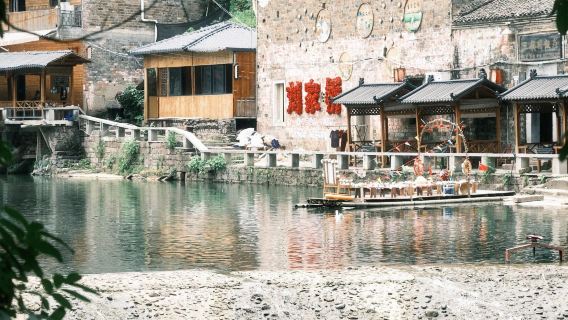
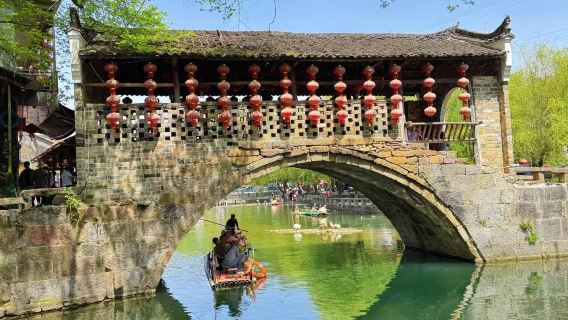
Wander Two Towns: Liujiaqiao Ancient Town + Yangloudong Ancient Town
󱌍
FromCAD 258.32
One-Day Tour from Changsha: Yue Yang Tower + Lake Dongting + Quzi Garden
󱌍
Duration: 11 hrs
English
Free cancellation
Instant confirmation
Book now for tomorrow
FromCAD 72.13
One order one group [Private tour] Yueyang tower + Lake Dongting + Qu Yuan's hometown Yueyang day tour
󱌍
4.8/5
· 64 reviews· 583 booked
Duration: 11 hrs
English
Free cancellation
Instant confirmation
Book now for tomorrow
93.8% of travelers recommend
FromCAD 139.72
Tongcheng Today's weatherFoggy 11-21℃
Tongcheng weather for the next 2 days11/6: 13-21℃, 11/7: 14-17℃

Free things to do in Tongcheng

What travellers say about Tongcheng

user-avatar
清风明月August 31, 2020
5.0
As a leisure attraction in Tongcheng County, it is quite good. The Ancient Yao Museum is very rich in content, with many ancient Yao cultural relics. There is a shouting spring at the entrance, and it is nice to hike on the plank road. There are Yao song and dance performances inside, and a bonfire party at night. There are also some homestays and farmhouses. The second phase is being developed in the mountain, and I believe it will get better and better! It would be even better if it could be free of charge!

The ancient Yao Village of Yaogu Mountain in Tongcheng County

user-avatar
YazonDinAltOctober 23, 2026
4.0
Orange Island is a bit of a mixed experience, and I'm honestly not entirely sure whether I'd consider it a must-visit in Changsha.It's a large, green, and pleasant park, with beautiful riverside views and plenty of space for walking. If you enjoy places with historical significance or simply want to experience a different side of the city, it's definitely worth considering.Most visitors seem to take the sightseeing train to the southern end of the island, where the famous Mao Zedong statue is located. That's also where you'll find plenty of people taking photos, so don't expect a particularly quiet experience.The main downside is that visiting the island takes quite a bit of time, especially if you want to explore it properly. And while it's certainly a nice place, I'm not sure the experience justifies spending several hours here if you have a limited amount of time in Changsha and other places you'd like to see.On the other hand, if you're simply looking for a relaxing walk through a green park, with opportunities to stop by the river and enjoy the scenery, it's a lovely option.Overall, I'd say it's worth visiting if you have some extra time or are particularly interested in Chinese history. Otherwise, I wouldn't necessarily put it at the very top of your Changsha itinerary.

Orange Isle Scenic Area

user-avatar
FouchéNovember 1, 2026
5.0
The half-price student ticket is quite a good deal; otherwise, 70 yuan seems a bit expensive. The scenery from the top of the Yellow Crane Tower is beautiful, but unfortunately the weather was so-so that day. It's a pity the tower was rebuilt in the last century and isn't an original structure, although the stairs and other structures show considerable wear and tear. There are two elevators inside; seniors over 70 can get down for free from the top. Incidentally, the Hubei Military Governor's Mansion is right next door, so I recommend checking it out; it's quite interesting.

Yellow Crane Tower

user-avatar
圣奥莫波诺伊马加张宪October 31, 2026
5.0
For cultural attractions, a guided tour is definitely worthwhile. Our guide, Xiao Xiao, provided an excellent, insightful, and engaging explanation, leading us through the most essential parts of the museum. Highly recommended!

Hunan Museum

user-avatar
_We***01October 29, 2026
5.0
Yueyang Tower, one of the four great ancient towers of my country, stands majestically on the shore of Dongting Lake, inspiring awe in visitors throughout history. Unfortunately, when we arrived in the afternoon, it was raining, and by evening, visibility was poor, greatly diminishing the view.

Yue Yang Tower

user-avatar
Anonymous userNovember 3, 2026
5.0
When it's not crowded, you can go upstairs to see the river view; it's a different experience, although the stairwells are indeed narrow. I didn't go inside the scenic area for the night view, but the photos I took outside were also very beautiful; the night view is truly stunning.

Tengwang Pavilion Tourist Area

user-avatar
hylxzNovember 1, 2026
5.0
✅Advantages: Well-equipped mountaintop town, no need for repeated hikes; combines natural scenery with cultural attractions; easy and friendly western route; stunning sea of ​​clouds and sunrise; comfortable summer retreat. ⚠️Disadvantages: Scattered attractions, reliant on sightseeing buses; many steps to San Die Quan and Wu Lao Feng; sea of ​​clouds depends on the weather, fog diminishes the experience; prices on the mountain are relatively high.

Lushan National Park

user-avatar
大土豆一颗October 4, 2026
5.0
The exhibited artifacts were quite good; I've also been to joint exhibitions organized by museums like the Hunan Provincial Museum. The Kremlin artifacts here are well-prepared and thoughtfully designed. However, the souvenir and merchandise section was rather boring. I was thinking of buying a pendant or something, but that saved me some money.

Hubei Provincial Museum

user-avatar
沅大王September 30, 2026
5.0
The scenic area is filled with the fragrance of osmanthus blossoms. From the top, you can enjoy panoramic views of the Yangtze River Bridge and the Yellow Crane Tower. At the very top, watching the ships on the Yangtze and the cars and trains on the bridge, with the breeze blowing, is very pleasant, and it's not too crowded. The scenic area isn't large; a leisurely hour is about right to appreciate the scenery. Qingchuan Pavilion and Guishan Scenic Area are directly connected by the Iron Gate Pass, which leads to the West Gate of Guishan. Climbing the mountain and enjoying the breeze and osmanthus fragrance is a wonderful experience.

Qingchuan Pavilion

user-avatar
Linda-玲August 2, 2026
5.0
It's incredibly beautiful, like being in a fairyland. It's especially cool in the mountains during the summer, and breathing in the fresh air is invigorating. It's also very close to Changsha. I recommend everyone spend a day visiting it.

Tianyue Mafu Mountain

Trip Moments in Tongcheng

Popular cities near Tongcheng

Frequently asked questions

What are the recommended tours and excursions in Tongcheng?

When choosing a tour, start with how much time you have and the kind of experience you're looking for. Trending options right now include 1-day tour to China's Ancient Yao Village, Liujia Bridge, and Shiliutan Park in Xianning, Hubei with Chinese and English services available, Wander Two Towns: Liujiaqiao Ancient Town + Yangloudong Ancient Town, and One-Day Tour from Changsha: Yue Yang Tower + Lake Dongting + Quzi Garden. Check the real-time availability and itinerary before you book.

As of November 5, 2026, the reference price for day tours and activities in Tongcheng is around CAD 72.13 – CAD 623.31. Rates vary by duration, group size, transport, tickets, meals, and any special admission requirements. Before you book, please confirm the billing currency and whether the price is quoted per person or per group.

Get help anytime, anywhere within 30 secondsContact customer support

Change and cancellation policies vary by attractions and tours. Please check the product details page for more information.

Ticket prices may vary between weekdays and weekends, as well as during peak and off-peak seasons. When booking with Trip.com, you can also use Trip Coins to get extra savings. For more tips on booking discounted tickets, please visit Trip.com for the latest information.