Xincheng

Things to do in Xincheng

Search attractions or local attractions & tours
Search

Explore top experiences

Top 10 attractions in Xincheng

View all Attractions
Detian Transnational Waterfall Scenic Spot
2026 Asia 100 - Best Things to Do

Detian Transnational Waterfall Scenic Spot

9.1
4.7/5
27.6k reviews

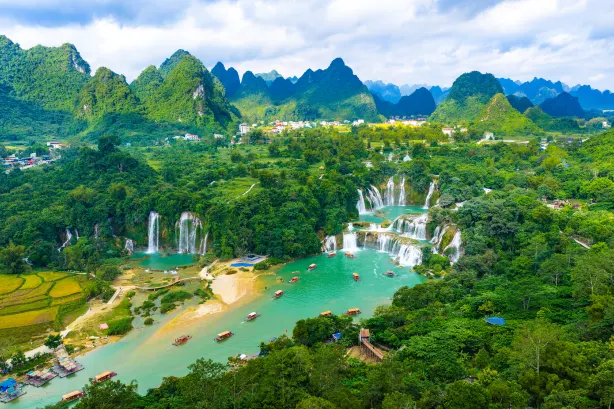
Detian Transnational Waterfall Scenic Spot is located on the Guichun River along the China-Vietnam border in Guangxi. Here the border river meets a cliff, and the water drops in three tiers with a fall of about 60 m, facing Vietnam's Ban Gioc Waterfall across the cliff. In the rainy season, when the water is abundant, the two waterfalls almost merge into one, with a combined width of more than 200 m, and the roar can be heard across the valley. This is also one of the filming locations for the TV drama The Journey of Flower. The highlights of the visit mostly unfold around this border river: after passing through the Detian Archway, you can take a bamboo raft from the bank toward the foot of the waterfall, look up as the curtain of water crashes down from the cliff top and mist hits your face, and experience up close the unique atmosphere of two countries just a step apart on the border river; on the river, you can often encounter Vietnamese border residents rowing small bamboo rafts to sell coffee, dried fruit, and other small goods, and the bargaining has much of the fun of a cross-border market. After coming ashore, follow the waterfall-viewing boardwalk and the multi-level viewing platforms to look back at the full panorama of the waterfall from different heights. The No. 53 boundary marker, erected in the Qing Dynasty and inscribed with "China Guangxi Boundary," is a popular photo spot. The waterfall view changes noticeably with water volume: during the summer wet season, the water is surging and visually stunning, while in the dry season it is relatively delicate; bamboo raft docks have long queues during peak season, so if you want to view the waterfall up close, it is recommended to plan an early start; there is heavy mist on the bamboo raft, so remember to protect your phone and camera from water.

China · Daxin
Elephant Hill Scenic Area
No. 1 of Best Things to Do in Guilin

Elephant Hill Scenic Area

8.9
4.6/5
25.6k reviews

The Elephant Hill Scenic Area is located in the heart of Guilin, at the confluence of the Li River and the Peach Blossom River. It derives its name from its resemblance to a giant elephant stretching its trunk to drink from the sweet waters of the Li River. In his work "Records of Elephant Hill," Shu Shu, a Qing Dynasty official from the Ministry of Works, wrote: "The marvels of Guangxi lie in its mountains; the marvels of Guangxi's mountains lie in their rocks, and the elephant-shaped hill facing the provincial capital is the most marvelous of all." With its lifelike form, the attraction captivates visitors and stands as a quintessential representation of Guilin's landscape. In 1995, it was designated as the city emblem of Guilin. The main attractions in the scenic area include: Elephant Hill and Water Moon, Puxian Pagoda, Elephant Hill Scenic Area and Guilin Sanhua Liquor, Elephant Hill Scenic Area - Love Island, and Elephant Hill Scenic Area - Yunfeng Temple Taiping Heavenly Kingdom Exhibition Hall. Elephant trunk hill and water moon cave "Elephant trunk hill and water moon" is a spectacular wonder here, as described in the poem by Ji Bei Hermit of the Song Dynasty.Harmony of water, moon and caveThe poem reads: "The moon is beneath the water, the moon floats upon the water. The water flows but the moon stays, the moon departs yet the water still flows." On a moonlit night, visiting the Water Moon Cave at the Elephant Trunk Hill attraction presents a magical scene where the moon in the sky, the cave, and the water reflect each other beautifully. Inside the cave, you can find the "Poem and Preface of the Morning Sun Pavilion" by Zhang Xiaoxiang from the Song Dynasty and works by Fan Chengda.Inscription on the water and moon caveAnd over 50 precious cliff carvings including Lu You's poetry manuscripts. Xiangshan scenic area - Puxian pagoda Winding up along the rocky cliffs, you can see the Puxian pagoda standing tall amidst the greenery from afar. Built during the Ming dynasty, this 13.6m-high solid brick lama-style pagoda has a history of over 400 years. On the northern side of the pagoda, there is a line-engraved bluestone statue of a bodhisattva, with the mantra "Namo Puxian Bodhisattva" inscribed above it, hence the name Puxian pagoda in the Xiangshan attraction. Buddhist scriptures record that Puxian bodhisattva's mount is a six-tusked white elephant, making the pagoda's location atop Xiangshan mountain a perfect embodiment of this scripture. Elephant Hill Scenic Area and Guilin Sanhua liquor This is a natural wine cellar, with two-thirds of the mountain being hollow. It stays warm in winter and cool in summer, maintaining a constant temperature of 19°C and humidity above 90% year-round. Since the Song Dynasty, it has served as an official cellar for storing Sanhua wine. Sanhua wine is colorless and transparent, with a fragrant yet spicy taste. It drawsLi RiverWith the essence of the mountains and the soul of the Li River, it has become a representative of China's rice-aroma liquor. The cellar liquor was designated as a tribute to the imperial court as early as the Northern Song Dynasty and is one of the three treasures of Guilin. To date, nearly a thousand tons of liquor are stored in the caves. Love island Love island is located on the north side of the attraction, adjacent toLi RiverIt is another scenic viewpoint for distant viewing. The island boasts a beautiful environment and lush vegetation, making it a popular dating spot for locals in the 1970s, hence the name "love island". Today, it serves as an outdoor photography base for wedding celebrations against the backdrop of Guilin's landscape, where couples make their vows of love under the witness of the elephant trunk hill and the moon reflected in the water.

China · Guilin
Libo Xiaoqikong Scenic Area
2026 Global 50 - Cool Water Escapes

Libo Xiaoqikong Scenic Area

8.7
4.7/5
24.4k reviews

Libo Xiaoqikong Scenic Area is located among the peaks in the southern part of Libo County and is named after a seven-arch stone bridge built during the Daoguang era of the Qing Dynasty over the Xiangshui River. Set against a karst landscape, the scenic area brings together mountains, waters, forests, caves, lakes, and waterfalls, and is known as the "emerald on the Earth's belt." The Xiaoqikong ancient bridge is the attraction's signature view. The seven-arch stone arch bridge, built of bluestone, spans the Xiangshui River. Beneath the bridge, the water of Hanbi Pond is deep blue, and ancient trees tower on both banks, making it a classic photo spot. Following the Xiangshui River downstream, the 68-tier waterfall cascades in overlapping layers, with the river water dropping step by step over the karst rock surface with a roaring sound. Nearby, the Laya Waterfall pours down from the cliff beside the path, and visitors can feel the mist on their faces up close. The water forest is another unique view in the attraction, where trees take root among the streams in the water. Visitors walk along the stone stepping path through the forest, with babbling water beneath their feet and a canopy of green shade overhead. Mandarin Duck Lake is formed by two large lakes, the Male Mandarin Duck Lake and the Female Mandarin Duck Lake, connected with several small lakes. The lake surface is emerald green and serene, and boats can pass through the trees growing in the water. Wolong Pond is the surface outlet of an underground karst river. An arc-shaped stone embankment encloses the underground river water into a deep pond, and the water is as green as jade. Where the water overflows the stone embankment, a rolling-water waterfall forms, creating a striking contrast between the still pond and the moving waterfall. The area around the attraction is home to ethnic minorities such as the Bouyei and Yao, and villages like Yaoshan Ancient Village retain traditional dwellings and ethnic customs, adding cultural richness to the natural scenery. The attractions are distributed along the Xiangshui River; touring from Wolong Pond and Yuanyang Lake all the way down to the Xiaoqikong Ancient Bridge, walking along the stream is relatively effortless.

China · Libo
Xijiang Qianhu Miao Village
2026 Global 100 - Night Attractions

Xijiang Qianhu Miao Village

8.6
4.3/5
26.6k reviews

Xijiang Qianhu Miao Village is a collection of over ten natural villages built along the mountainside, inhabited by the "Xi" clan of the Miao people. The village features layers of wooden stilt houses on the slopes, with coffee-colored old houses nestled against lush green mountains. The Baishui River divides the village in two. The side of the river (to the left after entering the Xiaobei Gate for travelers) is mainly a commercial pedestrian street, while the opposite side (to the right after entering the Xiaobei Gate for travelers) is primarily the viewing platform overlooking the village. Upon arriving at Xijiang Qianhu Miao Village, you'll see a gate with the plaque "Xijiang Qianhu Miao Village" after getting off at the parking lot. From this gate to the village is a 1.5 km walk, which you can cover either by electric bikes or on foot. After this 1.5 km stretch, you'll encounter another gate similar to the one at the parking lot, also bearing the "Xijiang Qianhu Miao Village" plaque—this marks the true entrance to the village. First drink the welcoming wine, then enter the village. The first thing you see is the commercial pedestrian street, selling a dazzling array of Miao ethnic specialty products. The most eye-catching are the Miao silver ornaments. Kongbai in Xijiang town of Leishan near the Miao village is a well-known silversmith village, where almost all the men master the silver ornament making techniques, and the craftsmanship of Miao silver is exquisite. The performance venue in the pedestrian street area offers Miao ethnic song and dance shows. You can also visit the Xijiang Miao Ethnic Museum and the Drum Head's House (the Miao king's residence, where a bronze drum is enshrined). Alternatively, take a stroll along the Baishui River to see the wind-and-rain bridges with roofed eaves sheltering from the elements, or the low, narrow wooden plank bridges. At the end of the village lies a pastoral landscape, where even during peak season few visitors come. Across the river is a station for electric bikes to the viewing platform, but walking there isn't far, and several spots along the way offer excellent views. Upon reaching the viewing platform, wait for nightfall—the grand spectacle of Xijiang is just beginning. Thousands of lights illuminate from beneath the eaves of wooden stilt houses, dotted like stars to outline the entire Miao village in the shape of an ox head. It's hard to imagine such a brilliantly lit scene in a mountain village. Returning to the viewing platform at dawn, the Miao village is shrouded in mist as the first sunlight gilds the wooden houses golden. Smoke curls up from chimneys, marking the start of a new day. In Miao villages, you can often see Miao women with their hair buns coiled on top of their heads and adorned with large flowers. Just looking isn't enough—you can also rent a few sets of Miao costumes to dress up as a Miao woman yourself. It's especially beautiful and very popular among young women. Xijiang Qianhu Miao Village has mature tourism development, with no worries about food and accommodation. For dining, the famous option is the long-table banquet. Restaurants in the village will often ask if you'd like to try it—simply joining tables to make them longer counts as a long-table banquet, serving as a fun experience. The authentic long-table banquet is held outdoors, with dozens of tables connected end-to-end, sometimes so long that you can't see from one end to the other. These are set up during important festivals or when significant group tours visit, so don't miss the chance if you encounter one. The cuisine of southeastern Guizhou tends to be sour, and the village's specialty dishes include sour fish soup, pickled vegetables, and cured meat.

China · Leishan
Longji Rice Terraces
No. 1 of Fall Viewing Attractions in Guangxi

Longji Rice Terraces

8.2
4.5/5
8.4k reviews

Longji Rice Terraces is a massive cluster of terraced fields in the Guilin area. Several ancient ethnic minority villages are located here, inhabited by the Zhuang and Yao peoples. The famous villages arePing'an Village, Longji Rice Terraces Jinkeng Dazhai, Guzhuang Village, and Huangluo Yao Village. It is relatively convenient to take a self-drive trip to Longji Rice Terraces. Sightseeing here mainly involves hiking, enjoying the views, and taking photos. You can also taste local farmhouse dishes, stay in a homestay with beautiful scenery, and experience the customs of ethnic minorities. Ping'an Zhuang Rice Terraces scenic area: a classic picturesque pastoral landscape Visit Longji Rice Terraces,Ping'an VillageIt is a classic destination, as tourism was developed here early and the dining and entertainment facilities are more complete. There are 170 households and over 700 residents in this Zhuang village, mostly a settlement of the Zhuang people with the last name Liao. The terraced fields are mostly composed of small plots, and the scenery is quiet and beautiful. In fall, when the crops mature, the fields turn golden, and the fall-colored terraced fields are especially beautiful at this time. The viewing platforms in the attraction are "Seven Stars Accompanying the Moon" and "Nine Dragons and Five Tigers," though visitors need to use some imagination when enjoying them. "Seven Stars Accompanying the Moon" refers to the seven small hills left over from when the fields were first opened, like seven little stars accompanying the moon-shaped terraced fields. "Nine Dragons and Five Tigers" refers to the nine small ridges branching off from the main Longji ridge here, and the five slightly protruding hilltops like five tigers, which surround the terraced fields and guard this land. Longji ancient Zhuang village terraced fields: a time-honored pristine landscape Longji ancient Zhuang villageIt is one of the ancient villages with a long history in the attraction, dating back to the Wanli era of the Ming Dynasty.Longji ancient Zhuang villageWith more than 200 households and over 1,000 residents, this Zhuang village is mostly a settlement of the Zhuang people with the three last names Pan, Liao, and Hou. Due to poor transportation and late development, the original terraced field view is preserved here, and the traditional stilted wooden houses distributed along the mountain ridge are authentic and form a unique view. When visiting, you can walk up along the bluestone path, admire the stone bridges, stone tablets, stone carvings, and other relics that tell of the past, pass by the "Ancestral Field," and reach the "Longgou" viewing platform to overlook the beauty of the entire village. On the way down, you can stand at the "Youlong Xiajiang" viewpoint to see the terraced fields spiraling down like a giant dragon all the way to Jinjiang, which is truly spectacular. Jinkeng Hongyao rice terraces: majestic curves of the fields In addition to the spectacular and grand rice terrace scenery, the long hair of the Red Yao women here is also a beautiful sight. Dazhai Village has 245 households and a population of over 1,130. It is a Yao village, mostly a settlement of the Yao people with the last name Pan. When visiting, you can choose to walk up along the stone path and first go to the "Longji Rice Terraces - Thousand-Layer Sky Ladder" viewing platform to see the terraced fields stacked layer upon layer like a sky ladder reaching the clouds, which is very magnificent. Continuing upward, there is the "Xishan Shaoyue" viewing platform, where you can overlook the panoramic view of the terraced fields, which is truly spectacular. If you want to go to the "Golden Buddha Peak" viewing platform to enjoy the amazing view of the entire mountain sitting upright like a Maitreya Buddha, you need to take the cable car directly from Longji Rice Terraces Jinkeng Dazhai at the foot of the mountain to reach it. Travel route: 1-day tour:Ping'an Zhuang Rice Terraces or Ancient Zhuang Village Rice TerracesOr Longji Rice Terraces Jinkeng Dazhai + Huangluo Yao Village. If you only have one day to visit Longji Rice Terraces, it is recommended to head straight to one of the villages after purchasing the admission ticket to enjoy the scenery and taste the local farmhouse cuisine. 2-day/multi-day tour: Jinkeng Hongyao Rice Terraces-Ping'an Zhuang Rice Terraces-Longji ancient Zhuang village terraced fields. If you plan to stay for a few more days, you can visit in order from the farthest to the nearest to Guilin city. Admire the terraced fields, explore ancient villages, and experience the customs of ethnic minorities. Enjoy sunrise and sunset: Watching the sunrise over the rice terraces is a must-do for many visitors here, and even many photography enthusiasts come specifically for the sunrise. In the Jinkeng Red Yao Rice Terraces, there are three sunrise and sunset viewing spots: "Xishan Shaoyue" is a viewing spot that is farther away but offers a broader field of view, making it great for both sunrise and sunset — many promotional videos of Longji Rice Terraces were filmed here; the "Longji Rice Terraces - Thousand-Layer Sky Ladder" viewing platform is relatively close to the foot of the mountain, where you can see the Yao villages and feel the integration of culture and nature, making it suitable for watching the sunset; "Golden Buddha Peak" is a spot for photographing the sunset. Because it is relatively far, not many people used to take photos here, but since the cable car from the entrance of Longji Rice Terraces Jinkeng Dazhai directly to Golden Buddha Peak opened, taking photos here has become much more convenient.

China · Longsheng
Li River Three-star cruise ship
No. 6 of Best Things to Do in Guangxi

Li River Three-star cruise ship

8.2
4.5/5
6.2k reviews

Basic information about the three-star cruise The Li River cruise has undergone a comprehensive upgrade, setting new standards for high comfort, aesthetics, and personalized service. With star-rated cruises now fully equipped with Wi-Fi coverage and real-time networked security monitoring, these high-tech and safety features cater to diverse traveler needs. The upgrades fully incorporate environmental and cultural elements, showcasing Guilin's quality as an international tourist destination. Layout structure and decoration The three-star cruise has been designed with careful consideration of visitors' sightseeing experience and expectations, implementing strict regulations for cabins, seats, dining table specifications, and deck space per person. While using high-standard materials to enhance visitor comfort, it also provides more activity space. The upgraded cruise presents a new "one cruise, one view" concept that harmonizes with Guilin's magical landscapes, offering visitors an experience of "sailing through paintings, touring within scenery, with beauty both inside and outside the cruise." This creates a lower‑carbon, comfortable, and fantastically beautiful sightseeing experience. The three-star cruise features double-deck cabins and double-deck promenade decks with spacious views, providing at least 0.9㎡ of space per person. The deck is equipped with a sunshade and surrounded by 1.2m-high aluminum alloy safety railings. Meal The three-star cruise ship meals meet the standards of airline or high-speed rail prepared meals, featuring standardized production from a central kitchen and cold chain logistics throughout transportation. After secondary heating, the meals are distributed to visitors, ensuring food hygiene with all tableware being recycled and biodegradable. By implementing unified meal distribution, this approach addresses the emission pollution caused by cooking on older Li River cruises and resolves the frequent visitor complaints about cruise dining quality over the years.

China · Lingchuan
Solitary Beauty Peak Prince City Scenic Area
No. 7 of Best Things to Do in Guangxi

Solitary Beauty Peak Prince City Scenic Area

8.2
4.9/5
25.1k reviews

Solitary Beauty Peak Prince City Scenic Area, with a history dating back over 600 years to the Hongwu era of the Ming dynasty, was originally built by Zhu Yuanzhang for his grandnephew Zhu Shouqian as a princely city. Today, it is a national 5a-level attraction in guilin, with the solitary beauty peak serving as its iconic landmark. The Solitary Beauty Peak Prince City Scenic Area showcases a harmonious blend of natural landscapes and historical cultural views, embodying the concept of "a city within scenery and scenery within a city." It serves as a microcosm of Guilin, a world-renowned city celebrated for its picturesque landscapes and rich history. The famous saying "Guilin's scenery is peerless in the world," known globally, originates from the stone wall of Solitary Beauty Peak. Encompassing Guilin's three major historical and cultural systems, the attraction stands as a quintessential representation of Guilin's heritage. Entering this scenic area is like stepping through the gateway to Guilin's history and culture, giving rise to the widely circulated phrase: "Guilin's scenery is peerless in the world, and to know Guilin is to explore Prince City." As early as the Southern and Northern Dynasties period, renowned scholar Yan Yanzhi studied and composed poetry at the foot of Solitary Beauty Peak, initiating the literary tradition of the Lingnan region. During the Tang Dynasty, the first official educational institution in Guangxi's history was established here. In the Song Dynasty, Wang Zhenggong engraved the timeless phrase "Guilin's scenery is peerless under heaven" on the peak, which became the city's most representative slogan. The Ming Dynasty saw military strategist Liu Bowen recognizing Solitary Beauty Peak's auspicious location, leading to the construction of the Prince of Jingjiang's Mansion. During the Qing Dynasty, the mansion was converted into Guangxi's imperial examination hall, becoming a major testing center in southwest China that produced 585 jinshi (metropolitan graduates) and 4 zhuangyuan (top scholars), including one who achieved the rare "triple first" honor. In the Republican era, Sun Yat-sen established his Northern Expedition headquarters here. In 1954, Guangxi Normal University relocated to this site. The Solitary Beauty Peak Prince City Scenic Area has not only nurtured exceptional talents but also served as Guangxi's political, economic, and cultural center throughout history. Solitary Beauty Peak Standing solitary in the center of Guilin, Solitary Beauty Peak rises abruptly from the ground as the king of all mountains in the area. Ascending to its summit offers a panoramic view of the entire city of Guilin, embodying the majestic sentiment of "overlooking all surrounding peaks." It has been honored as the "Pillar of Southern Sky." As early as the Southern Dynasties period, renowned scholar Yan Yanzhi praised its grandeur in his poem: "None rivals Duxiu's majesty, towering above the city walls." Solitary beauty peak prince city scenic area The prince of Jingjiang mansion is the best-preserved princely relic in china and serves as the core attraction within the Solitary Beauty Peak Prince City Scenic Area. The prince of Jingjiang mansion museum, also known as the "chengyun hall," was where ancient princes handled administrative affairs. Today, the museum showcases the history of the prince of jingjiang mansion and the transformation of guilin. Visitors can explore through high-tech holographic projections and 3d displays, and even experience the ancient art of rubbing at the "prince mansion rubbing workshop."Solitary Beauty Peak cliff carvings On the cliffs of Solitary Beauty Peak, there are approx. 200 cliff carvings preserved from various dynasties, including the famous ancient saying "Guilin's scenery is peerless in the world". The site also features numerous precious buddha and tai sui stone carvings, as well as the five blessings series which appeared on the 2017 cctv spring festival gala. It is now a nationally protected cultural relic. Secret rubbings of the prince's mansion The secret rubbing technique of the Prince's Mansion has a history of over a hundred years. It is a colored feng shui rubbing craft developed by Zhu Zaojing, the third-generation Prince of Jingjiang, and has now been listed as an intangible cultural heritage. Visitors can experience this ancient rubbing technique here. Learning to create the Prince's Mansion secret rubbings holds significant value for the inheritance and development of Chinese historical culture and folk art.

China · Guilin
Xincheng Today's weatherOvercast 10-20℃
Xincheng weather for the next 2 days11/10: 13-22℃, 11/11: 14-23℃

Free things to do in Xincheng

What travellers say about Xincheng

user-avatar
港港@January 31, 2023
5.0
In the Zhuang language area of ​​Guangxi, many places were under the jurisdiction of Tusi in the past, and Xincheng was one of them.

Mo Tusi Government Office

user-avatar
街灯下的回忆March 29, 2020
5.0
I really like this place! The flowers are so beautiful!

Xincheng Lavender Manor

user-avatar
Anonymous userNovember 1, 2026
5.0
Aside from the water being a bit low when I went, everything else was fine. The boat ride past the waterfall was worth seeing, and the path to the viewing platform after disembarking was also okay. It was a bit commercialized but not overly so, and the facilities along the way blended well with the surrounding environment.

Detian Transnational Waterfall Scenic Spot

user-avatar
肝灵老师November 2, 2026
5.0
Qingxiu Mountain is a rare green lung in Nanning, and as a 5A-level scenic spot, the overall experience exceeded expectations. The entire mountain is lush with trees and diverse vegetation, offering picturesque views at every turn. The Longxiang Pagoda stands majestically on the mountain, offering panoramic views of the Yong River and city skyline. The Guanyin Temple is ancient, solemn, and serene, perfect for a tranquil stroll. The Orchid Garden is elegant, with flowers blooming year-round, and its landscaping is exquisite. The scenic area boasts well-developed trails, clear sightseeing bus routes, and ample rest stops. It offers opportunities for hiking, breathing in fresh air, connecting with nature, appreciating ancient architecture, and admiring flowers and plants, making it ideal for family outings or weekend getaways. Hidden amidst the bustling city, this tranquil mountain forest, untouched by excessive commercialization and offering a relaxed pace, is a must-visit destination in Nanning.

Qingxiu Mountain

user-avatar
M45***48September 25, 2026
5.0
When visiting Guilin, a must-see is Elephant Trunk Hill, the city's iconic landmark. It truly lives up to its reputation as the face of Guilin's landscape; only by seeing it in person can one truly appreciate the wonders of nature. The entire mountain sits on the banks of the Li River, resembling a giant elephant bowing to drink from the water. The Water Moon Cave cuts through the mountain, its reflection shimmering in the water, creating the famous Elephant Trunk Hill and Water Moon spectacle—a flowing ink painting. The scenic area is clean and comfortable, with walking paths built along the Li River, shaded by lush trees, making for a delightful stroll. You can climb the mountain for panoramic views of Guilin, or find classic vantage points along the riverbank to capture stunning, atmospheric photos. Boat trips are also available, offering a different and breathtaking perspective of Elephant Trunk Hill from the river. The scenic area is conveniently located in the city center, with excellent transportation and comprehensive facilities. Every step reveals a new vista, allowing you to truly experience the unparalleled beauty of Guilin's landscape. Don't miss it when traveling to Guilin; it's definitely worth a visit.

Elephant Hill Scenic Area

user-avatar
_TI***47November 8, 2026
5.0
We absolutely loved visiting Libo Xiaoqikong Scenic Area! The scenery is breathtaking, with beautiful landscapes everywhere you look. The entire area is exceptionally well-maintained, beautifully designed, and spotlessly clean. It’s a wonderful place to enjoy nature and spend quality time with your family.We also wanted to take a boat ride on Yuanyang Lake, but unfortunately, we weren’t allowed to do so because we were travelling with our 3-year-old child.Despite that small disappointment, we had an amazing experience and would highly recommend this place to anyone visiting the area. Definitely worth a visit!

Libo Xiaoqikong Scenic Area

user-avatar
M50***56November 9, 2026
4.0
The scenery is beautiful, the pleasant environment and the air is very good, but the commercial flavor is heavier, eating and buying things roughly match, if there are more elements added would be more perfect ah!

Xijiang Qianhu Miao Village

user-avatar
D16***72November 4, 2026
5.0
The autumn scenery was breathtaking, making the trip truly worthwhile! The rice paddies stretched as far as the eye could see, and the passion fruit orchards along the way were laden with fruit! It was indeed a bountiful harvest season! Passion fruit was 10 yuan for 5 jin (2.5 catties) along the way—sweet, delicious, and fragrant! The price at the scenic area wasn't that high! A day was more than enough to walk from the ancient Zhuang village to Jinzhai!

Longji Rice Terraces

user-avatar
波西米亚狂想你November 9, 2026
5.0
I'd been looking forward to this Li River cruise for ages, and it finally came true! I took my parents and two other people on this cruise, which lasted about four hours. It really exceeded my expectations and was even better than I imagined. The cruise ship was very spacious, and the seats were incredibly comfortable, just like on a train, but even wider. They also provided tea and the restrooms were very convenient. You could see the scenery outside the windows, and you could also go up to the deck to take pictures. It was a wonderful experience to cruise along the river and enjoy the beautiful scenery. I highly recommend it!

Li River Three-star cruise ship

user-avatar
Anonymous userNovember 4, 2026
5.0
The Jingjiang Prince's Palace in Guilin, Guangxi, was once the royal city of Zhu Shouqian, the Prince of Jingjiang. Climbing to the top of Duxiu Peak, known as the "Pillar of the South," one can overlook the entire city of Guilin. Below the peak are numerous cliff carvings, including the original inscription "Guilin's scenery is the best under heaven."

Solitary Beauty Peak Prince City Scenic Area

Trip Moments in Xincheng

Popular cities near Xincheng

Frequently asked questions

How can I contact Trip.com customer support?

Get help anytime, anywhere within 30 secondsContact customer support

Change and cancellation policies vary by attractions and tours. Please check the product details page for more information.

Ticket prices may vary between weekdays and weekends, as well as during peak and off-peak seasons. When booking with Trip.com, you can also use Trip Coins to get extra savings. For more tips on booking discounted tickets, please visit Trip.com for the latest information.