
Things to do in Hequ
Explore top experiences
Top 10 attractions in Hequ

Qin-Jin-Meng Three Provinces Cockcrow Scenic Area
Jungar Banner · 2.5 km from Hequ

Yellow River's Shanxi-Shaanxi Grand Canyon
Yellow River's Shanxi-Shaanxi Grand Canyon is a long, continuous canyon along the Yellow River's main course that spans a considerable distance, where deep gorges surge like dragons and muddy waves leap toward the sky, offering a dramatic view of the Yellow River's powerful rush.Hequ · 56m from downtown


Laoniuwan Yellow River Grand Canyon Tourist Area
The Laoniuwan Yellow River Grand Canyon Tourist Area is located in the southwest of Qingshuihe County, covering an area of 9.5 square kilometers. It is located in the core area of the Shanxi-Mongolian Yellow River Grand Canyon and the hinterland of the Yellow River "J" bend. It was rated as a national 4A-level tourist Attraction in 2016 and is currently actively creating a national 5A-level tourist Attraction. It is the place where the Yellow River and the Great Wall "shake hands" and is known as "the first bay of the Yellow River in the world", "one of the ten most beautiful canyons in China", and "the Little Three Gorges in the North". The Laoniuwan Village, where the Attraction is located, was rated as a traditional Chinese ancient village in 2015. There are many cultural relics and historical sites in the Laoniuwan Yellow River Grand Canyon tourist area, with beautiful natural and cultural landscapes and profound historical and cultural heritage. The canyon section of more than 30 kilometers has strange peaks and cliffs on both sides, with various postures. It has the unique wonder of the place where the Great Wall and the Yellow River shake hands, the ruins of the ancient city of Ningbianzhou, the Laoniuwan ancient village, the natural Shiping Square - Shenniu Square, the Nine Bends of the Yellow River with the symbolic significance of the 99 bends of the Yellow River, the quiet and profound Yangjiachuan Small Canyon, the 270-degree Taiji Bay, the walking trail winding through the canyon, the Wanghe Tower with a panoramic view of the canyon scenery, the parent-child paradise on the bank of the Yellow River - Shenniu Paradise, the VR Experience Hall, the historical memory of the beach crawling - the relief wall of the Yellow River trackers, and more than 30 scenic spots along the Yellow River waterway tour line, such as the Dahe Zisai, the Shenshi water-protecting stone, the water-controlling stone pillar, the Xicha Temple ruins, the Taiji Peak, the Ruyi Island, and the Wanli Jiangshan rock wall, which are of great scientific and ornamental value.Qingshuihe · 41.8 km from Hequ

Huanghe Longwan Scenic Area (The First Bend of the Yellow River Into Shaanxi)
Fugu · 5.9 km from Hequ
Xikou Ancient Ferry
Xikou Ancient Ferry, originally named Shuiximen Ferry, is located on the east bank of the Yellow River. It isbuilt from huge stones and features a walkway leading up along the street,extending along the river forover 100m, and is a very spectacular place that integrates sightseeing, leisure, and fitness.Hequ · 391m from downtown

Yungang Grottoes
Yungang Grottoes Scenic Area is divided into a landscape zone and the grottoes. It is one of the three largest grottoes in China. The sculpture combines Chinese and Western art. Here you can experience the artistic charms of Northern Wei Dynasty. Yungang Grottoes not only embodies traditional Chinese art style but also integrates art styles of ethnic groups from ancient India, countries west of China and China's central plains. It is a famous historical site in Datong City.China · Datong

Jinci Temple Museum
Jinci Temple is located on the banks of the Jin River at the foot of Xuanweng Mountain, 25 km southwest of Taiyuan. It was built by later generations to commemorate Tang Shuyu, the founding feudal lord of the Jin State, and served as the ancestral temple of the Jin State. It is often said that "a visit to Taiyuan is incomplete without seeingJinci Templethe saying "a wasted trip to Taiyuan". After getting off at Jinci Temple, the first place you'll reach isJinci MuseumThis is a free park with a pleasant environment, perfect for casual strolling. After about a 10-minute walk through the park, you'll reach the main area of Jinci. Inside Jinci Museum,Jinci TempleThe "Three Treasures" (Xian Hall, Flying Bridge Across Fish Pond, and Shengmu Hall) and "Three Wonders" (Zhou-bai, Nanlao Spring Pavilion, and painted clay sculptures) are must-sees for every visitor toJinci Templeview that everyone must see. Jinci TempleThe "Three Treasures" are connected and located atJinci Templeon the central axis, allowing for a combined visit. Xian Hall is a place for offering sacrifices, with fence-like walls on all four sides, providing good ventilation and coolness. Notably, not a single iron nail was used in the beams and pillars throughout the hall. The Flying Bridge Across Fish Pond is located in front of Xian Hall and was built during the Song Dynasty. The entire view resembles a modern overpass, making it the only existing example among ancient bridges in China. One end of the "Flying Bridge" connects to Shengmu Hall, which is the earliest existing main building in Jinci Museum. The main hall is spacious, and a major highlight is its beam-and-pillar structure without internal columns. Eight wooden carved coiled dragons, appearing ready to fly, are carved on the eight corridor pillars in front of the hall, which, together with the "Flying Bridge Across Fish Pond," present a magnificent sight. Centered around the Hall of the Holy Mother, it's easy to find the "Three Wonders." The painted clay figurines are located inside the Hall of the Holy Mother, with the main statue of the Holy Mother seated majestically in a wooden shrine, dignified and resplendent, while the other 42 attendant statues stand on either side. These figurines are dressed in vibrant colors with varied expressions, including one maidservant dressed as a flower-dan (young female role in Chinese opera), her face half joyful and half sorrowful, evoking complex emotions in viewers. Master Mei Lanfang once stood before this maidservant statue for a long time, carefully studying her posture and inner emotions, and praised it highly. The Zhou Cypress, located north of the Hall of the Holy Mother, was planted during the Western Zhou Dynasty and is over 3,000 years old. The Pavilion of the Never-Aging Spring stands south of the Hall of the Holy Mother, where the source of the Jin River flows continuously year-round. In addition,Jinci TempleInside, there is also the extremely precious "Jinci Inscription" stele, personally composed and handwritten by Emperor Taizong of Tang, Li Shimin. At the southernmost part, you can find the Shifang Fengsheng Zen Temple, which is said to have originally been the villa of Yuchi Gong, a founding general of the Tang Dynasty. In the northern part of the temple complex, the Futu Courtyard houses the Sheli Shengsheng Pagoda. Climbing the pagoda offers a panoramic view.Jinci TempleThe panoramic view is clearly visible.China · Taiyuan
Yingxian Wooden Pagoda
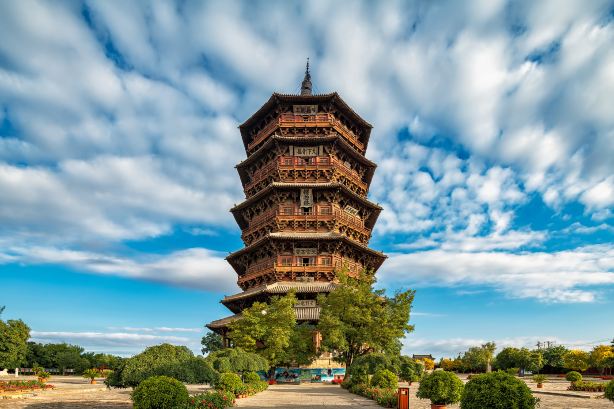
The full name of Yingxian Wooden Tower is Sakyamuni Pagoda of Fogong Temple. It is in the Fogong Temple in the northwest of Yingxian County. The octagonal wooden pagoda has five stories. Except for the high-end stone foundation of the first floor, the rest of the pagoda is made of wood using the traditional craftsmanship of Sunmao. Each layer of the wooden tower is equipped with wind chimes for a pleasant sound when the wind blows.China · Ying County

Pingyao Ancient City
Pingyao Ancient City is approx. 85 km from Taiyuan. The streets, shops, and residences within the ancient city still maintain their traditional layout and appearance, making it one of the best-preserved ancient cities in China. It is also the only ancient county town in China that has successfully been listed as a UNESCO World Heritage Site as an entire city. Pingyao was once the financial center of China during the late Qing Dynasty. Walking through this once-prosperous ancient city, you can feel the essence of Shanxi merchant culture everywhere. The ancient city has six gates in total, with the north gate near Pingyao bus station and the west gate nearPingyao train stationThe south gate and west gate are places with many travelers. Entering the ancient town does not require an admission ticket, but if you want to climb the city wall or visit attractions like the ticket number, you need to purchase a pass for the ancient town. The ancient town is not very large, and walking is enough to explore it all. If you prefer not to walk, you can also take electric bikes. The streets of the entire ancient city are laid out in the shape of the Chinese character "土" (earth). When visiting, you usually enter the city from the West Gate and walk along West Street to Rishengchang Draft Bank, known as the "ancestor of modern Chinese banking". Here you can not only learn about the development history of ancient banking, but also have the old manager in a long robe and mandarin jacket write a draft for you using the early draft method, which is particularly historical. Moving forward is the north-south spanningSouth street, it is the central axis of the ancient city. During the Ming and Qing dynasties,South streetControlling over half of the nation's financial institutions, it was hailed as the "Wall Street of China" in its heyday. Today, it remains a bustling area of the ancient city, known as the Ming-Qing Ancient Street. Most attractions in Pingyao Ancient City are concentrated here, centered around the landmark structure, the Ancient City Tower. Surrounding it are attractions like Xie Tong Qing ticket number (China Banking Museum) and Wei Tai Hou (Ticket number museumAttractions such as Baichuantong, China Escort Museum, Tongxinggong Escort, Weishengchang, China Rare Newspaper Exhibition Hall, and Tianjixiang are available, along with restaurants, musical instrument stores, cafes, and bars. After strolling along the street, you can dine here, buy some souvenirs, and then continue south for more sightseeing. At the Pingyao Ancient City's county government office on the south side of the ancient city, you can see a large number of ancient documents and torture instruments, with daily performances of court sessions; near the Shangdong Gate are the Pingyao Ancient City's Chenghuang Temple andConfucian templeIt is quite grand and meticulously built, with thriving incense offerings where you can burn joss sticks. The Pingyao Ancient City wall is also one of the highlights of the ancient city, being not only majestic but also remarkably well-preserved. Climbing the wall offers a panoramic view of the entire ancient city. Among the gates, the tower of the south gate (Yingxun Gate of Pingyao Ancient City wall) is exquisitely crafted, and this area is close to residential buildings, allowing visitors to observe the daily life of the locals. If time permits, you can walk around the ancient city along the wall to fully appreciate its charm, which takes about an hour. Watching the sunset from the wall in the evening presents a beautiful scene. Besides the ancient town itself, Pingyao has two other major attractions: Zhenguo Temple and Shuanglin Temple. Zhenguo Temple was built without a single nail, with all structures joined by interlocking wooden components. Shuanglin Temple houses over 10 halls containing exquisitely crafted painted sculptures dating from the Yuan to Ming dynasties. It is highly recommended to stay overnight in the ancient town to enjoy its night view. You can also rent a bicycle to explore the small alleys and experience the authentic Pingyao, where the local culture and customs or photography make excellent subjects. Especially during the Chinese New Year, Pingyao is full of festive atmosphere. The town features old courtyards converted into inns, which are usually affordable, with clean and tidy accommodations available for just a few dozen yuan. Additionally, Pingyao is renowned for its beef. In the late Qing Dynasty, Empress Dowager Cixi passed through Pingyao and was so fond of the local beef after tasting it that she designated it as a royal tribute. Shops bearing the name "Guanyun beef" can be seen everywhere in the ancient town, making it hard to distinguish authenticity, and prices are generally high. You may consider buying some outside the town to try or give as gifts to friends and relatives.China · Pingyao County

Xuankong Temple
Xuankong Temple is located between the cliffs of Cuiping Peak in Jinlong Gorge, Hengshan. It was built in the Northern Wei Dynasty and has a history stretching longer than 1,500 years. It is a well-preserved high-altitude wooden cliff building in China. At the foot of Hengshan, from a distance, you can see the Hanging Temple suspended over the mountainside. The entire temple is hung on the steep cliff, skillfully utilizing and building into the concave and convex portions of the cliff, making it exceptionally staggered and yet rhythmic. Visitors walk along the wooden plank road suspended within the temple to feel the magical architectural charm of the Hanging Temple.China · Hunyuan
Free things to do in Hequ


What travellers say about Hequ

M30***79September 12, 2025
5.0
It is worth visiting the Qin, Jin, Meng and Jimingwen Three Provinces Scenic Area, which is a famous ancient place in Hequ County, Xinzhou City, Shanxi Province. It has traditional Chinese culture, as well as Hequ County Wantuo, the Yellow River Niangniang Beach, Xikou Ancient Ferry, Errentai, the River God Temple, and Mifo Cave.
Qin-Jin-Meng Three Provinces Cockcrow Scenic Area

老鹰在飞翔September 16, 2020
5.0
In Fugu County, the northernmost part of Shaanxi Province, and Jungar Banner of Inner Mongolia Autonomous Region, across the river from Hequ County in Shanxi Province, there is a famous scenic spot - "The crowing of cocks can be heard in three provinces". In fact, this is the first bend of the Yellow River as it enters Shaanxi.
Yellow River's Shanxi-Shaanxi Grand Canyon

118***26October 22, 2026
5.0
Laoniu Bay is a place where the Yellow River and the Great Wall embrace each other on the Loess Plateau. The emerald green river meanders gently through the canyon, drawing a near-perfect Taiji Bay; the Ming Great Wall winds down the mountain ridge, quietly meeting the Yellow River at the cliff top. Stone castles, cave dwellings, and knife-cut cliffs intertwine with the gentle shimmering water, creating a scene that is both desolate and beautiful, majestic yet tranquil, like a landscape painting unfolding for thousands of years.
Laoniuwan Yellow River Grand Canyon Tourist Area

还不曾去过倒悬山!July 17, 2022
4.0
Due to the complex terrain and constant wars throughout the ages, Shanxi's population is not very large. In the 41st year of Emperor Qianlong's reign in the Qing Dynasty (1776 AD), the population of Shanxi Province was about 12 million, and by 1953, the population of Shanxi Province was 16 million. Over the past 160 years, the growth rate of Shanxi's population has not been large. This is related to the wars since the late Qing Dynasty, which caused a large number of Shanxi people to migrate out, such as the famous Zou Xikou.
Xikou Ancient Ferry

CW_01October 27, 2026
5.0
The Grottoes was huge, we could finish the entire site with just half a day. It was at least a 30-minute wait to get into major caves, a lot of time was spent waiting in line. However, is it a well-worth experience, spend an entire day there if you can.
Yungang Grottoes

M2v***o7October 28, 2026
5.0
A must-visit spot in Shanxi, with beautiful scenery and unique ancient architectural styles. The wooden dragon carvings in the Holy Mother Hall are especially beautiful, and the painted sculptures inside are even more stunning. The Nanlao Spring is also worth visiting, as are the 3,000-year-old cypress trees. The Huayan Sutra stone carvings are not to be missed, and the ginkgo leaves are perfect for taking photos. I spent four hours there, and the ticket price of 80 yuan was well worth it.
Jinci Temple Museum

M22***80October 28, 2026
4.0
We drove dozens of kilometers to Yingxian Wooden Pagoda. The scenic area is relatively small, mainly focusing on visiting the pagoda itself. The pagoda is definitely worth seeing; the details of the ancient architecture are truly amazing. The guided tour we had was also excellent, providing a fairly detailed understanding of its history. Unfortunately, due to the pagoda's increasingly severe tilt, the upper floors are no longer accessible for visitors.
Yingxian Wooden Pagoda

无锡易纯净化魏宏春October 27, 2026
5.0
Visiting Pingyao Ancient City has always been a dream of mine, because it is the best-preserved ancient city in China and also the most distinctive. Tens of thousands of residents still live in the city today. The hard-working spirit of the people of Shanxi and their banks, which spread throughout the country, are a microcosm of the economy of Qing Dynasty China.
Pingyao Ancient City

martha_hrOctober 27, 2026
5.0
Absolutely fantastic. Datong is a wonderful city and the Hanging Temple is something spectacular. We went at the end of October, so there were no crowds at all. Don't miss it.
Xuankong Temple


