Things to do in Huining
Explore top experiences
Top 10 attractions in Huining

Huining Red Army Meeting Site
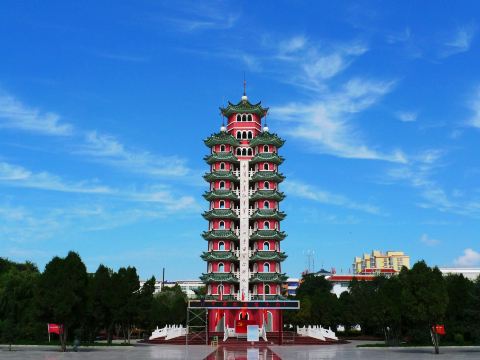
The former site of Huining Huishi of the Red Army is located in the center of the county, covering an area of 42,600 square meters. It is a national key cultural relics protection unit, one of the first 100 patriotic education demonstration bases in the country, one of the first 50 national integrity education bases, and one of the national key cultural relics protection units. Safety education base and national defense education base, national primary and secondary school student research and practice education base. In October 1936, the First, Second, and Fourth Fronts of the Chinese Workers' and Peasants' Red Army joined forces in Huining, Gansu Province. It was a sign of the victory of the Long March, a forward position in the national war of resistance, a model of great unity of revolutionary forces, and a turning point for the Chinese revolution to victory.Huining · 207m from downtown

Red Army Long March Victory Memorial Hall
The Huining Red Army Long March Victory Memorial Hall is a thematic memorial hall with the theme of commemorating the great historical event of the Red Army's three main forces successfully meeting in Huining and the victory of the Long March. It is the only memorial hall in the country that fully reflects the history of the Red Army's Long March. After its completion in October 2006, it became another landmark building in the Red Army Huining Meeting Site. The design and construction of the Huining Red Army Long March Victory Memorial Hall combines antique and modern architecture. The layout is centered on the Meeting Tower and the Meeting Building is a reference. It is located on the left side of the Red Army Huining Meeting Site. The main body of the memorial hall is a two-story, partially three-story, semi-underground frame structure.Huining · 212m from downtown

Garden of Victory of Red Army's Long March
Huining · 1.7 km from downtown


Shapotou Scenic Area
The scenic spot is located 16 kilometers west of Zhongwei City, Ningxia, on the southeastern edge of the Tengger Desert. The scenic spot has successively won honors such as "the first batch of national 5A-level tourist attractions", "the top 500 global environmental protection units", and "the first batch of national tourism standardization demonstration units". The three major cultural elements of the scenic area include the "Yellow River Culture" based on the intangible cultural heritage sheepskin rafts, the "Desert Culture" based on straw grids and Desert Legend Park, and the "Starry Sky Culture" based on the Desert Star Hotel. The tourism resources of these three elements have created a unique and magnificent landscape of "sunset over the long river and starry sky in the desert". The "six major ways to play" are highly praised and loved by tourists. Among them, the Yellow River projects include sheepskin rafting, Huangtengda, Yellow River speedboat, drift boat, passionate sandboarding and high-altitude bungee jumping, etc. The desert projects include Desert Camel, Desert Flying (Stepping into the Blue Clouds), and Sand Sea. Surfing, etc., starry sky projects include stargazing lectures, meteor feasts, sand therapy experiences, star cakes and other special products. In addition, there are also privately customized products for hiking, desert expansion, and educational and entertaining study experiences. The scenic area not only has diverse cultural elements and fun project experiences, but also multi-level accommodation experiences waiting for you: the butler-style Diamond Hotel, the quiet Desert Star Hotel for stargazing, the quiet Yellow River Courtyard in the bustling city, and finally the economical and affordable business-style Tourist Service Center Hotel and other differentiated tourist accommodations for you to choose from.China · Zhongwei

zhong guo gong nong hong jun di yi er si fang mian jun hui shi ji nian ta
Huining · 210m from downtown
Lanzhou Danxia Geological Park
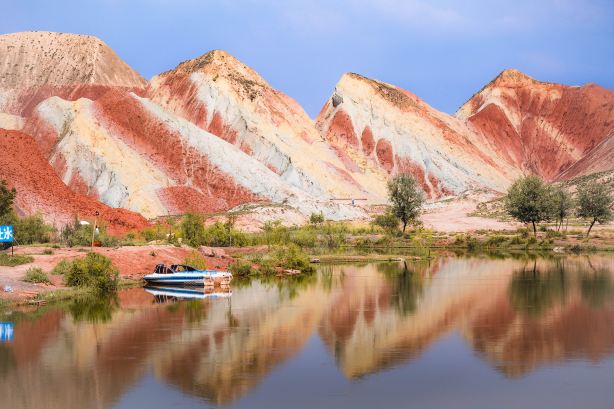
Lanzhou Danxia Geological Park is a key cultural tourism project in Gansu Province and a comprehensive cultural tourism initiative prioritized by the Lanzhou Municipal Committee and Government. Located by the Yellow River, the park is just 13 km from downtown Lanzhou and 30 km from Lanzhou Zhongchuan International Airport, making it one of the closest Danxia landform clusters to a major urban center in China. With a total planned area of 400 sq km and a core visiting area of 25 sq km in its first phase, it ranks among the largest discovered landscapes of its kind in the country. The park primarily features red mountain bay formations, along with spectacular Danxia cliffs, isolated peaks, secluded valleys, narrow gorges, and balancing rocks. Its colorful mountains set against winding waterways create a masterpiece of Danxia landform scenery. The attraction features seven viewing platforms showcasing the Danxia landforms: Silk Road Glow, Silk Road Eagle, Flying Apsaras Exploration, Nine-Colored Danxia, Danxia Reflecting Sky, Emerald Peaks Rippling Sky, and Danxia Summit Scenic View. It also includes the Ancient Silk Road Gateway, Shajing Tribe Cultural Square, Desert Bells Scenic Boulevard, and a 2,550m Danxia boardwalk viewing area. As a key cultural tourism project in the province, Lanzhou Danxia Geological Park adheres to the principles of "ecological protection, green development, preserving original features, and moderate development." Leveraging Lanzhou's unique resource advantages and focusing on the domestic tourism market, it aims to cultivate new growth drivers for Lanzhou's cultural tourism industry and establish a new highland for cultural tourism in the city.China · Yongdeng

Huining Nanchuan Red Army Village Tourist Scenic Area
Huining · 5 km from downtown

Zha Ga Na
Zhagana, also known as Zhagala, is located in Diebu County, Gannan Tibetan Autonomous Prefecture. It is a small Tibetan village surrounded by a circle of pretty cliffs. It has beautiful and magical scenery and is one of the most beautiful places in the entire Gannan Tibetan area. The ancient wooden Tibetan houses in the village are built along the mountain, and the locals work quietly and simply between the hillsides and rivers, forming a beautiful pastoral scenery. Whether you want to sightsee, take photos, or visit the traditional life of the simple Tibetan people, this is a wonderful place that you cannot miss. Zhagana is located in the valley of Yiwa Township, Diebu County. It takes about 1 hour to drive from Diebu County and about 2 hours from Langmusi. Zhagana is suitable for visiting in July and August, when the grassland is green and the scenery is beautiful. Most tourists come from Langmusi when they take the Gannan-Sichuanbei route. The usual time to visit is to arrive in the afternoon of the same day and take a leisurely stroll in the village to enjoy the beautiful scenery. Stay in a Tibetan homestay for one night, and leave the next morning after taking pictures of the early morning clouds and sunrise. In addition, there is a two-day hiking route in the back mountain of Zhagana, where you can rent a horse in the village or walk there. Zhagana Village is divided into four small villages, from bottom to top, they are Dongwa Village, Yeri Village, Dari Village and Daiba Village. Dongwa Village and Daiba Village are about 5 kilometers apart, and there is a winding road connecting the four villages. You can walk or drive to visit and take photos one by one. It takes about 1 hour to walk from the bottom to the top. Driving in from the entrance of the village, the first place you arrive at is Dongwa Village at the foot of the mountain. There is a big stone here called Dashimen. The small hillside next to Dashimen is a good place for taking photos. Here you can look up and take pictures of the beautiful scenery of the village built along the mountain. The back of the village is wrapped by cliffs, and there is a Tibetan Buddhist temple on the top of the village. The scenery is fantastic and beautiful. Dongwa Village has a large population and is also a good place to stay. You can book a stay at a farmhouse here, and then walk or drive to several higher villages to play. It takes about 1 hour to walk to the higher place. Going up the mountain along the road, you will reach Yeri Village. Next to Yeri Village is a vast barley field where you can often see Tibetans busy in the fields. The scene is peaceful and simple. In addition, there is a house in Yeri Village where the famous traveler Joseph Locke once lived for more than a year, but now it can only be visited from the outside. Continue to go up, after passing Dari Village, there is a viewing platform with a wide view, suitable for taking bird's-eye views of the whole village. You can see the whole village and the fantastic rock wall behind. All the houses are old wooden roofs and earthen walls, which look simple and peaceful. Under the cliff, they form a beautiful picture scroll, which is also a wonderful place to take good photos. After taking the panoramic view, you can go back to Dongwa Village for accommodation. Daiba Village is relatively remote and there are fewer scenery to see, so you can skip it. In addition to taking photos in the afternoon, there are many other things to look forward to in Zhagana. Every morning, there are almost clouds and mists between the rock walls on the mountain, and the starry sky is beautiful and brilliant at night when the lights are off, which are good opportunities for taking photos. If you have enough time, you can also take 1-2 hours to climb the back mountain of Dongwa Village to see the temple on the top of the mountain. The houses you pass by along the way are all ancient buildings, and the wooden wedge-rivet structure is even more ancient and peculiar. If you are lucky, you can meet kind locals and be invited to their homes to taste traditional food such as tsampa butter tea and experience the simple enthusiasm of the locals. In addition, there is a two-day hiking route behind the village, which leads to the rarely visited lakes and stone forests with pristine and beautiful scenery. However, this route is only suitable for outdoor enthusiasts and requires camping for one night. When walking this route, you can rent a horse in the village and find a horseman to lead the way. Generally, a horse costs about 150 yuan a day.China · Diebu

Gansu Provincial Museum
Gansu Provincial Museum is a large comprehensive museum centered on the civilization of the Silk Road. Located at a strategic point along the Silk Road and a convergence zone of Han and Tibetan cultures, its collections embody the diverse characteristics of the Central Plains, Western Regions, and the Tibetan Plateau. The three treasured artifacts—the Galloping Bronze Horse, the mural brick of a courier, and the painted pottery vase with a human-head-shaped mouth—serve as iconic representations of the museum. The museum has three floors, featuring permanent exhibitions on themes such as the civilization of the Silk Road, Buddhist art of Gansu, painted pottery of Gansu, paleontological fossils, and revolutionary Gansu. The Silk Road civilization exhibition on the second floor is the museum's centerpiece: the bronze galloping horse unearthed in 1969 from the Leitai Han tomb in Wuwei is displayed here. The horse has three hooves in the air and one stepping on a flying bird, standing steadily on a single hoof. Its image is now the symbol of Chinese tourism. In the same hall, the mural brick depicting a courier from the Wei-Jin tombs in Jiayuguan shows a messenger galloping on horseback, notably without a mouth, symbolizing the need for couriers to "keep their mouths shut." This pattern was later adopted as the emblem of China Post. The exhibition also features a procession of chariots and horses excavated from the same tomb as the bronze horse, along with Han and Tang dynasty silk textiles, gold and silver artifacts, making the prosperity of Silk Road trade vividly tangible. The Buddhist art exhibition hall on the third floor features replicas of caves from the Mogao Grottoes and Maijishan Grottoes, alongside statues, ritual objects, white pagodas, and prayer wheels from both Han and Tibetan Buddhism. Stepping into the hall feels like entering a temple, and this harmonious blend of Han and Tibetan styles is rarely seen elsewhere. On the same floor, the painted pottery exhibition showcases ceramics from cultures such as Dadiwan, Yangshao, and Majiayao, with intricate and fluid patterns like spiral and sawtooth designs. Among them, the painted pottery bottle with a human-head-shaped spout unearthed at Dadiwan in Qin'an, which integrates facial sculpture with the pottery vessel, is a highly popular exhibit. If you're interested in natural history, the paleontological fossils exhibition hall features the impressive skeleton of the Yellow River ancient elephant unearthed in Heshui, and the dinosaur fossils and reconstructed models are also popular with children. The revolutionary Gansu exhibition hall showcases historical artifacts and materials from periods such as the Nanliang base area and the Shaan-Gan-Ning border region, narrating the modern history of this land. The museum houses a large quantity of exhibits, and even a quick tour would take half a day. It's recommended to start with the Silk Road exhibition on the second floor, then proceed to the third floor for Buddhist art and painted pottery, following a logical route. In the exhibition halls, you can scan to listen to the audio guide, and at certain times, volunteers also provide guided explanations.China · Lanzhou

Maijishan Scenic Area
The Maijishan Scenic Area is located in the southeast of Tianshui, Gansu Province, within the Xiaolong Mountain forest area of the western Qinling range. A ridge extending from southwest to northeast separates the Wei River, a tributary of the Yellow River, from the Jialing River, a tributary of the Yangtze, placing them to the north and south respectively. The northern mountains boast majestic peaks, while the southern streams are serene and picturesque, blending both temperaments within the same landscape. The entire attraction comprises five major sections: the Maijishan Cave-Temple Complex, Xianren Cliff, Shimen Mountain, Quxi, and Jieting Hot Springs, with over 180 attractions scattered across more than 200 square km of forested terrain. Ancient Qinzhou scenes like "Maiji mist and rain," "immortals offering lanterns," "night moon at Shimen," and "pine waves in pure land" all originate from these mountains. The core of the attraction is the Maijishan Cave-Temple Complex, renowned alongside the Mogao Caves in Dunhuang, the Yungang Grottoes in Datong, and the Longmen Grottoes in Luoyang as one of China's four great cave-temple complexes. Maiji Mountain is an isolated peak in the Xiaolong range, named for its resemblance to a farmer's wheat stack. Its sheer red cliffs—over 100 m high on the eastern, western, and southern sides—are densely honeycombed with caves, connected by tiered aerial walkways spiraling upward to the Upper Seven-Buddha Pavilion, colloquially called "Sanhua Tower," where railings frame panoramic views of forested peaks. First excavated during the Later Qin period of the Sixteen Kingdoms, the complex saw continuous construction for over 1,600 years through the Northern Wei, Western Wei, Northern Zhou, Sui, Tang, and up to the Ming and Qing dynasties. With over 200 surviving caves and 10,000 clay and stone sculptures, it's hailed as the "Oriental Sculpture Gallery." Particularly lifelike are the life-sized round sculptures, including the smiling novice monk in Cave 133, celebrated as the "Oriental Smile." When rain clears during summer and fall, mist coils around the cliffs, veiling the grottoes in ethereal beauty—a spectacle enshrined as "Maiji mist and rain" among the Eight Views of Qinzhou. The other areas each have their own highlights: Xianren Cliff, located over 10 km from the grottoes, consists of three cliffs, five peaks, and six temples. The halls beneath the cliffs preserve nearly 200 statues dating back to the Northern Wei dynasty, and with the lake reflecting the red cliffs, the old scene of "immortals offering lanterns" has been passed down to this day. Shimen Mountain features a granite peak forest landscape and is known as "Little Huangshan." Juxian Bridge spans the north and south peaks, and on the night of the Mid-Autumn Festival, the bright moon hangs right over the bridge, creating the "night moon at Shimen" scene. Quxi is hidden deep in the Xiaolong Mountain forest, where a stream winds through nine bends, featuring small bridges and flowing water—a secluded spot full of wild charm. The hot spring water in Jieting Ancient Town maintains a temperature of about 40 degrees year-round. The ancient town is said to be related to the Three Kingdoms allusion of "losing Jieting" and also preserves traces of Du Fu's stay in Qinzhou, making it a perfect place to soak and relax after touring the mountains and waters. The major areas are spaced 10 to over 20 km apart, so it's recommended to plan your itinerary priorities in advance. If time is limited, prioritize the Maijishan grottoes. The grotto walkways are suspended with steep and narrow steps, so travelers with acrophobia or limited physical strength should proceed within their capabilities. The walkways become slippery after rain, so take your time ascending—it's also a perfect opportunity to enjoy the mountain mist.China · Tianshui
Free things to do in Huining
Huining Red Army Meeting Site
Huining · 207m from downtownRed Army Long March Victory Memorial Hall
Huining · 212m from downtownGansu Provincial Museum
China · Lanzhou
Lanzhou Old Street
China · Lanzhou
Zhongshan Bridge
China · Lanzhou
Baoji Bronze Ware Museum
China · Baoji
Tengger Desert
China · Zhongwei
Shi-ku Garden in China
China · Baoji
Ganjia Grassland
China · Xiahe
White Pagoda Mountain Park
China · Lanzhou
What travellers say about Huining

netcatAugust 12, 2020
4.0
The Huining Red Army Meeting Site is located on Huining Road, Huining Town, Huining County. The site is 110 meters wide from east to west and 400.6 meters long from north to south, with a total area of about 44,718 square meters. It is a revolutionary site expanded to commemorate the successful meeting of the First, Second and Fourth Front Armies of the Chinese Workers' and Peasants' Red Army. The main buildings of the meeting site include: the Red Army Meeting Building and the ancient city wall, the Red Army Meeting Party Site (Confucian Temple Dacheng Hall), the Three Armies Meeting Memorial Tower, the Huining Red Army Meeting Revolutionary Relics Exhibition Hall, and the Red Army Long March Generals Stele Forest.
Huining Red Army Meeting Site

江差町蔡邕October 5, 2020
5.0
The revolutionary holy land has memorial sites for various Red Army historical events and locations. The scenery is good. After climbing the entire mountain, I relived that red history. The stairs of Chaotianmen are too steep and very tiring to climb, but everything else is good.
Garden of Victory of Red Army's Long March

M33***23October 20, 2026
5.0
When people mention Zhongwei, Ningxia, many immediately think of Shapotou. This is a rare spectacle in China, where the desert and the Yellow River embrace. On one side are rolling golden sand dunes, and on the other, the mighty Yellow River flows ceaselessly. With the distant Gobi Desert and mountains as a backdrop, the natural scenery is rich and layered, making it perfect for family outings and short trips.
Entering the scenic area and standing atop a sand dune, you'll see an endless desert below, with the Yellow River meandering beneath. The stark contrast between the yellow sand and the blue water vividly brings to life the scene described by Wang Wei: "A lone plume of smoke rises straight from the desert, the setting sun sinks round in the long river."
Shapotou offers a wealth of activities, balancing relaxation and excitement, with various activities that can easily fill a day. Most people, having made the trip to the desert, will ride camels, traversing the dunes and experiencing the unique, desolate atmosphere of the desert.
For thrill-seekers, be sure to try the signature activities. Sandboarding is a classic activity at Shapotou. Sliding down the high sand dunes amidst billowing sand provides an exhilarating experience. Other attractions include Yellow River bungee jumping, desert ziplining, and the "Flying Desert" ride, offering thrilling challenges for the most adventurous visitors. The scenic area also features unique desert-themed architecture with avant-garde designs, perfect for taking photos.
The scenic area is divided into two main sections: the desert area and the Yellow River area. It's recommended to explore the desert area first before heading to the Yellow River. At the Yellow River, you can experience riding sheepskin rafts and enjoying the grandeur of the river up close. Along the way, you'll see sculptures of galloping horses and Wang Wei, allowing you to stroll and feel the rich history of Northwest China.
Shapotou Scenic Area

M77***27September 1, 2025
3.0
You can go inside the memorial hall, but you are not allowed to go up to the meeting tower now, it is very ordinary
zhong guo gong nong hong jun di yi er si fang mian jun hui shi ji nian ta

kiu先生October 13, 2026
5.0
The scenic area is large and clean, with a refreshing atmosphere. There are so many animals, the shows are fantastic, the kids had a blast, and the visit was very comfortable. The staff were very welcoming, and the routes were well-designed – it was so convenient! I'll definitely come back next time.
Lanzhou Danxia Geological Park

素年锦时xhlgOctober 21, 2026
5.0
Zhagana is unbelievably beautiful! Surrounded by rocky mountains, the Tibetan village is shrouded in mist in the mornings, like a thin veil draped over it. Standing on the viewing platform, you can see terraced fields stretching out, with yellow rapeseed flowers and green barley, set against the backdrop of shimmering snow-capped peaks in the distance—every snapshot is wallpaper-worthy. The air is filled with the scent of grass and cooking smoke, and yaks graze leisurely. It's so relaxing, you won't want to leave!
Zha Ga Na
M14***99October 6, 2026
5.0
Lina, the lecturer at the Gambo Museum, is exceptionally skilled. During the two-hour learning experience, she demonstrated a thorough understanding of the chronological order and comparative analysis of the artifacts, meticulously integrating historical evolution with everyday life. I look forward to the completion of the new Gambo Museum and visiting it again next time.
Gansu Provincial Museum

M40***13September 16, 2026
5.0
The environment is clean and elegant, the hot spring water is clear and comfortable, the temperature is just right, and you can relax and de-stress after soaking. The service is warm and thoughtful, the price is very reasonable, and the experience is superb.
Maijishan Scenic Area


