
Things to do in Jingtai
Explore top experiences
Top 10 attractions in Jingtai

Yellow River Stone Forest National Geological Park
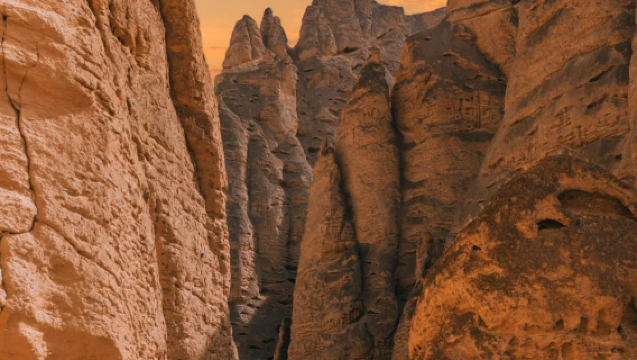
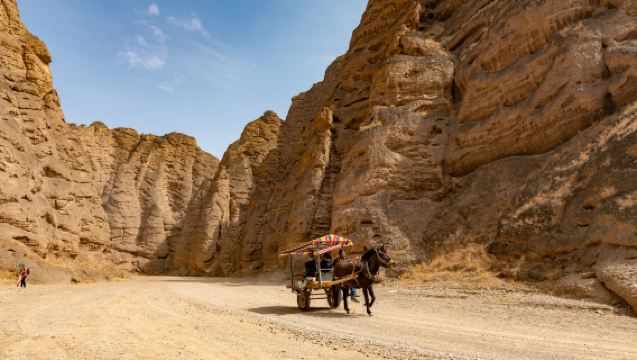
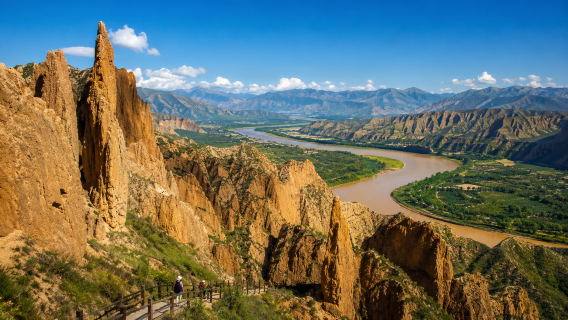
Yellow River Stone Forest National Geological Park is near the Yellow River, southeast Jingtai County, Baiyin City, Gansu Province. It is dominated by a large canyon about 9 kilometers (5.6 miles) long along the Yellow River. There are towering stone forests on both sides of the canyon presenting a very unique landform. The main attraction of the Stone Park is the observation deck at the end of the main grand canyon. In addition to the stone landscape, there is an opportunity to sample many of the local folk customs. The donkey carts in the canyon exemplify these folk customs. Local elderly women lead the donkey carts, often singing northwestern folk songs.Jingtai · 39.3 km from downtown

Yongtai Ancient City
Yongtai Ancient City is located in the Gobi wilderness of Baiyin, Gansu. Built in the 36th year of the Wanli reign of the Ming Dynasty (1608), it was a military fortress constructed by the Ming Dynasty to defend against northern border threats. Viewed from above, the ancient city's outline resembles a giant turtle, hence it is also known as "Yongtai Turtle City": the city's layout is oval, with the city gate facing south and slightly west, resembling a turtle's head; each of the four sides has a barbican, like turtle claws; a series of beacon towers to the north stretch into the distance, like a turtle's tail; and a moat surrounds the city. As an important barrier connecting Lanzhou and the Great Wall defense line during the Ming and Qing Dynasties, at its peak, the city housed over 2,000 soldiers, with auxiliary facilities such as gunpowder depots, fodder depots, and horse stables all in place. Beacon towers stretching for tens of miles toward Lanzhou and the Great Wall can still be traced today. The Qing Dynasty general Yue Zhongqi, said to be a descendant of Yue Fei, was born in the city. He rose to the rank of Governor-General of Sichuan and Shaanxi, and his father, Yue Shenglong, also served as the Provincial Commander-in-Chief of Sichuan. The three generations of the Yue family were all military leaders, bringing fame to this small frontier town. Today, only a few dozen households live in the city, most of whom are descendants of the soldiers who once guarded the border. Loess courtyards, Qing Dynasty residences, and an elementary school stand quietly in the city, and most of the city walls, gates, and barbicans have been preserved to this day. At dusk, the setting sun dyes the rammed earth walls gold, and villagers herding sheep pass by, framed against the mottled earthen walls; after nightfall, there is little light pollution, making it a great spot for stargazing.Jingtai · 19.7 km from downtown

Wufoyan Temple
Jingtai · 20.5 km from downtown

Great Wall
Jingtai · 31.3 km from downtown

Shapotou Scenic Area
The scenic spot is located 16 kilometers west of Zhongwei City, Ningxia, on the southeastern edge of the Tengger Desert. The scenic spot has successively won honors such as "the first batch of national 5A-level tourist attractions", "the top 500 global environmental protection units", and "the first batch of national tourism standardization demonstration units". The three major cultural elements of the scenic area include the "Yellow River Culture" based on the intangible cultural heritage sheepskin rafts, the "Desert Culture" based on straw grids and Desert Legend Park, and the "Starry Sky Culture" based on the Desert Star Hotel. The tourism resources of these three elements have created a unique and magnificent landscape of "sunset over the long river and starry sky in the desert". The "six major ways to play" are highly praised and loved by tourists. Among them, the Yellow River projects include sheepskin rafting, Huangtengda, Yellow River speedboat, drift boat, passionate sandboarding and high-altitude bungee jumping, etc. The desert projects include Desert Camel, Desert Flying (Stepping into the Blue Clouds), and Sand Sea. Surfing, etc., starry sky projects include stargazing lectures, meteor feasts, sand therapy experiences, star cakes and other special products. In addition, there are also privately customized products for hiking, desert expansion, and educational and entertaining study experiences. The scenic area not only has diverse cultural elements and fun project experiences, but also multi-level accommodation experiences waiting for you: the butler-style Diamond Hotel, the quiet Desert Star Hotel for stargazing, the quiet Yellow River Courtyard in the bustling city, and finally the economical and affordable business-style Tourist Service Center Hotel and other differentiated tourist accommodations for you to choose from.Zhongwei · 89.1 km from Jingtai

Kumbum Monastery
Kumbum Monastery is one of the important monasteries of the Gelug (Yellow Hat) sect of Tibetan Buddhism and the birthplace of Tsongkhapa, the founder of the Yellow Hat sect. The monastery features magnificent architecture, abundant treasures, and a strong religious atmosphere, making it one of the more popular travel destinations in Xining. Overview of the visit It has distinct differences in architectural layout compared to Han Chinese Buddhist temples in inland China: the complex here is not symmetrically arranged along a central axis. The monastery is an ancient architectural complex composed of numerous halls, scripture halls, stupas, and colleges, with each sutra hall, main hall, and stupa irregularly distributed on a small hill. Travelers can explore the site in a relatively free manner rather than following a straight path along a central axis. The Great Golden Roof Hall of Kumbum Monastery is the center of the entire architectural complex. It is said that Master Tsongkhapa was born here, and when he was born, his umbilical cord blood dripped on this spot, from which a bodhi tree grew. Later, a stupa was built around the tree, and a monastery was constructed, hence the name. Believers hold that this tree and stupa are the embodiment of the master. The three unique features of the attraction: butter sculptures, murals, and appliqué embroidery. Butter sculptures are made by mixing butter with various pigments to mold and carve into figures of Buddhas, people, flowers, birds, animals, and pavilions. Travelers can admire exquisite butter sculptures at the butter sculpture hall inside the temple (located far from the main gate). Vibrant centuries-old murals can be appreciated in the main halls, corridors, and front galleries of the temple. Appliqué embroidery involves cutting colored satin into desired shapes, such as Buddha figures or animals, stuffing them with wool or cotton, and embroidering them onto cloth hangings. In the temple's great sutra hall, two rare large appliqué embroidery pieces—"Sixteen Arhats Displaying Divine Powers" and "Eight Immortals Crossing the Sea"—hang on either side. The four major religious festivals (based on the lunar calendar): 1. Cham dance (14th day of the first month) and butter sculpture exhibition (15th day of the first month); 2. Cham dance (14th day of the fourth month), Buddha unveiling, and Cham dance (15th day of the fourth month); 3. Buddha unveiling, Cham dance (6th day of the sixth month), and golden Buddha procession (8th day of the sixth month); 4. Full-day Buddha unveiling (22nd day of the ninth month) and Cham dance (23rd day of the ninth month). During these festivals, activities like Buddha unveiling and ritual dances take place, attracting large crowds of devotees and travelers, creating a lively atmosphere.China · Xining

Lanzhou Danxia Geological Park
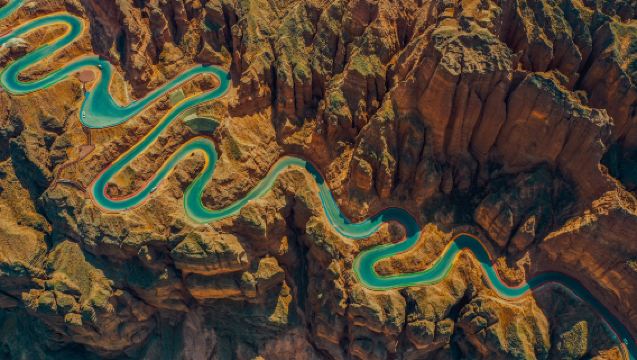
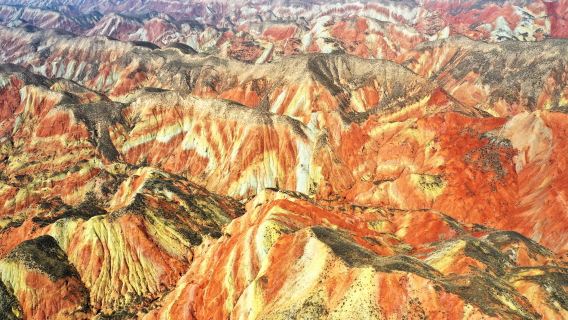
Lanzhou Danxia Geological Park is a key cultural tourism project in Gansu Province and a comprehensive cultural tourism initiative prioritized by the Lanzhou Municipal Committee and Government. Located by the Yellow River, the park is just 13 km from downtown Lanzhou and 30 km from Lanzhou Zhongchuan International Airport, making it one of the closest Danxia landform clusters to a major urban center in China. With a total planned area of 400 sq km and a core visiting area of 25 sq km in its first phase, it ranks among the largest discovered landscapes of its kind in the country. The park primarily features red mountain bay formations, along with spectacular Danxia cliffs, isolated peaks, secluded valleys, narrow gorges, and balancing rocks. Its colorful mountains set against winding waterways create a masterpiece of Danxia landform scenery. The attraction features seven viewing platforms showcasing the Danxia landforms: Silk Road Glow, Silk Road Eagle, Flying Apsaras Exploration, Nine-Colored Danxia, Danxia Reflecting Sky, Emerald Peaks Rippling Sky, and Danxia Summit Scenic View. It also includes the Ancient Silk Road Gateway, Shajing Tribe Cultural Square, Desert Bells Scenic Boulevard, and a 2,550m Danxia boardwalk viewing area. As a key cultural tourism project in the province, Lanzhou Danxia Geological Park adheres to the principles of "ecological protection, green development, preserving original features, and moderate development." Leveraging Lanzhou's unique resource advantages and focusing on the domestic tourism market, it aims to cultivate new growth drivers for Lanzhou's cultural tourism industry and establish a new highland for cultural tourism in the city.China · Yongdeng

Xixia Imperial Tombs
Xixia Imperial Tombs, located in the western suburbs of YinchuanHelan MountainThe Western Xia Mausoleum served as the royal burial site of the Western Xia Dynasty, where several emperors were interred. Today, the entire mausoleum complex contains 9 imperial tombs and over 140 accompanying burial sites, making it one of the largest royal burial grounds in Chinese history by area. The tombs feature a unique inverted steamed-bun shape unlike any other Chinese mausoleums. Additionally, the attraction includes facilities such as the Western Xia Mausoleum Museum, Western Xia Mausoleum - Western Xia Historical Art Gallery, and Western Xia Stele Forest to help visitors understand the historical and cultural significance behind these tombs. The attraction currently has mausoleums No. 1, 2, and 3 open for visitors. Mausoleum No. 3 (the "Tai Mausoleum" of Li Yuanhao, founding emperor of the Western Xia Dynasty) is located relatively close to The Western Xia Mausoleum's Western Xia History Art Museum and Western Xia Stele Forest. The Western Xia Dynasty was established by the Tangut people, with distinct writing systems and customs different from the Han Chinese of the Central Plains. After the dynasty's fall, its cities and history mysteriously vanished into the Gobi Desert, becoming an enduring enigma until modern discoveries and interpretations. The Western Xia Mausoleum Museum houses a rich collection of artifacts from the dynasty, including many precious stone carvings with Tangut script and murals showcasing Western Xia artistic styles. The museum offers free guides that provide fascinating insights into the customs, culture, rise, and fall of this mysterious dynasty, enhancing visitors' experience when exploring the mausoleum. On July 11, 2025, the Western Xia Mausoleum was officially inscribed on the World Heritage List. You can visit the Haowang Mausoleum up close within the attraction. The massive inverted semicircular tomb stands on the wasteland, bringing centuries of history vividly before your eyes, while in the distance...Helan MountainThe rugged ravines of the mountain ridges evoke a profound sense of desolate grandeur and timeless vicissitude. The Western Xia Mausoleum Museum inside the attraction has been newly unveiled. The exhibits are divided into six sections: history of Western Xia, Western Xia culture, Western Xia religious art, Western Xia socio-economy, Western Xia Mausoleum, and preservation & inheritance. Nearly 5,000 artifacts are displayed, including thangka paintings, documents, clay sculptures, bronze and ironware, textiles, and porcelain. Many of these are exquisite cultural relics unearthed during recent archaeological research at the Western Xia Mausoleum.China · Yinchuan

China West Film Studio
Zhenbeibao Western Cinema is located in Xixia District, Yinchuan City. In this studio, which is characterized by simplicity, roughness and desolation, classic films such as "Wrangler", "Red Sorghum", "Journey to the West", "Thorn Mausoleum", "Jin Yiwei" and hundreds of influential film and television films were filmed. In the remaining part, a large number of celebrities from the Chinese film industry have left their footprints here, such as Gong Li, Jiang Wen, Zhang Yimou, Ge You, Zhou Xingchi, Donnie Yen and so on. The cinema consists of three parts: Mingcheng, Qingcheng and Old Yinchuan Street. Tourists can visit the cinema along the "figure 8" route of Old Yinchuan Street. Here, you can see the appearance of Yinchuan in the first half of the 20th century, and eat local traditional snacks such as mutton soup. The Ming and Qing cities in the film city were rebuilt from the military castles left over from the Ming and Qing dynasties. In the Ming and Qing cities, you can see many familiar movie scenes, such as: the gate tower where Sun Wukong and Fairy Zixia are standing in "Journey to the West", the throne of the Bull Demon King, the torture platform of the Tang monk; and the movie "Journey to the West" The Moon Gate in "Red Sorghum", the winemaking workshop where "My Grandpa" urinated after being drunk, the sedan chair that Jiu'er took when he got married, the big vat for wine, and the bowls. There are costumes and props for rent in many places in the studio. Here, you can wear a set of costumes in the play, use the props in the movie, and walk around the scenes of the movie to live the addiction of being a star. Before going to Zhenbeibao Western Studios, you can revisit a few classic movies first, and then go to visit, you will have a different feeling.China · Yinchuan

Qilian Mountains Binggou River Scenic Area
Chairlong lake, at an altitude of 4,008 m, is a sacred natural alpine lake in the Qilian mountains with high elevation and vast area. The lake water, formed by melting snow from the mountains, displays emerald, azure and other colors as the light changes. Backed by the majestic Anigangar snow mountain, the landscape resembles a heavenly pool on earth. The round-trip hiking route is approximately 20 km, featuring wooden walkways and the Hero's slope viewing platform along the way. Successful summiters can receive a dedicated climbing certificate. The entire trail remains pristine with well-preserved natural features, accompanied by meadows, unique rocks and wild flowers, free from excessive commercial development. It's ideal for outdoor hiking enthusiasts and travelers seeking unspoiled natural scenery, offering pure and healing alpine views. The vast native alpine meadow bursts into bloom with purple iris flowers around the Dragon Boat Festival each year, creating a stunning visual spectacle across the wilderness. Gentle wooden boardwalks extend deep into the floral expanse, where cattle and sheep graze leisurely while wild marmots occasionally appear, all framed by distant rolling green mountains under expansive skies. During non-blooming seasons, the lush grassy fields serve as ideal spots for leisurely walks, picnics and aerial photography. With its flat terrain requiring no strenuous climbing, the attraction is easily accessible for seniors and children alike. At sunset when golden light blankets the grassland, the atmosphere becomes magical, making it a prime location for travel photography and camping throughout the year, with each season offering distinct pastoral landscapes. Vast stretches of pristine spruce and juniper forests form alpine woodlands, with wooden boardwalks winding along mountain streams. The area boasts exceptionally high negative oxygen ion levels, earning its reputation as a natural wellness oxygen bar. In spring and summer, lush greenery shades the paths accompanied by babbling brooks and constant birdsong. Come fall, the mountains transform into a breathtaking tapestry of red and gold hues. The interconnected canyons and forest sea provide continuous shade, shielding visitors from summer heat while offering soothing walks. The thriving ecosystem frequently rewards travelers with squirrel sightings and encounters with mountain birds. With gentle slopes suitable for all ages, it's an ideal destination for leisure, relaxation and rejuvenation. Nimela Grand Canyon, meaning "valley of the sun" in Tibetan, boasts unique wonders like "June glaciers with flowers blooming on ice." Glacial streams surge endlessly through the canyon, flanked by rugged rock formations where primitive spruce trees and alpine rhododendrons grow in harmony. A gentle wooden walkway runs the entire length, making for effortless exploration. Legend says this was the habitat of the three-legged golden crow, with dense forest vegetation and abundant negative oxygen ions. With an average summer temperature of just 18°C, it's a natural cool retreat. Afternoon mist often creates rainbows arching across the canyon, offering picturesque views at every step. Combining refreshing air, wilderness charm, and unique glacial landscapes, it's a hidden gem for light hiking. Princess Honghua ranch is the historical site where Princess Honghua of the Tang dynasty once herded livestock. On the vast and gentle alpine meadows, prayer flags flutter in the wind amidst scattered Tibetan tents and herds of yaks, immersing visitors in the rich Huari Tibetan culture. The location offers expansive views with a complete panorama of the Ani Gangkar snow mountain, complemented by cultural activities like Tibetan costume photography and butter-making workshops. Adjacent to the Malanhua grassland and the starting point of Tianchi hiking trails, it serves as an ideal resting spot during travels. At dusk, the setting sun bathes the entire meadow in warm golden hues, while the night sky remains unpolluted by light, providing excellent stargazing conditions. Blending millennia of history, grassland scenery and Tibetan folk customs, the site harmoniously combines cultural heritage with natural beauty. The Aniganggar snow mountain is the main peak of the eastern Qilian Mountains, standing at 4,874 m with perennial snow and crisscrossing glaciers, serving as the source of the entire Binggou River water system. The majestic mountain features alternating ice cliffs and bare rocks, shrouded in year-round mist, exuding a sacred and grand plateau aura. The hiking trail to Chairlonghai Tianchi offers a panoramic view of the snow-capped mountain, with golden sunlight covering the summit during sunrise and sunset, creating a breathtaking spectacle. Meltwater from the mountain flows down the valleys, forming streams that nourish grasslands, forests, and lakes, completing the ecological network of the attraction. As the iconic landmark of this hidden paradise, it presents unique charm in every season and is a must-visit destination for photography enthusiasts. The sea of azaleas is located on the mountainside of the Nimela Gorge, serving as a seasonal attraction in spring and summer. Every June, while remnants of ice still linger in the mountains, vast stretches of alpine azaleas bloom in competition, with clusters of pink-purple and white flowers dotting the evergreen pines and glacial rivers, creating a unique scene where ice and blossoms coexist. The gentle trail is easy to walk, allowing close-up appreciation of the floral branches and distant views of the gorge streams and faraway mountains. With few visitors, the area offers a tranquil escape from crowded hotspots. The floral sea, framed by glaciers and forests, provides rich compositional layers, making it ideal for capturing mountain portraits and stunning landscape shots. This hidden gem is a niche viewing spot, only accessible during the blooming season, making it highly time-sensitive. The great khan's camp is a 1:1 restoration of the Tuyuhun royal camp, faithfully replicating ancient nomadic tents, living utensils, and nomadic scenes to recreate the grassland lifestyle during Princess Honghua's marriage alliance period. The camp displays nomadic artifacts and historical exhibition panels, detailing the millennium-old stories of the Hexi Tuyuhun tribe and Princess Honghua, combining educational value with visual appeal. Located near Princess Honghua's ranch, it offers a convenient stop after exploring the grasslands, providing an immersive experience of ancient nomadic civilization. Unlike purely natural views, it adds profound cultural depth to your itinerary, making it ideal for family-friendly educational trips and history enthusiasts. The Shili gallery is a gentle mountain trail connecting Honghua ranch and Nimeila canyon, featuring minimal elevation changes. Along the way, it unfolds meadows, streams, and pristine pine forests, presenting ever-changing views like a flowing landscape painting. Multiple viewing platforms along the route unlock panoramic vistas of snow-capped mountains, flower fields, and forests with unobstructed sightlines. The entire trail is easy to walk with minimal physical exertion, perfect for leisurely strolls and spontaneous photo stops. Linking two core scenic areas, it serves both as a transit route and an independent attraction, offering richly layered landscapes and exceptional touring comfort throughout. Hidden deep in the Qilian forest lies Banmu Fangtang, a tranquil pond with a mirror-like surface that perfectly reflects the surrounding spruce trees, wildflowers, and distant mountains, blending the landscape and its reflection into a serene, healing scene. Encircled by dense woods that block out the outside noise, this secluded spot remains peaceful with few visitors, making it a hidden gem to escape the crowds. The forest trail passes by here, offering a brief stop to capture atmospheric photos of the water reflections, with soft and elegant lighting. Free from bustling crowds, it's ideal for solitary relaxation and quiet photography, allowing you to fully appreciate the quiet beauty of the forest. This underrated waterside spot is a must-visit highlight along the forest route.China · Tianzhu
Experiences you can't miss in Jingtai
Featured Day tours in Jingtai
View all Day tours![[Departing from Lanzhou] Yellow River Stone Forest & Danxia Landform Day Tour](https://ak-d.tripcdn.com/images/0355z12000o8a9r5f6CA2_C_568_320.jpg?_fr=wc)
5.0/5
· 4 reviewsFree cancellation
Instant confirmation
Book now for tomorrow
Save RUB 62.82
FromRUB 6,218.95RUB 6,281.77
Free cancellation
Instant confirmation
Book now for tomorrow
Save RUB 51.94
FromRUB 5,142.87RUB 5,194.81
Free cancellation
Instant confirmation
Save RUB 197.62
FromRUB 3,754.96RUB 3,952.58
Free cancellation
Instant confirmation
Book now for tomorrow
Save RUB 195.03
FromRUB 3,705.60RUB 3,900.63
Free cancellation
Instant confirmation
Book now for tomorrow
FromRUB 4,940.72
![[Depart from Lanzhou] Yellow River Stone Forest & Shuimo Danxia Private Day Tour](https://ak-d.tripcdn.com/images/0352x12000sh3tjpy28CE_C_568_320.jpg?_fr=wc)
Instant confirmation
Book now for tomorrow
Save RUB 119.7
FromRUB 11,850.94RUB 11,970.64
Free cancellation
Book now for tomorrow
FromRUB 22,162.63
Free things to do in Jingtai
Yellow River Stone Forest National Geological Park
Jingtai · 39.3 km from downtownYongtai Ancient City
Jingtai · 19.7 km from downtownWufoyan Temple
Jingtai · 20.5 km from downtownGreat Wall
Jingtai · 31.3 km from downtownShapotou Scenic Area
Zhongwei · 89.1 km from JingtaiImmediate access, Book now for today, Cancel anytimeKumbum Monastery
China · XiningImmediate access, Book now for today, Cancel anytimeLanzhou Danxia Geological Park
China · YongdengImmediate access, Book now for today, Cancel anytimeXixia Imperial Tombs
China · YinchuanImmediate access, Book now for today, Cancel anytimeChina West Film Studio
China · YinchuanImmediate access, Book now for today, Cancel anytimeQilian Mountains Binggou River Scenic Area
China · Tianzhu
More ways to travel from Jingtai
What travellers say about Jingtai

_We***48September 28, 2026
5.0
The Yellow River Stone Forest is truly awe-inspiring, showcasing the grandeur of Northwest China! The Yinmagou Grand Canyon boasts towering stone pillars and bizarrely shaped rocks on both sides. Climbing to the viewing platform offers panoramic views of the continuous stone forest, the winding Yellow River, and the Longwan Oasis. At sunset, the rocks are bathed in golden light, creating a truly cinematic experience. You can ride a donkey cart through the canyon, listening to the driver sing Northwest folk songs, or experience a sheepskin raft ride to immerse yourself in the Yellow River's charm. The pristine and magnificent natural scenery is perfect for those who appreciate geological wonders and love taking landscape photos—definitely worth a special trip!
Yellow River Stone Forest National Geological Park

水漫三楼September 21, 2026
5.0
Yongtai City Site, located in Yongtai Village, Sitan Town, Jingtai County, Baiyin City, Gansu Province, also known as Guicheng, is a large-scale earthen fortified city built during the Ming and Qing Dynasties, dating back to the 35th year of the Wanli reign (1607). The site is 520 meters long from east to west and 500 meters wide from north to south, covering an area of over 300,000 square meters. The city walls are constructed of rammed earth mixed with sand, reaching a height of 8-12 meters, with a base width of 6 meters and a top width of 5 meters. Semi-circular barbicans were built on the east, west, and north sides of the city. The city gates opened to the south and were surrounded by barbicans. Twelve watchtowers (or ramparts) were also present around the city. Archaeological exploration in 2017 revealed that only the flood control ditches on the east and west sides of the moat remain. Stone tablets and other artifacts were unearthed at the site. This ancient city was an important stronghold in the new border defense system of Gansu during the Ming Dynasty. Construction began in 1607 (the 36th year of the Wanli Emperor's reign) and was completed in 1608 (the 37th year of the Wanli Emperor's reign) under the supervision of Xing Yunlu, the Deputy Military Commissioner. In 1724 (the 2nd year of the Yongzheng Emperor's reign), Yue Zhongqi added the Five-Eyed Well and the Ganlu Pond water system. In 1914 (the 3rd year of the Republic of China), Yongtai Primary School, a school combining Chinese and Western styles with a Gothic influence, was established. It closed in 2014 and was converted into a museum. The ancient city contains ancient architectural complexes such as the Great Buddha Temple, the Zhushen Pavilion, and the Jade Emperor Hall, as well as several memorial archways, and is hailed as a textbook example of ancient Chinese military fortresses. In May 2006, it was listed as a sixth batch of National Key Cultural Relics Protection Units and was designated a Historical and Cultural Village of Gansu Province in the same year.
Yongtai Ancient City

点都不沉默September 24, 2026
4.0
This is a less-visited scenic spot in Jingtai County, Baiyin City, located on the banks of the Yellow River. It takes about an hour by bus from the Dongfang Bathhouse in the county town; for the return trip, ask the driver what time it is, as buses are infrequent. There are a few temple caretakers who work out of love and don't receive a salary. An elderly man guards the entrance to the main Five Buddha Hall; if you want to see the Buddha statues, he will open the temple gate and lead you on a tour, explaining in detail the construction dates of the statues. Unfortunately, two Northern Wei Dynasty statues have been stolen, leaving only one beautifully crafted one. The two Buddha statues in the back corner were built during the Ming Dynasty, and the smaller Buddha statues next to them include both privately and officially commissioned works. At the very front, in the center, is Shakyamuni Buddha; there are actually six Buddhas in total. Admission is free; there's a WeChat donation option at the entrance for those who wish to donate. I scanned a small amount to show my support. You can also climb a short ladder to the top of the mountain, where there is a white jade Shakyamuni Buddha statue, or sit in the pavilion at the summit for views of the scenery below.
Wufoyan Temple

美梦成真123!!October 18, 2020
5.0
The Great Wall will never fall. Although we can't see the high walls, the thick loess piles have already shown our determination to resist foreign invaders.
Great Wall

Anonymous userOctober 14, 2026
5.0
Shapotou truly lives up to its 5A rating; the overall experience exceeded expectations and is highly recommended!
We enjoyed both the Yellow River and desert areas, with seamless transitions between activities. The sheepskin rafts drifted leisurely on the Yellow River, with boatmen singing Northwest folk songs, creating a wonderful atmosphere. Sandboarding allowed for self-controlled speed, making it safe and stress-relieving.
The scenic area is well-managed, with comprehensive facilities. Trash cans, rest areas, and shops are readily available, and the restrooms are clean. The staff are friendly and helpful, always ready to assist.
The core attractions can be covered in half a day, making it excellent value for money. I'll definitely come back next time I'm in Zhongwei!
Shapotou Scenic Area
Anonymous userOctober 13, 2026
5.0
Kumbum Monastery is definitely worth a visit. The scenic area is well-planned, with many beautiful buildings and Thangka paintings. The monastery provides professional guided tours, which are excellent. You can also offer lamps for blessings.
Kumbum Monastery

kiu先生October 13, 2026
5.0
The scenic area is large and clean, with a refreshing atmosphere. There are so many animals, the shows are fantastic, the kids had a blast, and the visit was very comfortable. The staff were very welcoming, and the routes were well-designed – it was so convenient! I'll definitely come back next time.
Lanzhou Danxia Geological Park

156***36October 14, 2026
4.0
The World Heritage Site is definitely worth visiting. Since it was off-season, there weren't many people and the queues were minimal. However, the return trip was quite late, and the long wait for transportation meant it was difficult to get a taxi back to the city center. The management was somewhat chaotic, and the service was inadequate.
Xixia Imperial Tombs
Anonymous userOctober 8, 2026
4.0
It's quite famous, being a filming location for movies like "A Chinese Odyssey" and "Red Sorghum," and the film sets have a strong sense of Northwest China's rugged landscape, making it a good place for movie fans to take photos. However, the overall experience is just average. The park has many dirt roads, is windy and dusty, and sunny. Aside from taking photos, there's not much to see or do. If you're not particularly attached to the movies, don't have too high expectations.
China West Film Studio

姚思圆October 7, 2026
5.0
I went during the National Day Golden Week holiday and stepped into the autumn of the Qilian Mountains. The golden grasslands, the melting snow from the glaciers, and the dense forests were breathtaking. I took photos every step of the way. The only regret was not being able to climb to Tianchi Lake. I will definitely come back next time.
Qilian Mountains Binggou River Scenic Area


