
Things to do in Saint Petersburg
Explore top experiences
Top 10 attractions in Saint Petersburg


Winter Palace
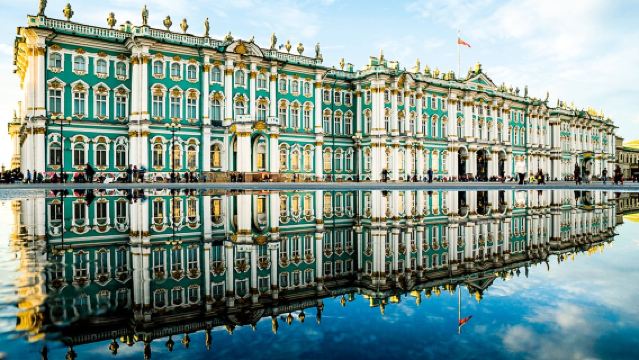
The Winter Palace is located on the banks of the Neva River in Saint Petersburg. Construction began in 1754 under architect Rastrelli. Its Russian Baroque facade, featuring green walls, white columns, and gold reliefs, stretches along the river. Once the long-time residence of Russian tsars, it now serves as the main building of the Hermitage Museum. The museum's collection originated from Empress Catherine II's private art treasury and was expanded by successive tsars. Open to the public since 1852, it houses over 3 million items, including paintings, sculptures, coins, furniture, and crafts. Often ranked alongside the Louvre, British Museum, and Metropolitan Museum of Art as one of the world's four great museums, its collections of ancient Greek vase paintings, Roman sculptures, and Western European paintings are particularly notable—though only a small fraction is on permanent display. The palace contains thousands of rooms, with over 350 galleries open to the public. Most of the museum's masterpieces can be found by gallery number: the ancient Egyptian mummies in gallery 100, the gilded mechanical peacock clock crafted by 18th-century British artisans in gallery 204, da Vinci's "Madonna and child" in gallery 214, the Raphael loggias replicating the Vatican originals in gallery 227, Rembrandt's "The return of the prodigal son" and Rubens' "Perseus freeing Andromeda" in gallery 254, as well as Michelangelo's sculpture "Crouching boy," are all worth a special visit. The exhibition is divided into seven sections: primitive cultural history, ancient Greek and Roman culture and art, oriental ethnic culture and art, Russian culture, western European art history, coins, and crafts, displayed across more than 350 galleries in geographical and chronological order. The exhibition route totals 30 km in length, earning it the title of the world's longest art gallery. Must-see highlights include Egyptian mummies (gallery 100), the peacock clock (gallery 204), da Vinci's "Madonna and child" (gallery 214), Rembrandt's "The return of the prodigal son" (gallery 254), Rubens' "Perseus and Andromeda" (gallery 246), and the Raphael loggias (gallery 227). Galleries 333–350 on the second floor house numerous art treasures from the late 19th and early 20th centuries, including major works by Matisse and Picasso, all well worth seeing.Saint Petersburg · 1.4 km from downtown

Catherine Palace
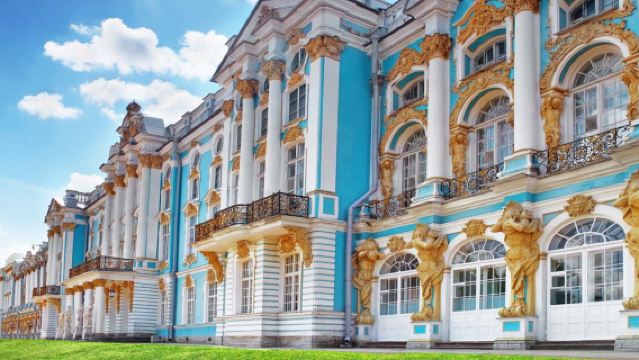
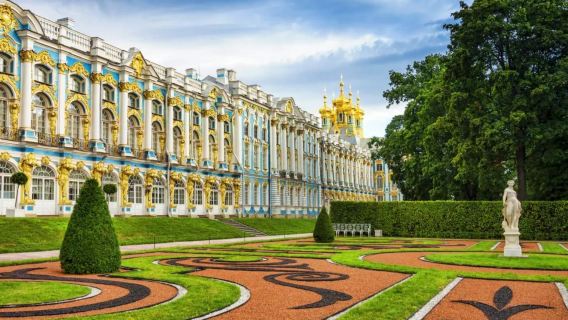
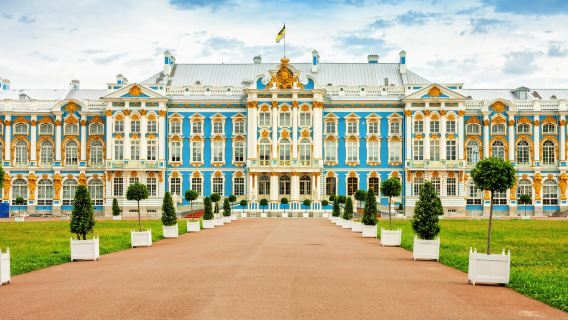
Catherine Palace, also known as Catherine Palace, is located about 25 kilometers south of St. Petersburg. It was the wife of Peter I in 1717, and his daughters Queen Elizabeth, Catherine II, Alexander I and Nicholas. The second favorite suburban palace. In order to show its identity, the area where the palace is located (including the Alexander Palace and the White Tower viewing platform, etc.) was called Tsar Village or Imperial Village after it was built. In 1937, it was renamed "Pushkin Village" to commemorate Pushkin's childhood. "Blonde" Appearance Ekaterina Palace is a two-story palace with a facade of more than 300 meters. It is mainly composed of blue, white and yellow. It is said that these represent the blue eyes of the hostess, White skin and blond hair. The architects added the palace church and the wing for administration, and the top was covered with five splendid and characteristic onion-shaped domes. The radiant interior is different from the fresh temperament outside the palace. The interior of the palace can be described as radiant and shrouded in golden light. From the entrance, go through the promenade on the first floor of the Yekaterina Palace to the main staircase leading to the second floor. The main staircase is more distinctive, with two-way lighting, and the decoration is a bit Rococo style. Marble sculptures "Sleeping Eros" and "Awakening Eros". There are also two exhibition halls at the entrance on the right side of the second floor, where various cultural exhibitions are often held. The magnificent reception hall is in the palace, and the splendid halls are one after another, forming a "golden corridor". Each room is named "Red Column Hall" and "Green Column Hall" according to different colors. The grandiose room in the palace was this spacious reception hall on the right hand side of the main staircase, where Elizabeth received her guests. There are large double-row windows on both sides of the hall, giant mirrors are set between the windows and on the walls on both sides of the hall, all decorations in the hall are gilded, and oil paintings are painted on the huge dome. Such designs are meant to confuse people's senses to cement Elizabeth's godlike status. This is not only her reception hall, but also her game room.Pushkin · 602m from downtown

Savior on the Spilled Blood
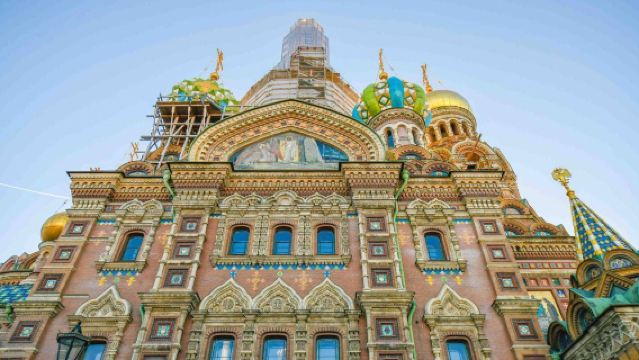
The Cathedral of Spilled Blood is located by the Griboyedov Canal, adjacent to the Mikhailovsky Garden and the Russian Museum. It is a rare authentic Russian architecture in St. Petersburg. In 1811, Tsar Alexander II was killed by members of the "will of the people" due to the failure of the revolution. Between 1883 and 1907, the Cathedral on Spilled Blood was built on the site of the Tsar's death, hence the name. The design of the Cathedral on Spilled Blood draws on the style of the Cathedral of St. Basil's Ascension. The colorful "onion head" roof is very eye-catching. The height of the chapel is about 81 meters high, which is quite majestic. The chapel is also elegant in outline and richly decorated, inlaid with intricate and vividly coloured image patterns, accompanied by richly coloured patterned tiles and enamel bronze panels. Among them, the gilded onion heads are famous all over the world. The whole church can be photographed from the other side of the Riboyetov Canal. The interior of the Cathedral of Spilled Blood is decorated with more than 7,000 square meters of exquisite mosaics, mainly depicting scenes and characters from the stories of the Bible. These mosaics are exquisitely processed from Italian-made marbles of different colors and Russian-made gems. Nearly 30 artists participated in the production, which can be regarded as artistic masterpieces. A marble bust of Shatrov stands where the Tsar was killed, as a memorial to Alexander II. There is a small market next to the Cathedral of Spilled Blood, where there are many souvenirs about the Cathedral and Russian characteristics. Near the church is the entrance to the Mikhailovsky Garden, which also leads to the Russian State Museum. If you have enough time, you can visit.Saint Petersburg · 733m from downtown

Mariinsky Theatre
The Mariinsky Theater is a historic building in St. Petersburg, opened in 1860. It was a famous Russian musical theater of the late 19th century, with Tchaikovsky, Mossorgsky and Rimsky-Korsakov Many of his works premiered here. Today, the Mariinsky Theatre is home to the Mariinsky Ballet, the Mariinsky Opera and the Mariinsky Symphony Orchestra.Saint Petersburg · 2.4 km from downtown

Peterhof Palace
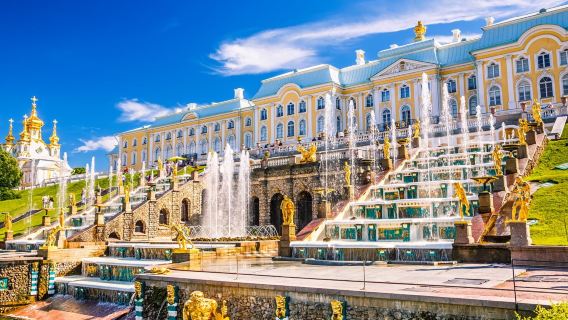
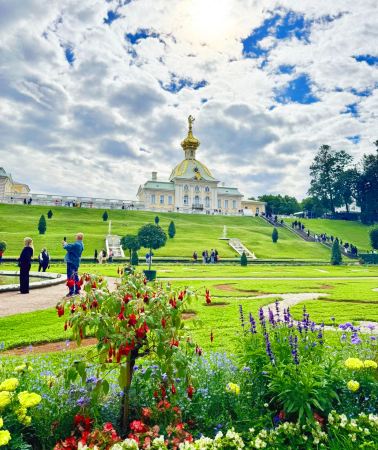
The magnificent summer palace is located in the quiet forest on the southern bank of the Gulf of Finland. It was built by order of Peter the Great in 1714, so it is also called Peterhof. Because of its luxurious and magnificent architectural style, the Summer Palace is also known as the "Russian Versailles". The Summer Palace is an early building in St. Petersburg. In the early 18th century, many large-scale balls, court celebrations and other activities were held here. Peter the Great would come here every summer before his death. The best way to visit the Summer Palace is to take a bus to the entrance of the Upper Garden, visit the Upper Garden, then visit the Lower Garden, and then leave by boat, while enjoying the beauty of the Gulf of Finland along the way. The Summer Palace consists of a French-style upper garden, a lower garden with more than 200 fountains, and many ingeniously designed fountains in the garden, with the Grand Palace in between. There is no need to buy a ticket to enter the upper garden, so tourists who come from land can enjoy the upper garden and buy a ticket to enter the lower garden. There are large grass gardens and sculptures in the upper garden. There are some small fountains here are sculptures depicting fairy tales. When the weather is good, you can see many locals strolling here, children playing, and newcomers shooting wedding dresses here. According to. At the end of the upper garden, you can see the great palace of Peter the Great. In front of the palace is the more striking golden waterfall fountain of the Summer Palace. Although the fountain is only open from May to October every year, no matter what Season, the exterior of these gilded sculptures looks so glorious and beautiful. The famous main fountain is called "Samson Fighting the Lion". In this golden sculpture with a height of 5 meters and a weight of 3 tons, Samson forcibly opened the mouth of a male lion, and its forceful gesture can be described as lifelike. . Behind the waterfall fountain is the grand palace of the Summer Palace. The interior and exterior are very ornately decorated, with gilded domes on both wings. The palace has a celebration hall, a banquet hall and a palace room. At that time, Peter the Great lived on the first floor, and Empress Catherine lived on the second floor. The second floor was luxuriously decorated. The upstairs was very ornately decorated. The columns of the ballroom were decorated with Venetian mirrors. Photography is not allowed in the palace. The overall size is much smaller than that of the Ekaterina Palace and the Winter Palace, and the decoration style is very similar. In addition, additional fees are charged, so many group tourists do not enter the inside to visit, but spend more time. in the lower garden. After coming out of the Grand Palace, we entered the Lower Garden, which spreads out in a fan shape towards the Gulf of Finland by the Grand Palace. Going down from the Grand Palace is a square. The lawn on the ground of the square is trimmed like a fine carpet. Gold-plated sculpture, glittering and lifelike. In the middle of the square is a river, and on both sides of the river are forests with towering trees. About one kilometer down the river is the vast Gulf of Finland. There are men and women in medieval costumes posing in many of the attractions in the lower garden, and you can choose to pay some money to take pictures with them as a souvenir. In addition, there is also the Marry Palace by the seaside of the lower garden, which is the private living place of the tsar.Peterhof · 582m from downtown

St. Isaac's Cathedral
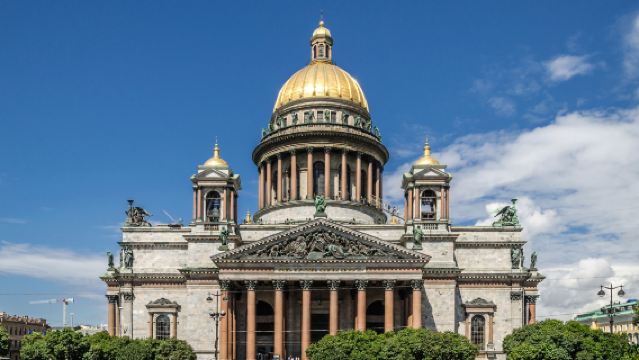
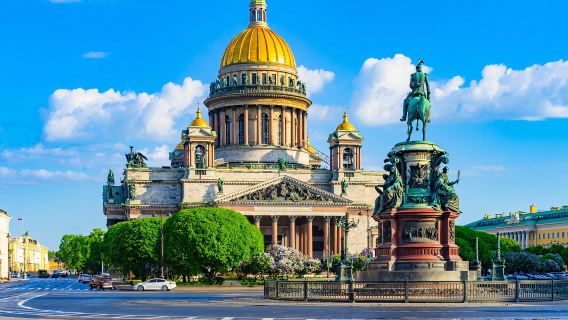
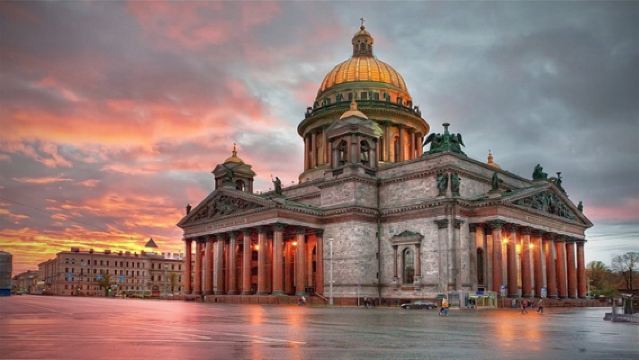
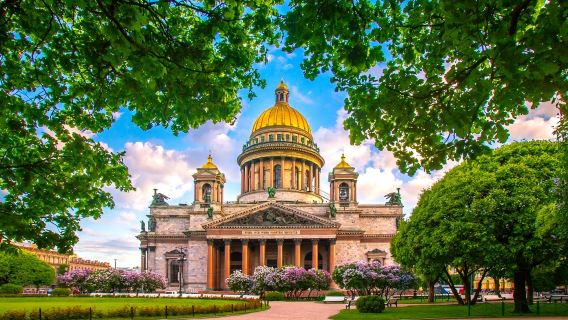
St. Isaac's Cathedral, also known as Isaac's Cathedral, is the largest church in northern Russia. The entire church has a magnificent architectural shape and is regarded as an outstanding work of late Russian classical architecture. It is one of the four cathedrals in the world. The church's altitude of about 100 meters is equivalent to the height of a 30-story building, and its golden "onion head" dome can be seen even in the distance. The entire church space can accommodate nearly 12,000 people at the same time. The majestic and grand architectural style is vividly interpreted. There are more than 10 huge stone pillars on each of the four sides of the church, each stone pillar weighing 120 tons, supporting the carved gables in double rows. The exterior wall of the church is veneered with gray marble, and the interior is decorated with precious minerals such as colored marble, malachite, and lapis lazuli. The gold used for decoration alone amounts to 410 kilograms, including about 100 kilograms used for gilding the outside of the dome. Since its completion in 1858, the church has not been re-gilded, but the dazzling posture of the dome is still enough to amaze visitors. The church was severely damaged in World War II, and it took more than 20 years to restore it to its present appearance after the war. On the polished granite pillars, bullet-riddled imprints can still be seen, which were not repaired during the restoration project, in order to warn future generations not to forget the past.Saint Petersburg · 1.6 km from downtown

Peter and Paul Fortress
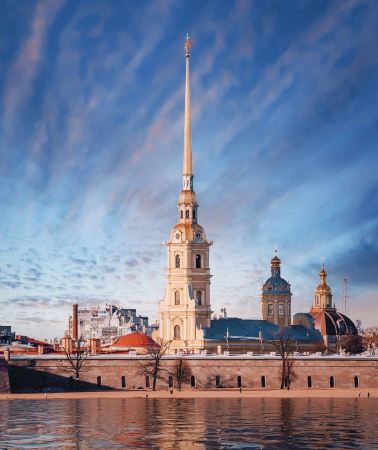
Peter and Paul Fortress is located on the Neva River in the city center and is an iconic ancient building in St. Petersburg. The fortress was laid by Peter the Great on Rabbit Island in 1703, where Peter the Great broke ground earlier to build St. Petersburg, and has stood for more than three centuries. The Peter and Paul Fortress has buildings such as Peter and Paul Cathedral, the Bell Tower, St. Peter's Gate, Peter the Great's Boathouse, the Mint, the Arsenal, the Kronwerk Fortress, and the December Revolutionary Monument. The most famous of them is the Peter and Paul Cathedral, which has a solemn appearance and a magnificent interior, with copper-plated chandeliers and colored crystal chandeliers. The interior walls of the church are decorated with 43 intricately carved woodcut statues. The church houses the tombs of the Russian tsars from Peter the Great to Alexander III, and many princes are also buried here. The gleaming spire of the church's tall bell tower is a symbol of Russian domination on the Neva River and the Baltic Sea Territory. First pass through the Ivanov Gate. The gate leading from the square to the fortress castle is called Petrov Gate, and it is decorated with a double-headed eagle in relief. The rear wall surrounding the fortress is 12 meters high and 2.5 to 4 meters wide, and there are also 6 bastions. Among them, the Nafushkin Fortress facing the Neva River will launch an empty shell into the air at noon every day to announce the time to the residents of the city. On the south side of the fortress are several military-related buildings, which have now been converted into museums. The St. Petersburg History Museum is also located here. This is a large-scale and rich museum that displays historical materials in the area from the Stone Age. It also uses small models, videos, etc. to display, which is very interesting. In addition, scattered along the battlements of the fortress is also a good way to visit the Peter and Paul Fortress, with amazing views of the Neva River and the cityscape on the opposite bank.Saint Petersburg · 2 km from downtown

Cruiser Aurora
Cruiser Aurora is a Russian Imperial Navy cruiser launched in Saint Petersburg in 1900. Its name is derived from the Roman goddess of the dawn, meaning "dawn" or "daybreak." It measures over 120 meters in length with a displacement of nearly 7,000 tons. Its service career spanned the Russo-Japanese War, World War I, and World War II: it survived the brutal Battle of Tsushima in 1905, broke through to Manila where it was interned, and only returned to the Baltic Fleet after the war ended. During the Siege of Leningrad, the ship's guns were removed for city defense, and the hull was damaged by bombing and shelling. It was only preserved to this day after being salvaged and extensively restored following the war. What truly made it world-famous was the night of the October Revolution in 1917, when a blank shot fired from the ship served as the signal to storm the Winter Palace. Because of this shot, it is regarded as an iconic witness to that history, and its silhouette was even minted on the Order of the October Revolution. Today, the Cruiser Aurora is permanently moored on the banks of the Neva River in Saint Petersburg as a museum ship. It has been open to the public since the mid-to-late 1950s and is a branch of the Peter the Great Central Naval Museum. After boarding, you can first stop by the various naval guns, including the 152 mm guns, displayed in their original positions on the deck. Then, follow the steep gangways into the ship to visit the captain's cabin, which retains its early 20th-century furnishings, the engine room with its steam engines and boilers, and the exhibition rooms that recount the ship's history through historical documents, photographs, and artifacts. The light on the river is soft around sunset, making it the perfect time to photograph the ship's silhouette. The corridors inside are narrow and the stairs are steep, so wearing comfortable, non-slip shoes will make your visit easier. After your visit, consider taking a stroll along the riverbank and adding the nearby Peter and Paul Fortress to your itinerary.Saint Petersburg · 2.4 km from downtown

Nevsky pr.
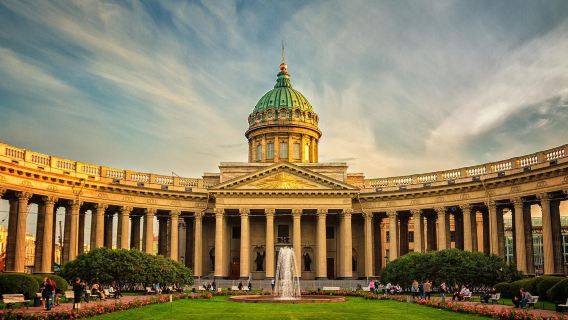
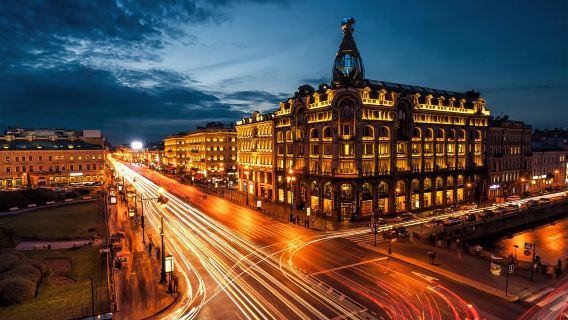
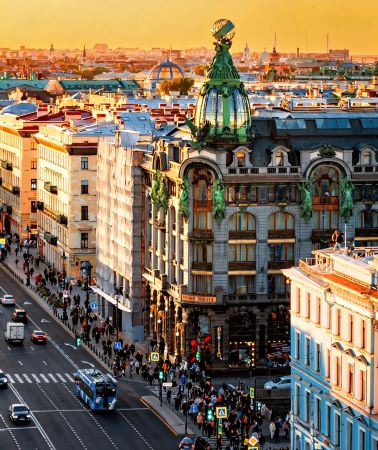
Nevsky pr. is the main street of Saint Petersburg. It took shape in the city's planning in the early 18th century, with a total length of approx. 4.5 km. It starts from the Admiralty on the banks of the Neva River in the west and ends at the Alexander Nevsky Lavra in the east, from which the street takes its name. The street is roughly divided into two sections by Uprising Square in front of the Moscow Railway Station: the western section is dense with shops, cafes, and historic buildings, making it the area where most people stroll; the eastern section was historically known as "Old Nevsky pr." and has a much quieter atmosphere. The highlights of this street are almost all embedded in the facades on both sides: the curved colonnade of the Kazan Cathedral facing the street is highly recognizable; the House of Books in the Singer House and the Eliseevsky Store, famous for its stained glass decorations, are each a sight to behold; the Anichkov Bridge, which crosses the Fontanka River, stands with bronze statues of horse tamers at its ends; turning from beside the Kazan Cathedral into the Griboyedov Canal, you can also see The Bank Bridge, decorated with gilded winged lions. The Literary Cafe, where Pushkin stopped before his duel, is also located on the street, and Gogol even wrote a short story using its name. Walking while looking up at the building facades is more enjoyable than just shopping. The western section is crowded. If you want a quieter scene, early morning or the eastern section is more suitable. The subway runs underground along the street, so you can turn into a station to take a ride whenever you get tired of walking.Saint Petersburg · 1.5 km from downtown

Lower Park
Lower Park is located in Peterhof, a suburb of Saint Petersburg, bordering the southern shore of the Gulf of Finland. It is a royal garden commissioned by Peter the Great in the early 18th century. Known for its magnificent layout of palaces and fountains, it is often called the "Versailles of Russia." The park is divided into two parts: the Upper Garden and the Lower Garden. The Upper Garden is known for its geometric flower beds, mirror pools, and symmetrical hedges, creating a quiet and elegant atmosphere. The Grand Palace lies on the ridge between the two gardens, and the Lower Garden directly in front of it is the highlight of the entire park. The core view of the Lower Garden, the Grand Cascade fountain complex, cascades down the natural slope. More than 60 groups of fountains and over 200 golden statues are layered on the steps, with water mist and golden light intertwined. The central Samson Fountain is famous for its gilded statue of the strongman prying open a lion's mouth. The water jet shoots into the sky, reaching a height of approx. 20 m, symbolizing Russia's victory in the Great Northern War. Remarkably, the entire fountain system does not rely on any pumps; it operates solely on water pressure formed by high-altitude springs and natural elevation drops, a design from 300 years ago that is still in use today. The garden is also dotted with sights such as the Chess Mountain Cascade. The straight Sea Canal extends from the Grand Cascade all the way to the Gulf of Finland, and the end of the tree-lined path along the canal leads to an open sea view. Please note that the fountains only operate during the warm season, typically from May to October each year. If you want to see the spectacular sight of all the fountains running, it is better to visit in summer. If you visit in winter, you can see another kind of quiet beauty where the golden statues are set against the snow.Peterhof · 784m from downtown
Experiences you can't miss in Saint Petersburg
Featured Cultural experiences in Saint Petersburg
View all Cultural experiences
FromCAD 253.83
FromCAD 268.85
FromCAD 268.85
FromCAD 253.83
FromCAD 253.83
Featured Day tours in Saint Petersburg
View all Day tours
4.6/5
· 134 reviewsFree cancellation
Book now for tomorrow
FromCAD 140.10
Free cancellation
Book now for tomorrow
FromCAD 173.22
FromCAD 253.83
FromCAD 268.85

FromCAD 268.85
5.0/5
· 1 reviewFree cancellation
FromCAD 268.85
FromCAD 268.85
Free things to do in Saint Petersburg
Winter Palace
Saint Petersburg · 1.4 km from downtownCatherine Palace
Pushkin · 602m from downtownSavior on the Spilled Blood
Saint Petersburg · 733m from downtownMariinsky Theatre
Saint Petersburg · 2.4 km from downtownBook now for tomorrowPeterhof Palace
Peterhof · 582m from downtownImmediate access, Book now for todaySt. Isaac's Cathedral
Saint Petersburg · 1.6 km from downtownPeter and Paul Fortress
Saint Petersburg · 2 km from downtownCruiser Aurora
Saint Petersburg · 2.4 km from downtownNevsky pr.
Saint Petersburg · 1.5 km from downtownLower Park
Peterhof · 784m from downtown
More ways to travel from Saint Petersburg
Private Tours in Saint Petersburg
View More Private Tours in Saint Petersburg


What travellers say about Saint Petersburg

all189March 4, 2026
5.0
Overall, the price was reasonable, transparent, and allowed for flexible spending. The itinerary and scenery were nice, but with a total of 7 days for the trip, I felt it would be better to add some more meaningful attractions or cities to the itinerary. For example, Vyborg Castle, which is on the border between St. Petersburg and Finland, the town of the Ninth Ring Road, or other worthwhile cities to visit. I also suggest adding one day of genuine free time in the middle of the trip, allowing you to rest or explore the surrounding area on your own, thus reducing regrets and making the trip more enriching and memorable!
Winter Palace

Anonymous userDecember 15, 2025
4.0
It’s a beautiful palace. I recommend that you visit it during summer so you can roam around the yard. I visited in winter so I didn’t get to see the park at it was fully-covered with snow. I chose the earliest time which is 10am as I thought it was just around St. petersburg but it was 1 1/2 hr travel so I came late at 10:45. The automatic ticket gate won’t let me get in bit when I asked the Info counter, she asked me to go the 2nd entrance which is the gate for tours and I was granted entry on that gate.
Catherine Palace

NasnikOctober 15, 2026
5.0
I recently visited the Church of the Savior on Blood in St. Petersburg, and it was one of the most unforgettable experiences of my trip. From the moment I saw its colorful onion domes and intricate mosaics, I was completely amazed. The architecture is breathtaking, and every detail, both outside and inside, feels like a work of art.Inside, the atmosphere is peaceful and inspiring. The walls and ceilings are covered with stunning mosaics that sparkle in the light. I spent a long time looking at the beautiful icons, patterns, and golden details. The history of the place also made a deep impression on me, and I left with greater appreciation for Russian culture and art.The staff were polite, and although there were many visitors, the space still felt calm and special. I would definitely recommend this place to anyone visiting St. Petersburg. Whether you love history, architecture, or beautiful places, the Church of the Savior on Blood will not disappoint. I liked everything.
Savior on the Spilled Blood
Anonymous userMay 16, 2026
5.0
What an amazing moment to watch The Nutcracker here. Spectacular performance!
Mariinsky Theatre

YoYo_0T9A3B0LNovember 2, 2025
5.0
Located in St. Petersburg, Russia, the Peterhof Palace is a world-renowned cultural heritage site due to its magnificent architecture and rich historical background. This palace, once the summer residence of the Tsars, boasts exquisite gardens and luxurious decorations, showcasing royal extravagance and majesty.
Peterhof Palace

SHARMIN KAugust 16, 2025
5.0
The architecture of this cathedral is simply breathtaking, and whereby you can go inside to take photos, attend mass, or purchase tickets & and go up the spiral stairs for an overview of the city! Tickets can be purchased at the ticket booth outside the church at the entrance. Summers are incredibly busy and crowded. This is a must-see as the inside of the church is very colourful! You can also purchase souvenirs inside the church.
St. Isaac's Cathedral

AlexZhAMay 8, 2025
5.0
Peter and Paul Fortress is a historic gem in Saint Petersburg, offering a fascinating glimpse into the city's past. Founded by Peter the Great in 1703, the fortress features impressive architecture and well-preserved structures, including the stunning Peter and Paul Cathedral with its iconic golden spire. Visitors can explore the fortress grounds, which include museums and exhibitions that delve into Russia's history and military heritage. The picturesque views of the Neva River from the fortress add to its charm, making it a perfect spot for photography. Overall, a visit to Peter and Paul Fortress is an enriching experience that combines history, culture, and stunning scenery in one remarkable location.
Peter and Paul Fortress

水漫三楼July 8, 2026
5.0
The cruiser Aurora (translated as "Goddess of Dawn") was the third ship of the Parada-class cruisers built by the Russian Empire. The Aurora was 126 meters long, 16.8 meters wide, and had a draft of 6.4 meters, with a standard displacement of 6,731 tons. Its armament consisted of eight 152mm 45-caliber guns (Model 1892), 24 75mm guns, eight 37mm guns, and two torpedo tubes. It had a crew of 570 and was powered by three steam turbines, achieving a speed of 19 knots and a maximum range of 4,000 nautical miles. The Aurora was launched in May 1900 at the St. Petersburg naval shipyard and commissioned on July 17, 1903, originally belonging to the Baltic Fleet of the Russian Empire. Before the October Revolution of 1917, the ship was moored on the Neva River in St. Petersburg (renamed Leningrad during the Soviet era). At 9:45 PM on November 7th, the ship was ordered to fire, signaling the attack on the Winter Palace. The cruiser Aurora, having survived three revolutions and four wars, is world-renowned for its participation in the October Socialist Revolution in Russia. In 1968, the Soviet government awarded the cruiser the Order of the October Revolution, recognizing the ship's legendary life. The ship remains in the Russian Navy's service, and its onboard museum is affiliated with the Ministry of Defense's Cultural Department.
Cruiser Aurora

Claudia VenterFebruary 10, 2024
5.0
Nevsky Avenue: St. Petersburg's Vibrant HeartbeatExploring Nevsky Avenue in St. Petersburg was a captivating journey through history and culture. The bustling thoroughfare, lined with stunning architecture and lively cafes, offered a glimpse into the city's rich heritage. From iconic landmarks like the Kazan Cathedral to charming boutiques and art galleries, there was something to discover around every corner.The energy of the avenue was infectious, drawing me in with its vibrant atmosphere and diverse array of sights and sounds. A stroll along Nevsky Avenue is a must-do experience for anyone visiting St. Petersburg, offering a true taste of the city's charm and vitality.
Nevsky pr.

Юлия ЯружнаяAugust 30, 2026
5.0
Yesterday I visited the Lower Park of Peterhof! It's simply a miracle - a fairy tale! Magic, brought to life by masters of their craft! The fountains are magnificent! The grounds are well-kept and covered in floral arrangements! Roses - roses everywhere! At the entrance, there's a unique little fountain for children - inside, there's a carousel with ducks and a dog! The alleys are beautiful and clean! You can feed the fish and ducks in the ponds! I definitely recommend visiting!
Lower Park


