Things to do in Yonghe
Explore top experiences
Top 10 attractions in Yonghe


Little Western Paradise
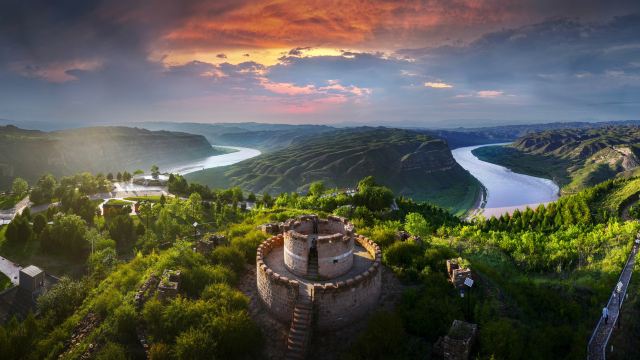
Little Western Paradise is perched atop Phoenix Mountain in Xi County, Linfen, Shanxi Province. This Buddhist temple, originally named the Thousand Buddha Nunnery, was established during the Chongzhen era of the Ming Dynasty. It earned its initial name from the thousand Buddha statues enshrined in its Main Hall of the Great Hero. Later, it was renamed due to the inscription "Entering the Western Paradise" above its gate and to distinguish it from another ancient temple, "Great Western Paradise," located south of the city. Surrounded by mountains on three sides and facing a river in front, the temple is compact yet ingeniously laid out across its upper and lower courtyards. Ascending the stone steps and passing through the secluded "Heavenly Grotto" corridor evokes a sense of gradually entering a Buddhist paradise. The upper courtyard centers around the Main Hall of the Great Hero, flanked by the Manjusri Hall and Samantabhadra Hall. The Main Hall is the temple's crowning jewel: within its modest 100-square-meter space, nearly 2,000 suspended sculptures adorn niches, gables, beams, and rafters, transforming the hall into a museum of suspended sculpture art. Five interconnected niches dominate the rear wall, housing the Medicine Buddha, Amitabha, Sakyamuni, Vairocana, and Maitreya seated on lotus thrones, with ten principal disciples standing beside them. The southern wall depicts Buddhist narratives featuring the Four Sages and Four Heavenly Kings, while the northern wall portrays the 33 celestial palaces of Mount Sumeru. Flying apsaras, divine birds, and musician bodhisattvas dance among clouds on the beams, their gilded polychrome surfaces retaining vibrant hues after centuries. This rare collection of late Ming to early Qing suspended sculptures has gained wider recognition since the temple became a filming location for the popular game Black Myth: Wukong, attracting many travelers for dedicated visits. The lower courtyard also rewards exploration: the Immeasurable Hall faces east, where dozens of bronze Buddha statues interplay with wooden celestial palaces in what was once the monks' meditation hall. Opposite stands the Skanda Hall, housing a single nanmu-carved statue of Skanda. The temple also preserves thousands of volumes from the Yongle Northern Canon, a Ming imperial gift. Visitors are advised to spend extra time in the Main Hall—dim lighting requires slow, upward gazes to appreciate the intricate details of the high-placed sculptures. After exploring both courtyards, one can ascend Solitary Paulownia Peak via the "Seemingly No Path" route behind Skanda Hall, where the Cloud-Touching Pavilion offers panoramic views of the rural landscape below.Xi County · 27.6 km from Yonghe
Yonghe Yellow River Qiankun Bay Scenic Area
The Yellow River flows through Yonghe for 68 kilometers, forming seven large bays from north to south, namely Yingxiong Bay, Yongheguan Bay, Guojiashan Bay, Hehuili Bay, Baijiashan Bay, Xianren Bay and Yujiazui Bay, collectively known as Qiankun Bay. It is the most densely populated and well-developed main stream canyon-type meandering group of rivers in my country. It is the core area for building the Yellow River National Cultural Park and creating an important landmark of Chinese civilization. The Yellow River Qiankunwan Attraction is located in the Shanxi-Shaanxi Canyon, one of the top ten canyons in China. It consists of seven parts: the "0KM" cultural station of the Yellow River No. 1 Tourist Highway, Geshan, Dongzheng Village, Yujiazui Village, Xianren Bay, Yujiazui Bay, and the Yellow River Snake National Geological Museum. Qiankun Bay is a place where rivers and mountains are interdependent, with towering rock walls and a magnificent view of nature. It is a magnificent canyon with a magnificent view of the world. The river bay preserves records of geological evolution from the Triassic Period of the Mesozoic Era, the Quaternary Period of the Cenozoic Era, and the formation of the Yellow River, showing the ancient river and lake environment and paleogeographic evolution characteristics of the Ordos Block. It is said that Fuxi, the ancestor of human civilization, imitated the heavens and followed the earth, deduced the Tai Chi Bagua, and pioneered the Chinese civilization. The Attraction consists of one gorge with two bays, one park with two museums, rich natural resources and profound cultural heritage. It is an important destination for China's Yellow River cultural tourism. A place where dragons roam, a beautiful universe, Shanxi Yonghe Yellow River Qiankunwan Attraction welcomes you!Yonghe · 10.3 km from downtown

Yanchuan Yellow river Qiankun Bay Scenic Area
Qiankun Bay lies in the Tugang Township, Yanchuan County, Yan'an City, and is a national geological park. Stepping out over Qiankun Bay and walking into the Qiankun Pavilion, you will have a panoramic view of the Qiankun Bay. They bay is shaped like the yin-yang fish of the Tai Chi Diagram, surrounded by lush green hills. People live on the mountain and yellow cattle on the grassy shore drink from the river. In addition to its magnificence and beauty, Qiankun Bay also paints a picture of life on the Loess Plateau.Yanchuan · 20.9 km from Yonghe

Emperor Qinshihuang's Mausoleum Site Museum
Emperor Qinshihuang's Mausoleum Site Museum, also known as the Terracotta Army, is located about 1.5 kilometers east of the Mausoleum of the First Qin Emperor and forms part of the extensive necropolis. There were more than a thousand terracotta soldiers unearthed here, each with a different facial expression. Standing before the massive underground army, you will feel the extraordinary might of the Qin Emperor that enabled him to unify six warring states two thousand years ago. The Qin Emperor Ying Zheng began building the mausoleum for himself at the age of 13. Nearly 720000 men and 38 years were required to complete this vast project.China · Xi'an

Xiaoxitian Temple - Mahavira Hall
The Main Hall is a Buddhist structure of significant religious and cultural significance in Linfen City, Shanxi Province. As one of the core buildings of the Xiaoxitian Scenic Area, the Main Hall attracts numerous visitors and believers with its rich history and exquisite architectural art. The Main Hall is the main hall dedicated to Sakyamuni Buddha in a Buddhist temple. It houses a majestic Buddha statue, surrounded by exquisite murals and carvings, showcasing the unique charm of Buddhist art. The hall's elegant architectural style and rigorous structure embody the essence of traditional Chinese architecture. Every year, the Main Hall attracts a large number of believers and tourists for worship and sightseeing. Here, believers can pray and worship, immersing themselves in the profound heritage of Buddhist culture. Visitors can also gain a deeper understanding of Chinese Buddhist culture and history by admiring the artwork and architectural details within the hall. The Main Hall is not only a center of religious belief but also a vital part of cultural heritage. Through its rich history and cultural heritage, the Main Hall of Linfen Xiaoxitian offers a precious opportunity to explore and experience Buddhist culture.Xi County · 27.5 km from Yonghe

The Hukou Waterfall Scenic Area
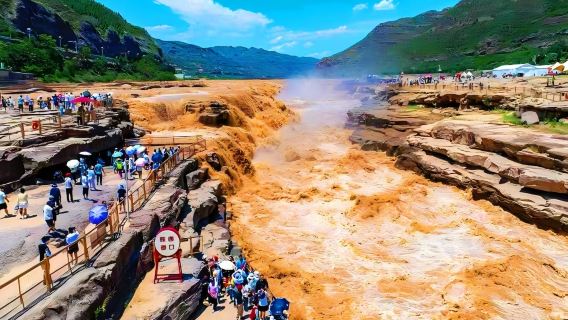
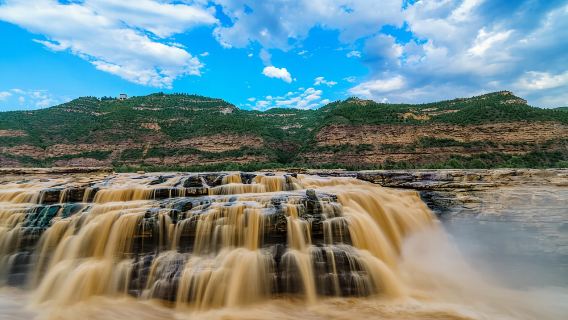
The Hukou Waterfall is a famous waterfall on the Yellow River. The roiling water of the Yellow River roars downward here with great power. The Hukou Waterfall area is divided by the Yellow River. On the west side is Yichuan County, Shaanxi, and on the east side is Ji County, Shanxi. The waterfall is also divided into the Hukou Waterfall (the part of the falls in Shaanxi) and the Shanxi Hukou Waterfall (the part of the falls in Shanxi). Separate tickets are sold for each area. The Shanxi section of the Hukou Waterfall is located 45 kilometers west of the seat of Ji County in Linfen City, Shanxi.Ji County · 71.3 km from Yonghe

Longmen Grottoes
One of the four major grottoes of China and a UNESCO World Heritage Site, the Longmen Grottoes are a trove of 1000 years of Buddhist art treasures. Bounded by the Yi River, the caverns are divided into two sections at East Hill and West Hill. The caverns at East Hill contain mostly Tang dynasty (618-907) works, while the caverns at West Hill were cut out during the Northern, Sui, and Tang dynasties and contain the carvings that are most representative of the site. The Buddha and bodhisattva sculptures that inhabit the caverns are carved into an endless variety of poses and expressions of mercy and kindness, while the caves themselves lend a stately and dignified atmosphere. The artistry of these sculptures is truly a priceless inheritance of Buddhist art.China · Luoyang

Hukou Waterfall tourist area of the Yellow River
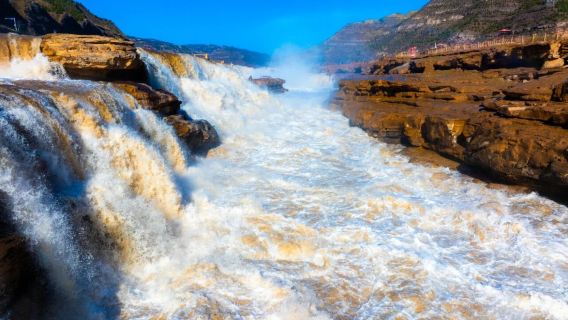
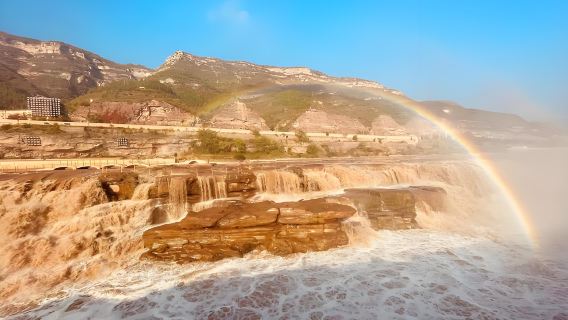
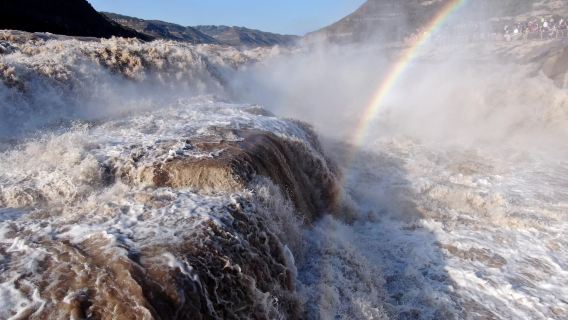
The Hukou Waterfall tourist area of the Yellow River is located on the riverbed of the Yellow River in the Qin-Jin Grand Canyon, where the provinces of Shanxi and Shaanxi face each other across the river. The main stream of the Yellow River, originally hundreds of m wide, suddenly narrows to dozens of m and plunges into a deep trough with a drop of 20–30 m, resembling water being poured from a giant pot—hence the name "Hukou" (Pot Mouth). Due to the large amount of sediment carried by the river, the waterfall presents a rare golden-yellow view: the turbid waves roar down with a sound like distant thunder rolling through the valley, while the rising mist lingers before the cliff, earning the nickname "smoke rising from the water." On sunny days, sunlight casts a rainbow over the waterfall, known as "a rainbow playing in the water." The mist may drench visitors even without wind or rain, creating the wonder called "rainfall under a clear sky." Hukou waterfall is regarded as the symbol of the "soul of the Yellow River" and the spirit of the Chinese nation. In 1938, when poet Guang Weiran crossed the Yellow River, he witnessed the roaring waves of Hukou and the boatmen's chants, which inspired him to create the now-legendary Yellow River Cantata. Liang Heng's essay of the same name was selected for middle school Chinese textbooks, and the back of the fourth series CNY 50 banknote also features this scene. Many first learned about it through textbooks and currency before visiting in person. In the past, cargo ships had to leave the water and bypass the waterfall here, leaving behind the maritime memory of "sailing on dry land." The scenery here varies with the seasons: In early spring, the upstream ice melts and the water level rises sharply, coinciding with the blooming of mountain peach blossoms on both banks, known as the "March peach blossom flood." In midsummer, the rainy season brings abundant water, with muddy waves towering into the sky. After fall begins, the rainy season subsides, and the water becomes high and steady. As the fall breeze sweeps by, rainbows often appear, earning the name "Hukou autumn breeze." In deep winter, layers of ice form along the banks, and overflow freezes into inverted ice peaks, glistening under the sunlight, creating the spectacular "upside-down ice peaks." The viewing platform on the Shaanxi side stretches along the cliff top on the western bank, offering a commanding view of the "thousand-mile Yellow River funneled into one pot" and the ten-mile-long Dragon Trough below the waterfall. During high-water seasons, the mist is heavy, and clothes get soaked quickly, so remember to protect your camera and phone; the boardwalk is slippery, so watch your step while walking and taking photos.Yichuan · 73.1 km from Yonghe

Huaqing Palace
Huaqing Palace attraction is located 30 km east of Xi'an, adjacent to the Terracotta Warriors. Renowned for its timeless hot spring resources and numerous historical events, it has become an iconic cultural tourism attraction of Tang Dynasty palaces in China. Palace scenic spots Huaqing Palace boasts a long history, serving as an imperial retreat for emperors from the Zhou, Qin, Han, Sui, and Tang dynasties. The palace features cultural zones like the Tang Imperial Hot Spring Relics Museum, the Xi'an Incident site—Five-Room Hall, Nine Dragon Lake and Lotus Lake scenic areas, and the Tang Pear Garden Museum. Notable architectural complexes include Feishuang Hall, Wanshou Hall, Changsheng Hall, Huanyuan Garden, and Yuwang Hall. The stele of "hot spring ode" Mount Li hot springs, developed early and favored by emperors throughout history, enjoy the reputation of being "the imperial hot springs under heaven." As far back as the Yangshao culture period 6,000 years ago, the ancient Jiangzhai people began utilizing these springs. With their profound cultural heritage spanning millennia, Mount Li hot springs represent an indispensable part of Chinese historical culture. The stele of hot spring ode in the attraction stands 154 cm tall, 72 cm wide, and 19 cm thick, featuring a coiled dragon design and a trapezoidal base. Engraved by Yuan Chang, the governor of Yongzhou during the Northern Wei Dynasty, the inscription reads, "The hot spring is nature's prescription and the primordial healer of the universe. People from all nations and those suffering from ailments come with provisions to seek relief in its waters." This stele is the earliest surviving written artifact at Huaqing Palace. Tang Imperial Hot Spring Relics Museum This is the site of the bathing pool described in the "Song of Everlasting Sorrow" where Yang Guifei emerged from her bath. After the An Lushan Rebellion, little remained of the original structure. In 1982, while constructing the "Guifei Pavilion," the Lintong County Government accidentally discovered the ruins of a Tang Dynasty bathing pool. After excavation and restoration, the Huaqing Palace imperial hot spring ruins museum was established. This small yet exquisitely designed pool measures 3.6 meters east-west and 2.9 meters north-south, with an oval-like shape. The pool walls are entirely built with bluestone slabs, featuring a two-tiered terrace structure composed of 18 arched stone sections. Inside the pool lies a dedicated bathing stone for Yang Guifei, engraved with the character "Yang." At the center of the pool bottom is a 10 cm diameter water inlet. A white marble lotus pedestal was unearthed here, connecting to both a showerhead above and ceramic water pipes below that linked to the main water source. Due to natural pressure, hot spring water would spray outward through the lotus showerhead, creating a mist effect remarkably similar to modern showers. Adjacent to the Guifei Pool to the east lies Emperor Xuanzong's exclusive imperial hot spring. During the Tang Dynasty, the Nine Dragon Hall stood above this pool, featuring nine white jade-carved dragons spouting water outside. This pool's surface resembles a realistic lotus shape, hence its alternate name "Lotus Pool." Xi'an incident site The five-room hall at the Xi'an incident site in Huaqing Palace is where the Xi'an incident took place. To this day, the glass windows and walls of the five-room hall still bear bullet marks from the fierce battle during the military remonstrance. The desks, chairs, beds, sofas, tea sets, stoves, carpets, telephones, and other office items in each room are replicated and arranged according to their original appearance. Historical events: Beacon fire to deceive the feudal lords In 779 BC, King You of Zhou obtained the beautiful Bao Si, yet she never smiled. To solve this, the king conspired with the treacherous minister Guo Shifu and lit the beacon fires at the Huaqing Palace attraction. The feudal lords across the land saw the signals.Beacon fireHe quickly led his troops to rescue the king, but King You told the feudal lords, "I lit the beacon fires just to make my queen laugh," upon which Bao Si burst into laughter. The feudal lords arrived valiantly but left resentfully. Seeing King You's incompetence and the people's discontent, the Quanrong tribe seized the opportunity to launch an attack. As the enemy troops approached the mountain, King You urgently raised the beacon fires.Beacon fireHe mobilized troops, but none of the feudal lords came to his rescue. King You fled with Bao Si toMount LiHe was later killed by the Quanrong tribe, leaving behind historical anecdotes such as "a smile worth a thousand gold," "losing the kingdom for a smile," and "playing with beacon fires to deceive the feudal lords." And this beacon tower at Huaqing Palace attraction towers at an altitude of 913.6 m.Mount LiThe beacon tower at Huaqing Palace attraction on the first peak of Xixiu Ridge. Su Dongpo composing poetry at Mount Li During the Jiayou era of the Northern Song Dynasty, the Lishan hot springs, meticulously restored by Liu Ziyong and others, became breathtakingly beautiful, attracting crowds of visitors who composed poems and essays to express their nostalgia. Among the countless poetic works, the emerging literary giant Su Shi stood out with his masterpieces like "Lady of Guo's night outing" and "Lishan" during his visit to the hot springs. Xi'an incident The Xi'an incident, also known as the "double-twelfth incident". Zhang Xueliang and Yang Hucheng launched a mutiny at Huaqing Palace, detaining the then chairman of the Military Commission of the National Government. Performance items You can watch a large-scale dance drama at the attraction. ▲ The Song of Everlasting Sorrow is China's first large-scale live historical dance drama created by Shaanxi Tourism Group. Based on Bai Juyi's timeless poem of the same name, it fully utilizes the attraction's resources and employs high-tech stage lighting to combine historical storytelling with live performances, recreating the love story of Emperor Li Longji and Yang Guifei at Huaqing Palace over 1,300 years ago. ▲There is also the historical adaptation "12-12 Xi'an Incident," which vividly and authentically recreates the lesser-known details of the "Xi'an Incident."China · Xi'an

Jinci Temple Museum
Jinci Temple is located on the banks of the Jin River at the foot of Xuanweng Mountain, 25 km southwest of Taiyuan. It was built by later generations to commemorate Tang Shuyu, the founding feudal lord of the Jin State, and served as the ancestral temple of the Jin State. It is often said that "a visit to Taiyuan is incomplete without seeingJinci Templethe saying "a wasted trip to Taiyuan". After getting off at Jinci Temple, the first place you'll reach isJinci MuseumThis is a free park with a pleasant environment, perfect for casual strolling. After about a 10-minute walk through the park, you'll reach the main area of Jinci. Inside Jinci Museum,Jinci TempleThe "Three Treasures" (Xian Hall, Flying Bridge Across Fish Pond, and Shengmu Hall) and "Three Wonders" (Zhou-bai, Nanlao Spring Pavilion, and painted clay sculptures) are must-sees for every visitor toJinci Templeview that everyone must see. Jinci TempleThe "Three Treasures" are connected and located atJinci Templeon the central axis, allowing for a combined visit. Xian Hall is a place for offering sacrifices, with fence-like walls on all four sides, providing good ventilation and coolness. Notably, not a single iron nail was used in the beams and pillars throughout the hall. The Flying Bridge Across Fish Pond is located in front of Xian Hall and was built during the Song Dynasty. The entire view resembles a modern overpass, making it the only existing example among ancient bridges in China. One end of the "Flying Bridge" connects to Shengmu Hall, which is the earliest existing main building in Jinci Museum. The main hall is spacious, and a major highlight is its beam-and-pillar structure without internal columns. Eight wooden carved coiled dragons, appearing ready to fly, are carved on the eight corridor pillars in front of the hall, which, together with the "Flying Bridge Across Fish Pond," present a magnificent sight. Centered around the Hall of the Holy Mother, it's easy to find the "Three Wonders." The painted clay figurines are located inside the Hall of the Holy Mother, with the main statue of the Holy Mother seated majestically in a wooden shrine, dignified and resplendent, while the other 42 attendant statues stand on either side. These figurines are dressed in vibrant colors with varied expressions, including one maidservant dressed as a flower-dan (young female role in Chinese opera), her face half joyful and half sorrowful, evoking complex emotions in viewers. Master Mei Lanfang once stood before this maidservant statue for a long time, carefully studying her posture and inner emotions, and praised it highly. The Zhou Cypress, located north of the Hall of the Holy Mother, was planted during the Western Zhou Dynasty and is over 3,000 years old. The Pavilion of the Never-Aging Spring stands south of the Hall of the Holy Mother, where the source of the Jin River flows continuously year-round. In addition,Jinci TempleInside, there is also the extremely precious "Jinci Inscription" stele, personally composed and handwritten by Emperor Taizong of Tang, Li Shimin. At the southernmost part, you can find the Shifang Fengsheng Zen Temple, which is said to have originally been the villa of Yuchi Gong, a founding general of the Tang Dynasty. In the northern part of the temple complex, the Futu Courtyard houses the Sheli Shengsheng Pagoda. Climbing the pagoda offers a panoramic view.Jinci TempleThe panoramic view is clearly visible.China · Taiyuan
Experiences you can't miss in Yonghe
Featured Day tours in Yonghe
View all Day tours
5.0/5
· 3 reviews· 78 bookedFree cancellation
Instant confirmation
Book now for tomorrow
FromIDR 778,379
5.0/5
· 4 reviews· 25 bookedFree cancellation
Instant confirmation
Book now for tomorrow
FromIDR 859,460
FromIDR 1,133,293
5.0/5
· 2 reviewsFree cancellation
Instant confirmation
FromIDR 2,211,303
5.0/5
· 1 reviewFree cancellation
Book now for tomorrow
FromIDR 5,773,956
4.0/5
· 1 reviewFree cancellation
Instant confirmation
Book now for tomorrow
FromIDR 805,406
5.0/5
· 2 reviewsFree cancellation
Instant confirmation
Book now for tomorrow
9% off
Limited-time sale
FromIDR 1,454,596IDR 1,616,217
Free cancellation
Instant confirmation
FromIDR 2,610,566
Free things to do in Yonghe
Little Western Paradise
Xi County · 27.6 km from YongheImmediate access, Book now for today, Cancel anytimeYonghe Yellow River Qiankun Bay Scenic Area
Yonghe · 10.3 km from downtownImmediate access, Book now for today, Cancel anytimeYanchuan Yellow river Qiankun Bay Scenic Area
Yanchuan · 20.9 km from YongheBook now for today, Cancel anytimeEmperor Qinshihuang's Mausoleum Site Museum
China · Xi'anBook now for tomorrow, Cancel anytimeXiaoxitian Temple - Mahavira Hall
Xi County · 27.5 km from YongheThe Hukou Waterfall Scenic Area
Ji County · 71.3 km from YongheImmediate access, Book now for today, Cancel anytimeLongmen Grottoes
China · LuoyangImmediate access, Book now for today, Cancel anytimeHukou Waterfall tourist area of the Yellow River
Yichuan · 73.1 km from YongheImmediate access, Book now for today, Cancel anytimeHuaqing Palace
China · Xi'anImmediate access, Book now for todayJinci Temple Museum
China · TaiyuanImmediate access, Book now for today, Cancel anytime
What travellers say about Yonghe

Anonymous userOctober 20, 2026
5.0
Xiaoxitian Temple in Xi County, Shanxi Province, also known as Qianfo Temple, is an ancient temple built on the summit of Phoenix Mountain during the Ming Dynasty, exuding a rich historical atmosphere! The main hall is filled with magnificent and resplendent hanging sculptures, with nearly two thousand exquisite and lifelike figures, truly a masterpiece of hanging sculpture. Elders who saw it repeatedly expressed their admiration. There are stone steps leading up the mountain, which elderly people with mobility issues should climb slowly. The main hall is not very spacious, and there are long queues during holidays, so it is recommended to avoid peak times. The ancient architectural art is well worth seeing.
Little Western Paradise

非凡轶生July 17, 2023
5.0
The Yellow River forms five S-shaped bends in the Qinjin Gorge in Yanchuan, from north to south: Xuanwo Bay, Yanshui Bay, Fusi Bay, Qiankun Bay, and Qingshui Bay.
Qiankun Bay Scenic Area integrates sightseeing, leisure, vacation, and scientific investigation. The scenic area has formed a unique Yellow River scenery and canyon wonders with its breathtaking natural wonders and profound cultural heritage. It was rated as one of the "Top Ten Most Beautiful Canyons in China" by "China Geography" magazine.
Yonghe Yellow River Qiankun Bay Scenic Area

M29***12August 7, 2026
4.0
Located in Qiankunwan Town, Yanchuan County, Yan'an City, with a core area of 27.4 square kilometers, it is the core area of the Yellow River Meander National Geopark and has been rated as a national 5A-level tourist attraction.
Yanchuan Yellow river Qiankun Bay Scenic Area
Anonymous userOctober 20, 2026
4.0
Of course it is very interesting to visit but there are too many people visiting at the same time. It is almost impossible to see the exhibitions due to the number of people. Thankfully we booked late and our tickets were for 2.30 pm which meant that we could wait until there were less people around and enjoyed the visit. There's very little value in hiring a guide in my opinion and even less on renting the audio. The guides can't help you get closer the audio recording was patchy. We took a taxi from Xian to the site 108 Y and a local bus on the way back 8Y. We didn't see a place to have a cup of tea. All in all it's worthy but challenging due to the crowds.
Emperor Qinshihuang's Mausoleum Site Museum

常霞客August 20, 2026
5.0
This place truly deserves its reputation as the pinnacle of suspended sculpture art—firstly, its grand scale and exquisite craftsmanship: the hall is filled with large-scale painted suspended sculptures, totaling nearly 2,000 Buddha statues. These statues vary greatly in size, ranging from 3.2 meters tall to the size of a thumb, with full and vivid shapes, serene expressions, and lifelike features. Secondly, its vibrant colors and resplendent gold: the sculptures are made with natural mineral pigments and covered with a large amount of gold leaf, and even after nearly four hundred years, their colors remain vibrant and their golden brilliance is extremely striking.
Xiaoxitian Temple - Mahavira Hall
Anonymous userOctober 20, 2026
5.0
A trip to Hukou Waterfall with friends is definitely worthwhile! The Yellow River rushes down with tremendous force, its roar audible from afar. Standing on the viewing platform, experiencing the Mother River is truly magnificent. The path is relatively smooth, making it easy for older people to view, but the water mist is heavy, and the wind can easily get your clothes wet, so remember to bring a jacket. The scenery is truly breathtaking, perfect for taking photos and creating lasting memories.
The Hukou Waterfall Scenic Area

M31***49October 19, 2026
5.0
The hotel is conveniently located, the rooms are clean and tidy, the bedding is comfortable, the front desk service is warm and attentive, and the facilities are complete. The stay was excellent, and the hotel is great value for money. I would choose this hotel again for my next trip.
Longmen Grottoes

M37***81October 20, 2026
5.0
The hotel was clean and hygienic, and even had an elevator. The receptionists were very helpful, and the breakfast was plentiful. The hotel rooms offered views of the Yellow River and mountains. It was great value for money.
Hukou Waterfall tourist area of the Yellow River

Natalia Valenzuela ubinaOctober 15, 2026
5.0
I’m really happy I visited this place! I thought I would find some gardens and a few temples, but instead, I discovered an entire mountain with a cable car and everything.I started walking around without really knowing where to go, but the area is full of maps, so it’s easy enough not to get lost.I had no idea Chiang Kai-shek’s temporary office was located here. It was truly interesting to visit!Afterwards, I wandered along the streams and lakes, surrounded by nature and temples, until I came across the cable car. I decided to take it only on the way up.From there, I continued hiking to Beacon Hill. There are quite a lot of steps, but the views make it absolutely worth it.After that, I walked all the way back down the mountain. I discovered so much more than I had expected! I even bought some souvenirs and grabbed some KFC along the way.If you’re planning to hike up to Beacon Hill without taking the cable car, be prepared for a very long walk!
Huaqing Palace

星星岩October 20, 2026
5.0
This is a very nice attraction. The ancient buildings are well-preserved. I recommend hiring a guide for a more in-depth understanding. A guided tour takes about 1.5 hours. The area is quite large, so you can explore at your own pace if you have time.
Jinci Temple Museum


