Hangzhou: A Millennium of Poetry in Ink and Water
1. Misty West Lake: A Lake of Natural Beauty, A City of Poetry
Before the morning mist disperses, West Lake dons its cicada-wing veil. Ascending the Broken Bridge, your feet touch the dew-kissed bluestone slabs, as if walking through the lingering melodies of "The Legend of White Snake." By the Crane-Releasing Pavilion on Solitary Hill's northern slope, Lin Bu's hermit spirit of "taking plums as wife and cranes as children" still lingers in the moss-covered couplets. At Su Causeway's spring dawn, six arched bridges pierce the emerald waves like jade hairpins, while weeping willows dip their branches to paint - perfectly illustrating Su Shi's eternal verse "both light and heavy makeup suit her well."
After snow clears on a sunny day, take a painted boat to the Mid-Lake Pavilion. Outside the cabin windows, Leifeng Pagoda's golden top reflects the remaining snow, facing Baoshi Mountain's Baochu Pagoda across the lake, like the history of the Wuyue Kingdom flowing in the rippling waves. As dusk falls, the palace lanterns illuminate the Nine-Curved Corridor in Long Bridge Park, while the evening bell of Nanping resonates through the mist, startling egrets flying over Three Pools Mirroring the Moon. Only then do you understand the captivating sentiment: "Unable to leave Hangzhou behind, half the reason lies in this lake."
2. Lingyin Temple's Zen Traces: A Thousand Years of Buddhist Serenity
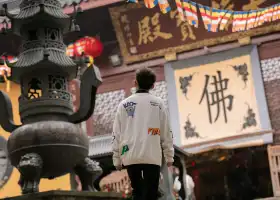
At the mountain gate, you encounter the murmuring Cold Spring, and under the thousand-year-old sweet gum tree's shade stands the stone table where Lu Yu, the Tea Sage of Tang Dynasty, once brewed tea and discussed philosophy. In the Grand Hall, a 24.8-meter statue of Sakyamuni Buddha sits with a gentle smile, while wind chimes harmonize with chanting sutras. Amid the sandalwood incense, the carved beams and painted rafters from the Wuyue Kingdom tell tales of the "Buddhist Kingdom of the Southeast."
Climbing Flying Peak along the stone path, you'll find the smiling Northern Song Dynasty statue of Maitreya Buddha and the wind-blown robes of the Yuan Dynasty Vaishravana. Suddenly, through the cliff carvings, a streak of skylight appears, bringing to life Yuan poet Sadula's verse: "Waking from an afternoon dream in the monk's chamber, window shadows cast by bamboo sway gently." During the Laba Festival, steam rises from copper cauldrons of porridge, as devotees wait quietly with their bowls amidst Buddhist chants and earthly warmth.
3. A Culinary Scroll: Southern Song Dynasty Flavors
In Hefang Street's Dingsheng Cake shop, the sweet aroma of rice wafts through the steam. The master craftsman fills pear wood molds with glutinous rice flour, garnished with sugared osmanthus and pine nuts. Once military provisions for Southern Song soldiers, it now melts like sweet whispers on tourists' tongues. At Kuiyuan Restaurant, the crispy eel noodles feature amber-fried eel pieces simmered with hand-peeled river shrimp, poured over alkaline noodles - a living fossil of the "silver thread cold noodles" recorded in "Dream of Splendor Records."
At Victory River Food Street under nightfall, beggar's chicken slow-cooks in yellow clay for six hours, cracked open to release lotus leaf fragrance mixed with wild aromas. At West Lake State Guest House, Dragon Well shrimp features early spring tea buds unfurling like banners in hot oil alongside translucent jade-like shrimp - one bite brings spring waters flowing across your tongue. Most delightful is the Nine-Curved Red Plum tea brewed with Hupao Spring water, watching tea leaves dance like whirling dervishes, reminiscent of Lu Yu's still-wet ink in "The Classic of Tea" noting "tea production at Qiantang's Tianzhu and Lingyin temples."
4. Elegant Lodgings: Nights of Waterside Zen
At Four Seasons Hotel West Lake, the old mansion walls in Fayun Lane are covered with trumpet creeper flowers, and carved wooden windows open to tea gardens. At dusk, servers bring lotus root powder in celadon bowls, accompanied by Dingsheng cakes wrapped in lotus leaves from Qu Yuan Garden, making one wonder if they've traveled back to Lin'an City from "Tales of Wulin." At Xizhiwo's Sunset Cottage, originally the Baopu Taoist Temple from the Qianlong era, the terrace overlooks Baochu Pagoda's silhouette. Morning mountain mist flows over white walls and dark tiles, like ink diffusing on rice paper.
For modern poetic charm, CIFL Hotel by the Grand Canal transforms a Republican-era factory into a steel forest, where loft room floor-to-ceiling windows frame cargo ships whistling past Gongchen Bridge, creating a fascinating fusion of industrial coolness and canal warmth. At Manluelong's Tea Hidden Guesthouse, the host gathers dewy osmanthus flowers each morning, teaching guests to make osmanthus honey, preserving not just floral fragrance but amber moments of mountain life in ceramic jars.
5. Secret Paths: Twelve Hours Across Time
At 6 AM, Yanggong Causeway's plane tree tunnel stands empty as shared bikes glide past Maojiabu's reed marshes, startling egrets against distant mountains. At noon, take a water bus north along the Grand Canal to visit the Scissors and Swords Museum on Gongchen Bridge's west bank, witnessing how Zhang Xiaoquan scissors forge century-old craftsmanship. At dusk, climb City God Pavilion to watch the setting sun gild Qiantang River Bridge, while Six Harmonies Pagoda's wind chimes ring as the Qiantang Tide rushes to its millennial appointment.
On rainy days, the rammed earth walls of China Academy of Art's Xiangshan Campus exude woody fragrance, while Wang Shu's architectural complex emerges through mountain mist. At corridor turns, you might glimpse students sketching under oil-paper umbrellas, momentarily bringing "Dwelling in the Fuchun Mountains" to life in the rain. Late at night on Nanshan Road, the ivy outside China Academy of Art flows like jade waterfalls under spotlights, while jazz from bars mingles with ancient drum beats from Southern Song Imperial Street, magically merging past and present.
Eternal Narrative of Mountains and Waters
Hangzhou's beauty lives in Su Dongpo's bamboo basket dredging West Lake, in Zhang Dai's night boat wine cup, and in grandmother's osmanthus Longjing tea in ordinary alleys. This city is like a living "Along the River During the Qingming Festival," with every street corner hiding an open scripture, every wisp of tea smoke carrying unfinished verses. When you step on Xiling Seal Society's mossy stone steps or touch Hu Qing Yu Tang's vermillion medicine cabinets, you'll understand: Hangzhou isn't meant to be toured, but to be savored like a slow-paced poem, experienced with all five senses.
The Qiantang River tide is a magnificent spectacle gifted by nature. Its arrival is like a galloping horse, shaking the heavens and earth, while its retreat is like a thousand soldiers disarming and returning to the sea. Watching it is a marvel of the power of nature, a unique hydrological spectacle in China. The feeling cannot be expressed literally; only by experiencing it in person can you truly experience the beauty of nature's power. Please be careful when watching!
The Qiantang River has been the lifeblood of Hangzhou for thousands of years. The Qiantang River's mighty tides and the West Lake's pleasure boats complement each other beautifully; the Wulin Song Dynasty charm, salted silk, tea, and rice, Dongpo pork with Manjianghong, all reveal cultural heritage and the secret to wealth. As the tide of internationalization ebbs and flows, the people of Yiwu embrace the world. Zhejiang cattle, Hangzhou is the bull's head 🌹👍
Qiantang River is not only famous and beautiful in the tide, but now both sides of the Qiantang River in Hangzhou have been built into a beautiful garden in the bustling urban garden. Walking along the river in the morning light and evening breeze is the most cost-effective enjoyment! The happy life of the people is a stable, peaceful, within reach, a popular, ordinary...
**《Qiantang River Travel Guide》** **Destination Introduction**: Qiantang River is the largest river in Zhejiang Province and is famous for its spectacular Qiantang River Tide. It not only has magnificent natural scenery, but also rich history, culture and food. **Best Travel Time**: The Qiantang River Tide is generally the most spectacular on the 18th day of the eighth lunar month, but you can see the tide from the first to the fifth day and the fifteenth to the twentieth day of each lunar month, so you can choose the travel date according to your schedule. **Preliminary Preparation**: - Book air/train tickets and plan your transportation in advance. - Book a hotel near the Qiantang River Tide Viewing Point or with convenient transportation. - Prepare comfortable sports shoes, cameras, sunscreen products, etc. **Itinerary** - Day 1: - Morning: Arrive in Hangzhou, check in at the hotel and take a short rest. - Noon: Taste Hangzhou specialties such as Dongpo Pork and Beggar Chicken in a restaurant near the hotel. - Afternoon: Go to the West Lake in downtown Hangzhou to enjoy the lake and mountains and feel the gentleness of Jiangnan. - Evening: stroll around Hefang Street, experience the ancient customs of Hangzhou, and taste various snacks. - Day 2: - Morning: Take transportation to Yanguan Tide Watching Scenic Area. It is recommended to arrive early to occupy a favorable position for tide watching. - Noon: Enjoy lunch in or around the scenic area. - Afternoon: Visit Yanguan Ancient Town to learn about the local history, culture and folk customs. - Evening: Return to downtown Hangzhou. - Day 3: - Morning: Go to Jiuxi Yanshu, stroll along the forest trails, and enjoy the natural scenery. - Noon: Taste local farm dishes. - Afternoon: Prepare to return and end the pleasant Qiantang River trip. **Tip for Tide Watching**: - Learn about the tide time of the day in advance. You can get accurate information through the official website or consult the scenic area staff. - Pay attention to safety, follow the instructions of the on-site staff, and do not cross the safety cordon. - Bring a telescope to better view the tide view in the distance. **Food recommendations**: - West Lake Water Shield Soup: smooth and tender, with a fresh and fragrant taste. - Longjing Shrimp: fresh and tender shrimp, fragrant Longjing tea. - Lotus Root Powder: delicate and sweet. **Transportation Guide**: - You can choose to travel by subway, bus or taxi in the city. - You can take a special bus or rent a car to go to the tide-watching point. I hope this guide can help you have a pleasant and unforgettable journey in Qiantang River!
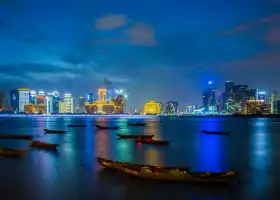
Hangzhou's favorite night tour place, direct subway access! What a city! Come to Hangzhou and want to play at night Highly recommend Qiantang River Night Tour Citywalk ✔️You can see the natural landscape of Qiantang River and major landmark buildings Big Lotus, Hangzhou Gate, Sun and Moon (Hangzhou International Conference Center and Hangzhou Grand Theater) ✔️Watch a Qianjiang New City Light Show, which lasts 15 minutes and is very shocking 📍Location: City Sun. 🚇Subway: Civic Center Subway Station . Qianjiang New City Light Show: 🕤2 shows every night on Friday and Saturday, at 19:30 and 20:30; 1 show every night from Sunday to Thursday, at 20:30 Note: This is daylight saving time,
Yanguan Town, located on the edge of Hangzhou, is an ancient town with a history of more than 2,000 years. As early as the Han Dynasty in China, it began to sun salt and make salt, so it was named Yanguan. Walking in Yanguan Old Street, there are many shops. The Qinglou, Haishen Temple, Jinyong Academy and Wang Guowei's former residence are well preserved. Yanguan Ancient City is a good place to watch the tide. Every year, the Qiantang River tide on August 18 of the lunar calendar is a wonder in the world. On this day, the tide of people is surging like the tide.
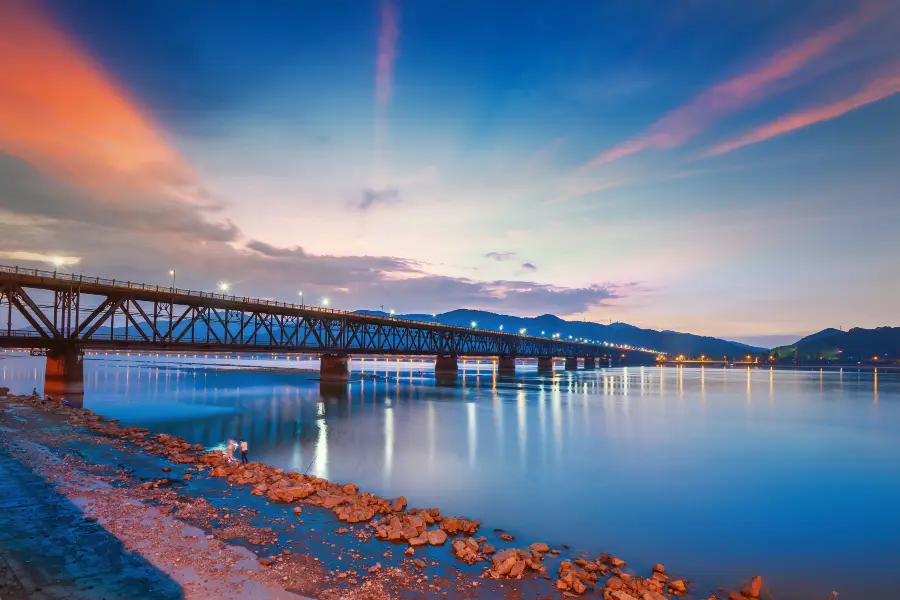
Qiantang River, known as Zhejiang in ancient times, has its full name "Zhejiang", also known as "Zhijiang". Generally, the Fuyang section of Zhejiang Province is called Fuchun River, and the Hangzhou section of the lower reaches of Zhejiang Province is called Qiantang River. Qiantang River, first known as Shanhai Jing, is one of the main birthplaces of Wu-Yue culture because it flows through ancient Qiantang County (now Hangzhou). Qiantang River is the largest river in Zhejiang Province. It is the naming source of Liangzhe Road in Song Dynasty and the provincial name of Zhejiang Province when it was founded in early Ming Dynasty. Beiyuan Xin'an River is 588.73 kilometers long and Majinxi River is 522.22 kilometers long in the upper reaches of Nanyuan Qujiang River. From its source, it flows through southern Anhui Province and Zhejiang Province. The basin covers an area of 55,058 square kilometers and flows into the East China Sea through the Hangzhou Bay. On the Qiantang River, the order from west to East is Qiantang River Bridge (1st Bridge), Fuxing Bridge (4th Bridge), Xixing Bridge (3rd Bridge) and Qiantang River Second Bridge (2nd Bridge). Among them, Qiantang River Bridge is a double-deck railway and highway bridge, Xixing Bridge does not take freight cars, and the second bridge is also a highway railway bridge. Qiantang River, the largest river in Zhejiang Province, flows from west to East into Hangzhou Bay and into the East China Sea. Qianjiang tidal bore is a natural wonder in the world. It is caused by the centrifugal effect of gravity of celestial bodies and the rotation of the earth, together with the special topography of Hangzhou Bay trumpet. We entered through the main entrance of Yunqi Bamboo Trail, then went up Wuyun Mountain, and then came down from Jiuxi. We were caught up with the flood on August 18 of the lunar calendar. We watched the tide on the River Road West of Qiantang River Bridge in Jiuxi, and our legs and feet were weak. The day before, I went to Qianjiang Century City in Xiaoshan District, the main venue of the 11th Summit of the leaders of the Group of Twenty (G20) in Hangzhou International Expo Center, and then went to Wentao Road to see the Hangzhou Grand Theatre in Qianjiang New Town on the North Bank of the Qiantang River and the area of the Hangzhou International Conference Center in the Great Golden Globe. Now, there is a light show in this area at night. It's good to watch the light show across the Qiantang River.
1. Zhejiang No. 1 Pier Night Tour (Hangzhou) Features : The century-old pier has been renovated and restarted, featuring the "cruise + drone" night tour mode. Take the "Sunny West" to enjoy the light show on both sides of the Qiantang River (Olympic Sports Center, City Balcony, etc.), the whole journey is 70 minutes, including AR interaction and drone performances, and the cabin provides river view dining that combines Hangzhou cuisine and Western cuisine. Recommended crowd : Family tourists, photography enthusiasts, and night leisure experiencers. Tips : Currently, there is only one night tour per day, it is recommended to make an appointment in advance; theme flights 1 will be added in the future. 2. Haining Yanguan Tide Watching Resort Features : World-class natural wonders, the tide is the most spectacular around the 18th day of the eighth lunar month, and you can watch the "first-line tide" and "turning tide" and other forms, the waves are several meters high, and the sound is like thunder. Recommended crowd : Natural landscape enthusiasts, cultural and historical fans (related to the legend of Wu Zixu). Tips: Check the tide time in advance for the best tide-watching period. The scenic area is well-equipped but crowded during the peak season. 23. 3. Wenyan Wharf (Xiaoshan) Features: The 2-yuan ferry crosses the Qiantang River. The river is like an "orange sea" at sunset, which is suitable for shooting literary blockbusters; fresh river food can be purchased near the wharf. Recommended groups: tourists with limited budgets, photography enthusiasts, and local life experiencers. Tips: The operating hours are 6:00-17:00. It is recommended to go on a sunny day. 3. 4. Hangzhou City Balcony Features: Free light show (every Tuesday, Friday, and Saturday night), integrating the modern buildings of Qianjiang New City with the river view, with a shocking visual effect. Recommended groups: city night view enthusiasts and parent-child families. Tips: The specific time of the light show may be adjusted. It is recommended to confirm the arrangement on the day. 3. 5. Recommended niche check-in spots Haixing Village (Haining): Few people, quiet, small crabs can be observed on the beach, and the green forest road is suitable for cycling or walking3. Jiangdong Bridge Section (Qiantang District): The most beautiful runway along the river view, there are citizen activities in the summer night, and the atmosphere is relaxed3. Baita Park + Liuhe Pagoda (Shangcheng District): Climb the Liuhe Pagoda to overlook the Qiantang River Bridge, the retro train and cherry blossom season in the park are worth checking in3. Summary and suggestions Natural wonders first: Yanguan tide watching (best in autumn)24. Night tour experience: Zhejiang's first wharf "Qingxizi" 1. Cost-effective choice: Wenyan Wharf Ferry + City Balcony Light Show3. Niche avoid the flow of people: Haixing Village, Jiangdong Bridge Campground3. For more dining recommendations, please refer to the high-end Jiangsu and Zhejiang cuisine around West Lake (such as Jinsha Hall and Hubin 28 Chinese Restaurant)4.