
Things to do in Huangnan
Explore top experiences
Top 10 attractions in Huangnan


Kanbula Global Geopark
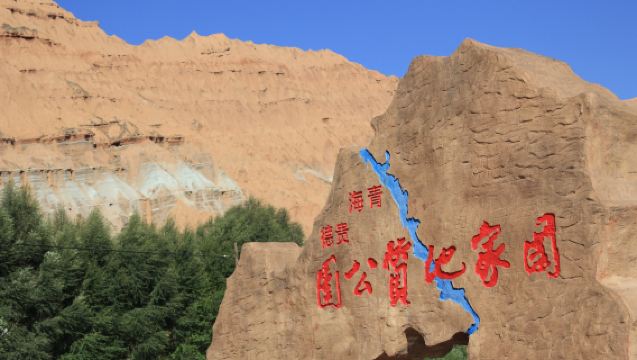
Kanbula National Forest Park is located in Jianzha County, Huangnan Prefecture, Qinghai Province, about 110 kilometers away from Xining. The Attraction is centered on the Yellow River Reservoir formed by the Lijiaxia Dam. The reservoir is emerald green and clear, surrounded by red and steep Danxia landform peaks. The scenery is very spectacular and it is a popular niche tourist destination in Qinghai. Kanbula Forest Park is very large, with a depth of dozens of kilometers. The main entrance of the Attraction is on the east side. After entering, you can take a shuttle bus or a Cruise to visit, which is divided into water and land tours and lake tours. In addition, if you come from Guide, you can also enter from the back door of the Attraction on the west side, which is more convenient.Jainca · 33.6 km from downtown

Longwu Temple
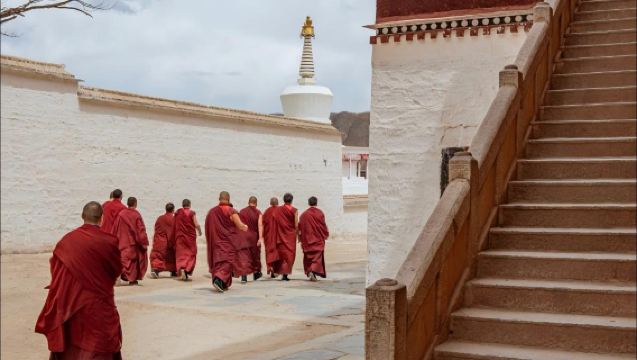
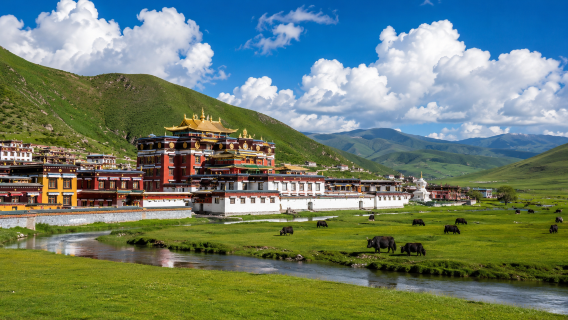
Longwu Temple is located on the southwest side of the county seat of Tongren County, Huangnan Prefecture. It was built in the Yuan Dynasty and is one of the famous Tibetan Buddhism temples in Amdo Tibetan area (Qinghai and Gansu area). Labrang Monastery is an ancient Tibetan Buddhist monastery. When visiting Longwu Temple, you can watch the magnificent Tibetan Buddhist temple complex, learn the story of Tibetan Buddhism, and watch many exquisite thangkas. It is a good tourist destination. More importantly, it is quieter and purer than the Ta'er Temple, which is a good choice for tourists who like quietness. Like ordinary Tibetan Buddhist monasteries, Longwu Temple is composed of many scattered buildings. The main hall in the scenic area is the Great Scripture Hall of Wensi College, which is equivalent to the Mahavira Hall of Chinese Buddhism. There will be monks debating scriptures here every afternoon, and you can come and watch. Other buildings in the temple mainly include Tiannv Hall, Lingta Hall, Guanyin Hall, Wenshu Hall, Quwa Hall, etc., which can be viewed one by one. The special feature here is the Thangka works. Since Tongren County is a famous hometown of Regong art, the Thangka here is exceptionally beautiful and worth visiting. There are also some resplendent Buddha statues in the courtyard of the temple, which can be viewed.Tongren · 1.1 km from downtown

Guomari Castle
Tongren · 6.4 km from downtown

Aqiongnanzong Temple
Aqiong Nanzong Temple is located in the central scenic area of Danxia landform in Kambura National Forest Park. It is a Nyingma monastery of Tibetan Buddhism. It is a historic site where an eminent monk lived and has a history of more than 1,000 years. Here the peaks are protruding, the mountains are peculiar, the trees are green, the springs are gurgling, and the scenery is very magnificent. To the northeast of the monastery stands a towering and steep Nanzong Peak, which is as extraordinary as Mount Huashan. To the north of her, there is a stone-stepped mountain path that is the only one that can reach the peak. Most of them are excavated from the cliff. Passing through, some sections are almost straight up and down from the cliff, as steep as climbing a cloud ladder. From the stone path to the top, you can see an ancient temple hidden in the pines. This ancient temple is composed of five small grottoes. Some of these grottoes are naturally formed, and some are excavated. The cave door passes through. The velvet is repaired, the eaves are on the mountain, and it is elegant and beautiful. Climbing to Nanzong Peak and overlooking, the magnificent Kambra scenery is unobstructed.Jainca · 31.7 km from downtown

Sengge Shong Yago
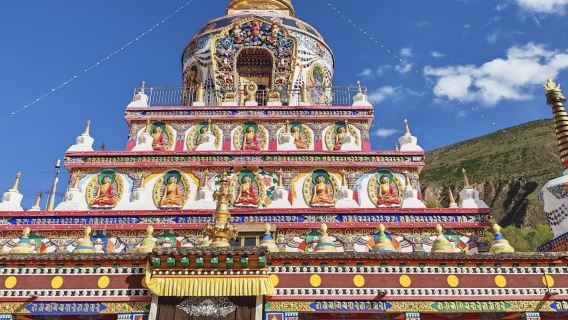
Wutun Xia Temple is also known as "Senge Yang Xia Temple". In Tibetan, it is called "Gedan Phuntsok Qulin", which means "good and perfect Dharma continent". The Wutun Xia Temple has a Dajing Hall, a Maitreya Hall, a Dharma Protection Hall, a tea house and a courtyard. The building covers an area of about 80 acres. The important cultural relics in the temple include provincial cultural relics such as the sandalwood carving of Maitreya Buddha in the Qing Dynasty, and there are five Shakyamuni Buddha hair relics that are said to have been invited from India. In addition, there are more than 1,000 monks' relics offered as offerings. The temple has a collection of Buddhist scriptures such as "Kangyur" and "Dangyur", with a large number of more than 7,000 copies. Outside the monastery, there are eight white pagodas named "Eight Pagodas of Liberation", all of which were donated and built by Wutun villagers. Wutunxia Temple has many decorative patterns with Tibetan national characteristics, mainly some wooden walls and partitions, as well as interior decorations and daily utensils. This pattern art has largely jumped out of the scope of Buddhist art. The signs of a secular development are clear. Dharma Assembly Post: The Dharma Hui at Wutunxia Temple starts every year on the eighth day of the first lunar month.Tongren · 6.2 km from downtown

Chaka Salt Lake
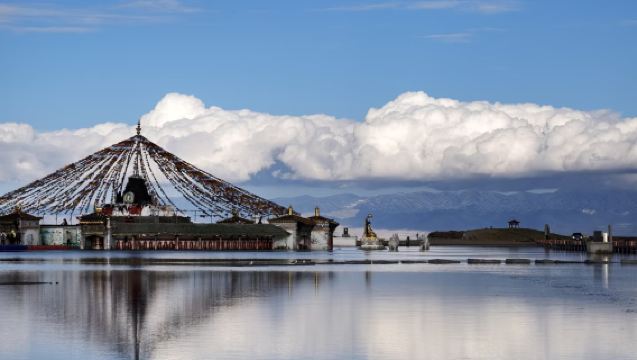
Chaka Salt Lake is a 3,000-year-old salt field with highly saline water that naturally crystallizes into a white surface, beautifully reflecting the sky, clouds, and mountains on the opposite shore. Visitors can walk barefoot on the lake to observe and photograph their reflections, creating a mirror-like illusion of the sky. On sunny days, Chaka Salt Lake boasts highly crystallized waters where you can see a thin layer of brine covering the pristine white salt lake, creating clear and pure reflections. In the sculpture area of the attraction, you'll find the stone-carved Goddess of the Salt Lake, along with around a dozen other massive salt sculptures depicting figures like Maitreya Buddha and Genghis Khan. Walk along the path to the lakeshore, and you'll see the pristine white Chaka Salt Lake, perfect for exploration. A railway extends into the lake, with its starting point serving as the boarding area for the small train. Ride it to the deeper parts of the lake, where the scenery is even more breathtaking.China · Ulan

Wutun Shangsi
Wutun Shang Temple is called "Sang Ge Xiong Hua Dan Qun Jue Lin" in Tibetan, which means auspicious law and wealth continent. It is an affiliated temple of Longwu Temple. Founded in 1645 AD, the temple houses the hair of Sakyamuni, the relics of Master Fazong, various statues, Thangkas and other cultural relics. The monastery is the birthplace of "Regong Art". Most of the monks are good at painting, clay sculpture and carving, and the old artists there are enthusiastic to teach apprentices, so it is called "Regong Art School". Wutun Shang Temple is not very impressive in appearance. The main buildings are only a large scripture hall, a Sakyamuni Buddha hall and a Maitreya Buddha hall. Walking into the Buddhist hall of the Buddhist scripture hall, I realized its extraordinaryness only after being dazzled. A lifelike Buddha statue shone with golden light in the dim light. Except for the ground, almost all the space was filled with countless murals and thangkas. Full to the brim. Dharma Assembly Post: The Dharma Hui at Wutunxia Temple starts on the fifth day of the first lunar month every year.Tongren · 5.4 km from downtown

Kumbum Monastery
Kumbum Monastery is one of the important monasteries of the Gelug (Yellow Hat) sect of Tibetan Buddhism and the birthplace of Tsongkhapa, the founder of the Yellow Hat sect. The monastery features magnificent architecture, abundant treasures, and a strong religious atmosphere, making it one of the more popular travel destinations in Xining. Overview of the visit It has distinct differences in architectural layout compared to Han Chinese Buddhist temples in inland China: the complex here is not symmetrically arranged along a central axis. The monastery is an ancient architectural complex composed of numerous halls, scripture halls, stupas, and colleges, with each sutra hall, main hall, and stupa irregularly distributed on a small hill. Travelers can explore the site in a relatively free manner rather than following a straight path along a central axis. The Great Golden Roof Hall of Kumbum Monastery is the center of the entire architectural complex. It is said that Master Tsongkhapa was born here, and when he was born, his umbilical cord blood dripped on this spot, from which a bodhi tree grew. Later, a stupa was built around the tree, and a monastery was constructed, hence the name. Believers hold that this tree and stupa are the embodiment of the master. The three unique features of the attraction: butter sculptures, murals, and appliqué embroidery. Butter sculptures are made by mixing butter with various pigments to mold and carve into figures of Buddhas, people, flowers, birds, animals, and pavilions. Travelers can admire exquisite butter sculptures at the butter sculpture hall inside the temple (located far from the main gate). Vibrant centuries-old murals can be appreciated in the main halls, corridors, and front galleries of the temple. Appliqué embroidery involves cutting colored satin into desired shapes, such as Buddha figures or animals, stuffing them with wool or cotton, and embroidering them onto cloth hangings. In the temple's great sutra hall, two rare large appliqué embroidery pieces—"Sixteen Arhats Displaying Divine Powers" and "Eight Immortals Crossing the Sea"—hang on either side. The four major religious festivals (based on the lunar calendar): 1. Cham dance (14th day of the first month) and butter sculpture exhibition (15th day of the first month); 2. Cham dance (14th day of the fourth month), Buddha unveiling, and Cham dance (15th day of the fourth month); 3. Buddha unveiling, Cham dance (6th day of the sixth month), and golden Buddha procession (8th day of the sixth month); 4. Full-day Buddha unveiling (22nd day of the ninth month) and Cham dance (23rd day of the ninth month). During these festivals, activities like Buddha unveiling and ritual dances take place, attracting large crowds of devotees and travelers, creating a lively atmosphere.China · Xining

Lanzhou Danxia Geological Park
Lanzhou Danxia Geological Park is a key cultural tourism project in Gansu Province and a comprehensive cultural tourism initiative prioritized by the Lanzhou Municipal Committee and Government. Located by the Yellow River, the park is just 13 km from downtown Lanzhou and 30 km from Lanzhou Zhongchuan International Airport, making it one of the closest Danxia landform clusters to a major urban center in China. With a total planned area of 400 sq km and a core visiting area of 25 sq km in its first phase, it ranks among the largest discovered landscapes of its kind in the country. The park primarily features red mountain bay formations, along with spectacular Danxia cliffs, isolated peaks, secluded valleys, narrow gorges, and balancing rocks. Its colorful mountains set against winding waterways create a masterpiece of Danxia landform scenery. The attraction features seven viewing platforms showcasing the Danxia landforms: Silk Road Glow, Silk Road Eagle, Flying Apsaras Exploration, Nine-Colored Danxia, Danxia Reflecting Sky, Emerald Peaks Rippling Sky, and Danxia Summit Scenic View. It also includes the Ancient Silk Road Gateway, Shajing Tribe Cultural Square, Desert Bells Scenic Boulevard, and a 2,550m Danxia boardwalk viewing area. As a key cultural tourism project in the province, Lanzhou Danxia Geological Park adheres to the principles of "ecological protection, green development, preserving original features, and moderate development." Leveraging Lanzhou's unique resource advantages and focusing on the domestic tourism market, it aims to cultivate new growth drivers for Lanzhou's cultural tourism industry and establish a new highland for cultural tourism in the city.China · Yongdeng

Qinghai Lake
Qinghai Lake is called "Qinghai Lake" in Tibetan (meaning "blue sea"). Located in the northeastern part of the Qinghai-Tibet Plateau, within Qinghai Province, it is formed byQilian MountainsDatong Mountain,Riyue Mountain and South Qinghai MountainFormed by fault subsidence, it is one of China's largest inland lakes and the origin of Qinghai Province's name. The lake covers a vast area, with a circumference of approx. 360 km. Its waters are boundless, azure, and ethereal. Surrounded by mountains, the lakeshore blends into expansive grasslands. Qinghai Lake boasts spectacular views and numerous attractions, making it a key destination in Qinghai. Natural environment: Qinghai Lake features a plateau continental climate with abundant sunlight and intense radiation. Winters are cold, summers are cool, warm seasons are brief, and cold seasons are prolonged. Spring brings frequent strong winds and sandstorms. Rainfall is scarce, concentrated in the warm season, with distinct wet and dry periods. This climate creates unique beauty in each season. The lake's color shifts with weather and light, sometimes displaying multiple hues in a single day. Scenery varies by season, with the ideal visiting period from April to August. July and August are particularly stunning, as vast rapeseed fields bloom along the shore, their golden yellow contrasting beautifully with the endless blue waters. In addition, when Qinghai Lake is frozen for thousands of miles in winter, you can also experience a different kind of natural grandeur. Historical legend: It is said that over 1,000 years ago, the Tang Dynasty and Tibet formed a marriage alliance, with Princess Wencheng marrying the Tibetan king Songtsen Gampo. Before her departure, the Tang emperor gave her a sun-moon treasure mirror that could reflect images of her hometown. On the journey, the princess missed her hometown and took out the mirror, indeed seeing the long-lost Chang'an. Tears welled up in her eyes. However, she suddenly remembered her mission and resolutely threw the mirror away. Unexpectedly, when it hit the ground, a golden light flashed, and it transformed into Qinghai Lake. Attraction introduction: Some attractions have been developed around Qinghai Lake. South of the lake is the main attraction, Qinghai Lake Erlangjian scenic area, where you can take a boat tour. East of the lake lies the famousRiyue Mountain and Daotang Riveretc.; to the north there areJinyintan and the atomic cityand other attractions. In addition, when touring around Qinghai Lake, nearby attractions such as those west of the lake are usually included.Chaka Salt Lake, Hubei'sRapeseed flowers in MenyuanEtc. Ways to explore: You can visit just one side of Qinghai Lake or take a circular tour around it. Most travelers choose the south side for a simple lake view, where the grassland is lush and the scenery is stunning. For a circular tour, you can take a private charter from Xining and travel clockwise, which is also the direction local Tibetans follow for their lake pilgrimage.China · Gonghe
Experiences you can't miss in Huangnan
Featured Day tours in Huangnan
View all Day tours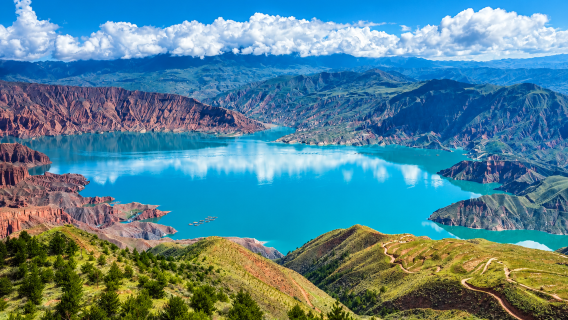
4.0/5
· 1 reviewFree cancellation
Instant confirmation
From€67.93
Free cancellation
Instant confirmation
Save €3.25
From€61.84€65.09
Free cancellation
Instant confirmation
Save €1.93
From€36.83€38.76
![Gannan (private charter) 1-day tour [Labrang Monastery + Sangke Grassland + Ganga Secret Scenic Spot + genuine pure fun]](https://ak-d.tripcdn.com/images/0356612000so9rb873F5E_C_568_320.jpg?_fr=wc)
4.8/5
· 223 reviews· 1.1k bookedFree cancellation
Instant confirmation
27 consecutive positive reviews
From€117.21
5.0/5
· 2 reviewsFree cancellation
Instant confirmation
Save €0.79
From€77.92€78.71
5.0/5
· 2 reviewsFree cancellation
Instant confirmation
Save €2.64
From€50.34€52.98
Free cancellation
Instant confirmation
Save €0.46
From€44.95€45.41
Featured Outdoor experiences in Huangnan
View all Outdoor experiences
5.0/5
· 1 reviewInstant confirmation
Book now for tomorrow
Save €0.98
From€96.95€97.93
![[Lanzhou Departure] Labrang Monastery & Sangke Grassland & Ganga Mijing Day Tour](https://ak-d.tripcdn.com/images/0350z12000sh4egz48A29_C_568_320.jpg?_fr=wc)
Instant confirmation
Save €1.45
From€143.70€145.15
![[Depart from Lanzhou] Private Car Day Tour to Labrang Monastery, Sangke Grassland and Ganjia Secret Land](https://ak-d.tripcdn.com/images/0356n12000stxltth1FA1_C_568_320.jpg?_fr=wc)
Save €2
Limited-time sale
From€197.79€199.79
Free cancellation
Instant confirmation
Save €1.93
From€36.83€38.76
Instant confirmation
Book now for tomorrow
Save €1.41
From€139.18€140.59
Free things to do in Huangnan
Kanbula Global Geopark
Jainca · 33.6 km from downtownLongwu Temple
Tongren · 1.1 km from downtownImmediate access, Book now for today, Cancel anytimeGuomari Castle
Tongren · 6.4 km from downtownAqiongnanzong Temple
Jainca · 31.7 km from downtownSengge Shong Yago
Tongren · 6.2 km from downtownChaka Salt Lake
China · UlanBook now for tomorrow, Cancel anytimeWutun Shangsi
Tongren · 5.4 km from downtownKumbum Monastery
China · XiningBook now for tomorrow, Cancel anytimeLanzhou Danxia Geological Park
China · YongdengBook now for tomorrow, Cancel anytimeQinghai Lake
China · Gonghe
What travellers say about Huangnan

135***20September 13, 2026
4.0
It's changed a lot; I haven't been here for ten years, but the scenery is still beautiful. The reservoir is azure, the Danxia landforms are magnificent, and the peaks stand tall. There are now man-made walking trails, which adds to the fun, and shuttle buses and escalators have been installed, making things much more convenient. Overall, it's quite good, and it's still the scenery I love!
Kanbula Global Geopark

挂剑的季札August 20, 2025
5.0
Originally built in the 14th century, this Sakya temple later converted to the Gelugpa tradition. The pre-sunset sunlight shone brightly on the golden dome of the temple. Inside, only a few tourists were present, quietly admiring the Buddha statues, thangkas, and embroidery, all of which were truly magnificent. There were no guides or explanations within the temple, and while visitors were neither prohibited nor welcomed, it was a place of spiritual practice.
Longwu Temple

听爵士的流氓兔August 1, 2023
5.0
Guomari Castle (Litun) is located in Guomari Village, 7 kilometers north of Tongren County, on the terrace on the west bank of Longwu River, surrounded by mountains and rivers.

The castle was built in the Ming Dynasty. It was built to defend the border and defend against enemies. The castle is rectangular, 200 meters long from east to west and 180 meters long from north to south, covering an area of 36,000 square meters. The wall is rammed earth, with a base width of 4 meters, a remaining height of 10 meters, and a rammed layer of 13-15cm. There are three gates in the east, west and south. Each gate is a two-story building with a mani house.
Guomari Castle

坎布拉丹霞February 23, 2026
5.0
Entering Nanzonggou, the reddish-brown Danxia peaks rise like towering pagodas, while pines and cypresses stubbornly cling to the cliffs. Clear springs gurgle at the bottom of the valley, and the mountain breeze carries the fragrance of grass and trees past your ears. Occasionally, a argali sheep flashes by between the cliffs. There is movement within stillness, like a flowing painting of Danxia mountains and clear waters on the plateau. Danxia is the body, the Yellow River is the vein, and ancient temples are the soul. Here, the creation of nature and human beliefs are perfectly integrated.
Aqiongnanzong Temple

华-RainbowJanuary 26, 2022
4.0
The purpose of the monastery is to study and transmit Rekong art, so there are many young lamas from all over the place, and it seems very lively.
Sengge Shong Yago

菲凡 DianaOctober 14, 2026
5.0
It was good, but we arrived late and the shuttle buses were not available, so we couldn’t see many areas. The mirror effect can still be seen in some areas, but I will definitely recommend to arrive earlier than 6 pm.
Chaka Salt Lake

卖菜的猫March 16, 2023
4.0
The temple is not big, but it is still good to go in and learn about the culture
Wutun Shangsi

Anonymous userOctober 13, 2026
5.0
Kumbum Monastery is definitely worth a visit. The scenic area is well-planned, with many beautiful buildings and Thangka paintings. The monastery provides professional guided tours, which are excellent. You can also offer lamps for blessings.
Kumbum Monastery

kiu先生October 13, 2026
5.0
The scenic area is large and clean, with a refreshing atmosphere. There are so many animals, the shows are fantastic, the kids had a blast, and the visit was very comfortable. The staff were very welcoming, and the routes were well-designed – it was so convenient! I'll definitely come back next time.
Lanzhou Danxia Geological Park

suyuOctober 5, 2026
5.0
Erlangjian is the main scenic area of Qinghai Lake, shaped like a long sword entering the lake. Visitors can take a cruise to explore the heart of the lake and also get a close look at the ruins of a torpedo launching test base. The facilities are well-developed, making it suitable for first-time visitors, but prices are high during peak season due to crowds.
Qinghai Lake


