Can You Bring Batteries on a Plane? Flight Rules & Guidelines

Many Canadian air travelers are unfamiliar with aircraft battery packing rules. All flights departing from Canada follow a three-layer regulatory system: Transport Canada (federal legal baseline standards), CATSA (on-site airport security enforcement), and individual airline policies (stricter operational limits). This guide covers Canada-specific official rules, international flight differences, security checkpoint tips, hidden regulatory details, self-check capacity methods, and airline-specific limits to help travellers pack compliantly.
New York
Singapore
Shanghai
Tokyo
Seoul
Bangkok
See all flights


Official Rules for Bringing Batteries on Planes in Canada
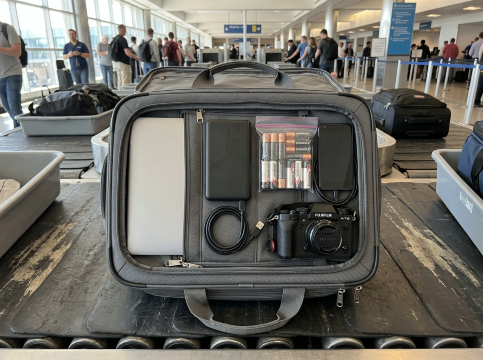
Nearly all consumer batteries are permitted on flights with correct packing procedures. All battery transport rules for flights within, to, and from Canada are governed by two authoritative bodies, forming mandatory national safety standards:
- Transport Canada: Establishes federal legal standards for dangerous goods (including lithium batteries) in air travel. It aligns with global ICAO/IATA frameworks while enforcing exclusive localized rules for all Canadian carriers and passengers.
- CATSA (Canadian Air Transport Security Authority): Conducts front-line security screening at all Canadian airports, strictly enforcing Transport Canada’s battery rules by inspecting battery condition, packaging, and storage placement.
Fixed National Mandatory Rules (Zero Exception)
- All spare/uninstalled lithium batteries and power banks are carry-on only; placement in checked baggage is illegal in Canada.
- Damaged, swollen, defective, or manufacturer-recalled lithium batteries are fully prohibited on all Canadian passenger flights.
- Standard non-lithium household batteries have unlimited personal-use allowances on all Canadian domestic flights.
CATSA Checkpoint Screening Rules & Fast-Pass Tips
CATSA screeners prioritize battery safety risks during inspections. Understanding screening focuses helps travellers speed up security processes:
- Core inspection focuses: Damaged/leaking batteries, exposed battery terminals (short-circuit risk), spare lithium batteries/power banks hidden in checked/gate-checked bags, and unapproved over-capacity batteries.
- Fast-screen tips: Store power banks and loose batteries in easy-to-reach carry-on pouches; avoid contact with coins/keys/metal objects; retain original battery packaging when possible.
- Special protocol: Travellers carrying high-capacity medical batteries must prepare airline approval documents for verification if requested.
- Common penalties: Non-compliant batteries face immediate confiscation and mandatory secondary bag screening.
Stay Connected With Trip.com!
See all attractions
 663192 booked













Three Core Categories of Flight-Approved Batteries
Aviation authorities classify all permitted batteries into three categories based on chemical composition, rechargeability, and fire risk. Each type has independent rules for carry-on/checked storage, quantity limits, and capacity restrictions. Power banks are classified as standalone spare lithium-ion batteries and follow stricter rules than device-integrated lithium batteries.
1. Standard Non-Lithium Dry Batteries (AA, AAA, C, D, 9V)
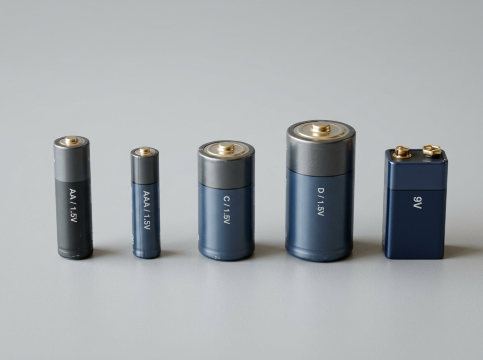
Low-risk daily-use batteries with the most flexible air travel policies:
- Common types & uses: Alkaline, NiMH, NiCd, zinc-carbon batteries for flashlights, remotes, toys, and small household devices.
- Baggage rules: Allowed in both carry-on and checked baggage for all Canadian domestic and international flights; no personal-use quantity limits.
- Safety requirements: Loose batteries require covered terminals, original packaging, or protective cases.Damaged, leaking, or corroded batteries are strictly banned.
2. Rechargeable Lithium-Ion Batteries (Phones, Laptops, Drones)
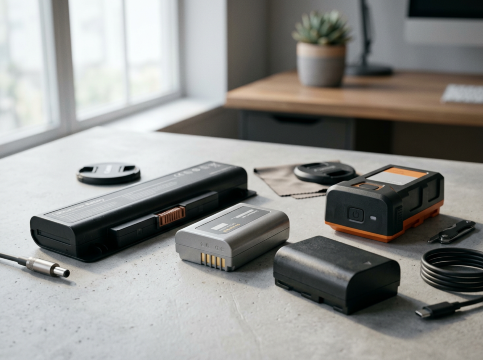
High-energy batteries for modern portable electronics carry overheating and thermal runaway risks when damaged. Rules are strictly based on watt-hour (Wh) capacity:
- 0–100 Wh: Fully approved in carry-on baggage, unlimited personal quantity (covers most consumer electronics).
- 100–160 Wh: Permitted only with advance written airline approval; max 2 spare batteries per passenger (for professional equipment).
- Over 160 Wh: Permanently banned on all commercial passenger flights (zero exceptions).
- Key storage rule: Devices with built-in lithium-ion batteries may go in checked baggage only if fully powered off (sleep mode invalid). Spare lithium-ion batteries are never allowed in checked baggage.
3. Non-Rechargeable Lithium Metal Batteries (Watch/Coin/Medical Cells)
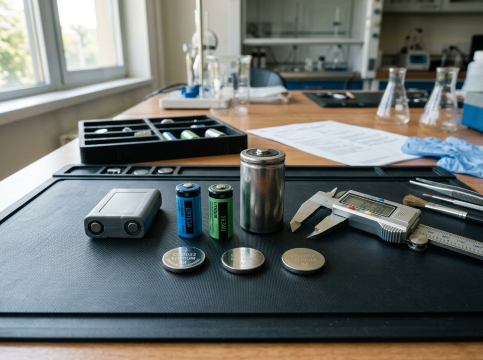
Single-use pure lithium cells with high combustion risk. Regulated by lithium gram content (not watt-hour rating):
Lithium Content Per Cell | Flight Approval Status | Carry-On Allowance | Checked Baggage Allowance | Key Notes |
|---|---|---|---|---|
≤ 2 grams | Fully approved | Unlimited personal use | Only if pre-installed in powered-off devices | Requires short-circuit protection; for watches/medical devices |
2–8 grams | Airline approval required | Max 2 spare batteries per passenger | Strictly prohibited | For professional high-capacity specialty cells |
> 8 grams | Strictly prohibited | Not permitted | Not permitted | Banned on all commercial flights |
Universal rule: All spare/uninstalled lithium metal batteries are banned from checked baggage, regardless of size.
Can You Bring a Power Bank on a Plane? Official Rules
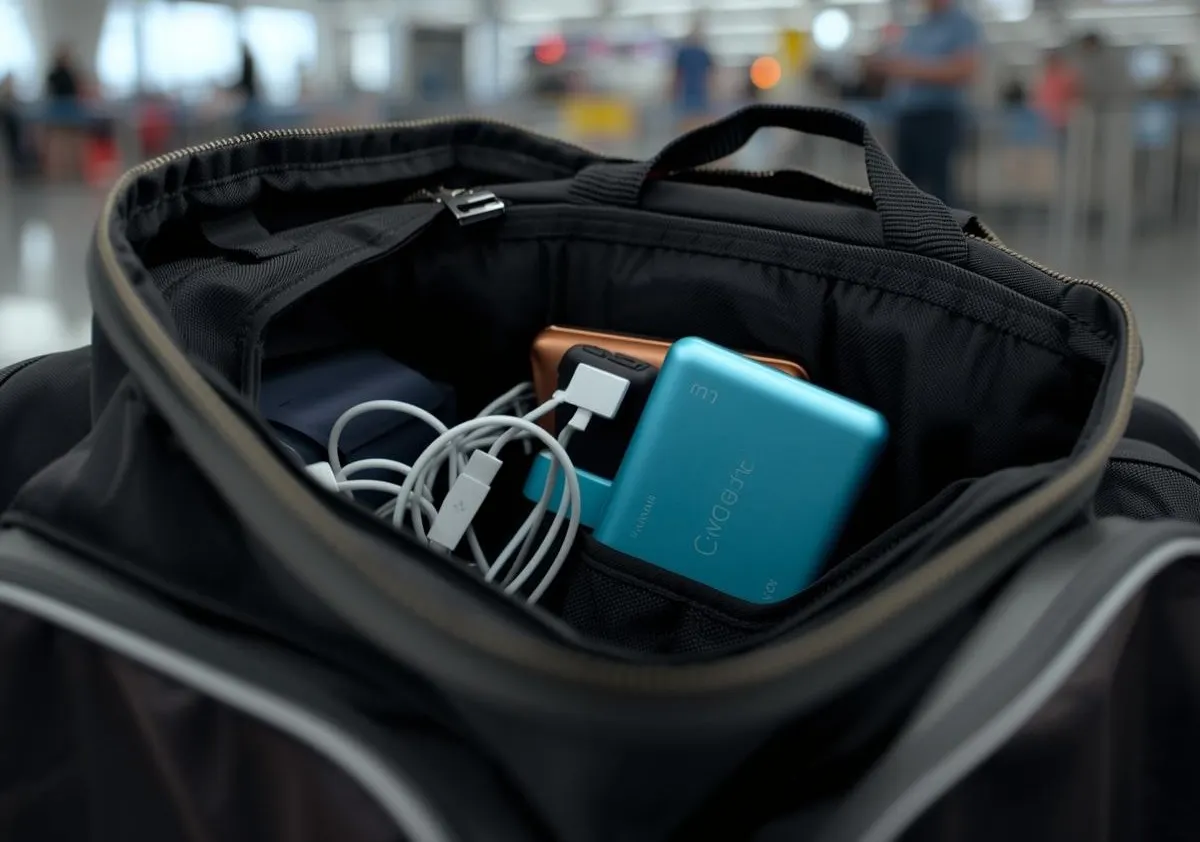
Power banks are defined as spare uninstalled lithium-ion batteries with the strictest aviation rules:
- Non-negotiable core rule: 100% cabin-only storage; banned in checked baggage for all sizes/capacities (zero exceptions).
- Gate-check rule: All power banks must be removed from gate-checked carry-on bags and kept in the cabin.
Watt-Hour (Wh) Range | Approval Status | Core Restrictions |
|---|---|---|
Under 100 Wh | Fully approved for personal use | No quantity limits (standard consumer models) |
100–160 Wh | Airline approval required | Max 2 units per passenger |
Over 160 Wh | Strictly prohibited | No onboard permission |
Additional rule: Power banks cannot be charged mid-flight, even with available cabin USB ports. All units require short-circuit protection.
Batteries on Plane Clear Storage Guidelines: Carry-On vs. Checked Baggage
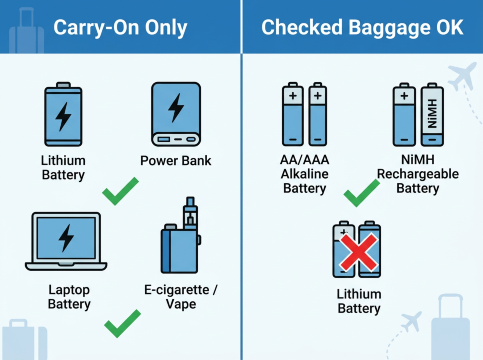
Permitted in Carry-On Baggage
All compliant battery types: non-lithium batteries, approved lithium-ion/lithium metal cells, and eligible power banks. Cabin storage is the globally preferred method for real-time hazard monitoring by crew.
Permitted in Checked Baggage
Standard AA/AAA/C/D/9V non-lithium batteries; fully powered-off electronics with factory-installed lithium batteries.
Prohibited in Checked Baggage
All spare uninstalled lithium-ion batteries, loose lithium metal batteries, and all power banks (unattended cargo hold fires are high-risk and hard to extinguish).
How to Check a Battery’s Watt-Hour (Wh) Rating
Wh rating is the official standard for lithium battery compliance. Most devices do not print Wh directly, so self-calculation is required:
- Official formula: Wh = (mAh ÷ 1000) × Voltage (V)
- Parameter location: mAh capacity and voltage are printed on battery/charger casings or product labels.
- Example: 20000mAh, 3.7V power bank = (20000 ÷ 1000) × 3.7 = 74 Wh (fully compliant)
- Quick compliance judge: <100 Wh = allowed; 100–160 Wh = approval needed; >160 Wh = banned
Airline-Specific Battery Policies

Transport Canada and CATSA set only minimum safety standards. Individual airlines enforce stricter operational rules:
- Air Canada: Max 2 approved 100–160 Wh spare lithium batteries; full ban on loose lithium batteries in checked baggage; mandatory declaration for professional high-capacity battery gear.
- WestJet: Strict gate-check compliance; all power banks must be removed from gate-checked bags (zero exceptions).
- Porter Airlines: Pre-flight declaration required for all 100–160 Wh batteries; enhanced manual inspection for loose battery packaging.
- International carriers: Often add extra quantity limits for power banks/drone batteries; some European/Asian airlines ban high-capacity batteries for regular passengers.
Transport Canada’s Lesser-Known Lithium Battery Rules
- Damaged battery zero-tolerance: Swollen, punctured, leaking, overheated, or recalled lithium batteries are fully banned for passenger travel.
- Mandatory spare battery protection: All uninstalled lithium batteries require covered terminals or insulated cases; bare loose cells are prohibited.
- Passenger vs. cargo difference: Personal passenger batteries are exempt from dangerous goods documentation. Lithium batteries shipped as commercial cargo require professional packaging, certification, and carrier approval.
- Strict device shutdown rule: Electronics in checked baggage need full power-off; sleep/hibernate mode is not compliant.
Car Rentals
Car Rental Promo Code - 8% Off
New User Enjoy up to 8% Off
TRIPCAR8
Batteries on International Flights: Rule Differences

Top traveller question: Are AA batteries allowed on international flights? Yes. All standard non-lithium batteries (AA, AAA, C, D, 9V) are permitted in carry-on and checked baggage worldwide with no personal-use quantity limits.
Nearly all global airlines follow unified IATA baseline rules for lithium battery capacity limits, power bank cabin-only rules, and spare lithium baggage bans. However, regional stricter enforcement applies:
Travel Region | Core Standards | Key Enforcement Notes |
|---|---|---|
European Flights | Full IATA compliance, 100 Wh limit, no spare lithium in checked bags | Budget airlines enforce extra quantity caps on high-capacity batteries/power banks |
Asian Flights | Aligned with global IATA safety rules | Japan/South Korea/Singapore conduct rigorous screening; 100–160 Wh batteries require advance declaration |
Global Destinations | Local rules may override IATA baselines | E-cigarettes/vape devices are restricted or banned in most countries’ checked baggage |
Specialty Device Battery Rules Onboard
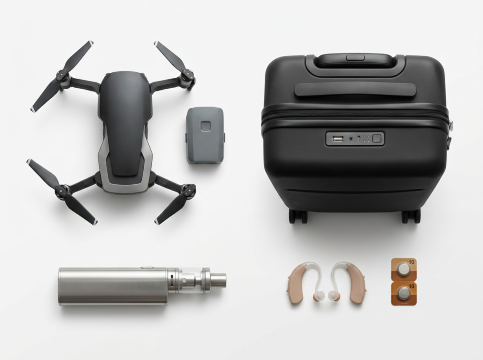
Device Category | Official Flight Rules | Key Restrictions |
|---|---|---|
Drones | Follows lithium-ion Wh tiers; installed batteries allowed in carry-on; spares need terminal protection & cabin storage | 100–160 Wh needs airline approval; >160 Wh banned; airlines enforce spare battery quantity limits |
E-Cigarettes & Vapes | Cabin-only storage globally; prohibited in checked baggage | In-flight use and charging are forbidden; some countries impose full transportation bans |
Hearing Aids & Medical Devices | Devices can be worn onboard; spare medical lithium batteries allowed in carry-on | Flexible quantity limits for personal medical use |
Smart Luggage | Removable batteries must be taken out and packed in carry-on; luggage itself can be checked or carried | Non-removable lithium batteries are banned on all commercial flights |
Practical Travel Tips for Bringing Batteries onto Plane
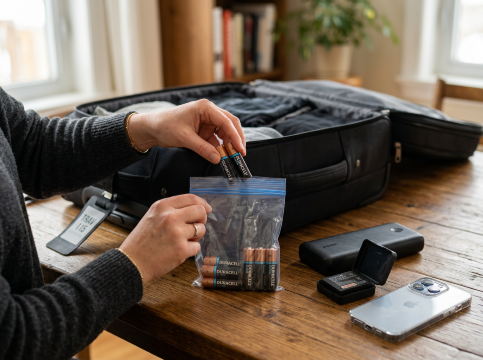
- Cabin-only for spare lithium gear: Never place spare lithium batteries or power banks in checked/gate-checked luggage.
- Prevent short circuits: Cover exposed terminals with tape/cases; separate batteries from metal objects.
- Full device power-off: Sleep mode is invalid for electronics stored in checked baggage.
- Pre-approve high-capacity batteries: Apply for airline approval for 100–160 Wh batteries at least 48 hours before departure.
- Remove smart luggage batteries: Detach all removable lithium batteries before checking smart luggage.
- Discard faulty batteries: Swollen, damaged, leaking, or recalled batteries are prohibited for travel.
- Retrieve power banks from gate checks: Always remove power banks and spare lithium batteries from gate-checked bags.
- Verify airline rules: Carriers may enforce stricter limits than federal baseline standards.
Final Summary
Canadian travellers can fly safely and hassle-free with battery-powered devices by following Transport Canada and CATSA baseline rules, verifying battery watt-hour ratings, adhering to strict checked-baggage bans for spare lithium batteries and power banks, and confirming airline/destination-specific policies in advance. With compliant packing habits, nearly all personal consumer batteries are permitted for both domestic and international air travel.
[10% OFF] Global Hotel Recommendations
New York
London
Rome
Paris
Sydney
Bangkok
See All Hotels



















































FAQs About Batteries on Plane
-
Can you bring batteries in a carry-on on a plane?
-
Where should I put AA batteries when flying?
-
What happens if you have a lithium battery in checked luggage?
-
Why are lithium batteries not allowed in checked baggage on planes?
-
Can you bring batteries on international flights from Canada?
Disclaimer: This article has been provided by an individual contributor or third party platform. If there is any discrepancy regarding the copyright, please contact us directly and we will delete the content immediately.
Popular Searches
-
Air travel guide
-
Latest Flight Deals
-
eSIM/SIM card